by Cecile de Veyra (Managing Editor)
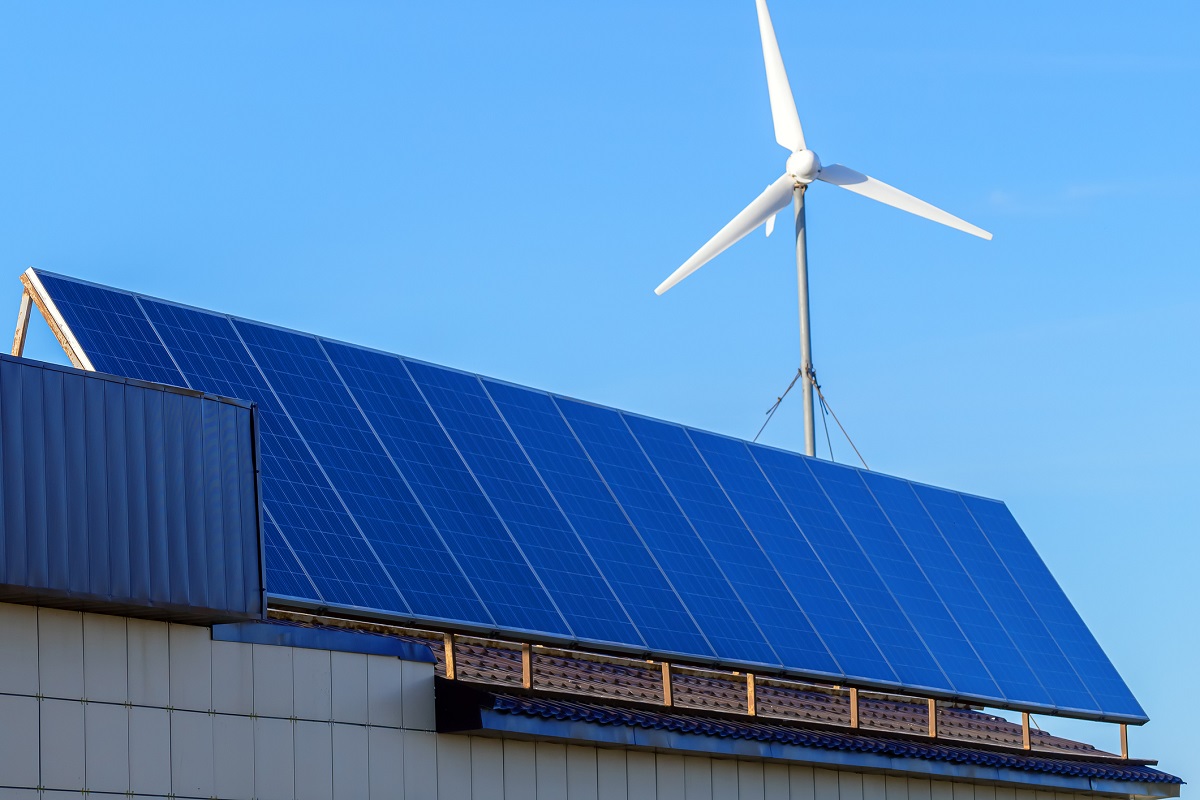
Image from Getty
Global energy consumption continues to grow amid increasing population, urbanization and economic development. Oil, natural gas and coal are still the world’s primary energy source – reserves of which will be depleted by 2052, 2060 and 2090, respectively, according to the Millennium Alliance for Humanity and the Biosphere at Stanford University. And this time span could still shrink as colder winter and hotter summer seasons are expected to jack up power demand.
To help stem the tide, renewable sources are being harnessed and made more efficient to fill the need for environment-friendly power generation. About 30 percent of electricity used around the world currently comes from them. They are solar, wind, geothermal, hydropower and bioenergy systems, while ocean energy is still being developed.
Solar power systems are projected to “account for 60 percent of global renewable power growth in 2022, followed by wind and hydropower,” according to the International Energy Agency.
Going hybrid
While available renewables are usually separate systems, combining their technologies has been gaining traction. Popular are solar/wind hybrid power systems because they are complementary – one harvesting energy during the day and summer months and the other at night and the winter season. This ensures round-the-clock and year-round power.
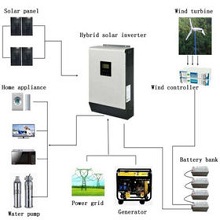
There are standalone and on-grid types for residential, commercial and industrial installations. Such setups usually consist of solar panels, a wind turbine, a battery bank, an inverter and a wind solar hybrid controller or charge controller.
Standalone solar wind power systems
Standalone systems work off the grid. But there are some that include a diesel-powered engine generator, which can recharge the battery when there is not enough energy collected by both the solar panels and wind turbine. This entails an additional cost but the trade-off is a lower requirement for energy storage and an assured supply.
On-grid solar wind power systems
These systems are connected to the grid and can transfer and sell energy to it during sunny periods and draw from it when collected solar and wind energy is not enough.
Having such a setup is ideal for locations where there is abundant sunlight and wind. This helps stabilize power supply in either direction, making this a zero-carbon and net-positive option for a home, business or community.
Company: Chonghong Industries Ltd
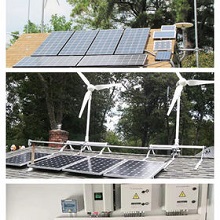
Model CHZJL1161217 from Chonghong is a 2.2kW off-grid solar wind hybrid power system. It consists of a 48V, 1kW wind turbine that includes a generator, tower and blades, a 48V, 1kW wind turbine controller and dump load box, four 31V, 300W monocrystalline solar panels and a 48V, 4kW hybrid solar inverter with an 80A MPPT solar charge controller. A 12V, 200Ah deep-cycle battery and a set of aluminum mounting brackets for the solar panels are bundled with this system. Price is available on direct inquiry. An order of one system is accepted and has a lead time of 15 to 30 days.
Company: Zibo Hans International Co. Ltd
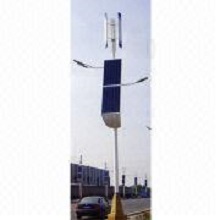
Zibo Hans’ solar wind hybrid power system, the WH-2000-1-7995, is a solar wind hybrid power system for street lighting. Its rotor has noise-free operation and generates high voltage at minimum rotating speed. This system realizes high power output and improved efficiency at low to high wind velocities. Price is available on direct inquiry. An order of one set is accepted. Lead time is seven to 15 days.
Company: Shenzhen SmartPropel Energy System Co. Ltd
The 6kW Wind Solar Hybrid System-2242 from Shenzhen SmartPropel has 1.8kW solar panels, 1kW wind turbine, 6kW inverter and a 10kWh lithium battery. It has a daily power generation of about 15kWh and is designed for locations with 220V. Price is $4,844.24. An order of at least three sets is required. Lead time is 15 to 20 days.
Company: Shenzhen SmartPropel Energy System Co. Ltd
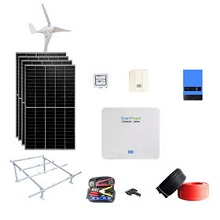
Shenzhen SmartPropel’s 6kW Wind Solar Hybrid System-2437 consists of four solar panels and a mounting bracket, a combiner box, a wind turbine with 114mm-diameter strut, a lithium battery, an inverter, a controller, cables and a set of tools. It is priced at $4,844.24. The supplier requires a minimum order of three sets. Lead time is 15 to 20 days.