Download App
Better Online and Trade Show Sourcing Experiences.Scan the QR code to download.
Learn More
Hot Topics
by Melanie Victoriano (Content Editor)
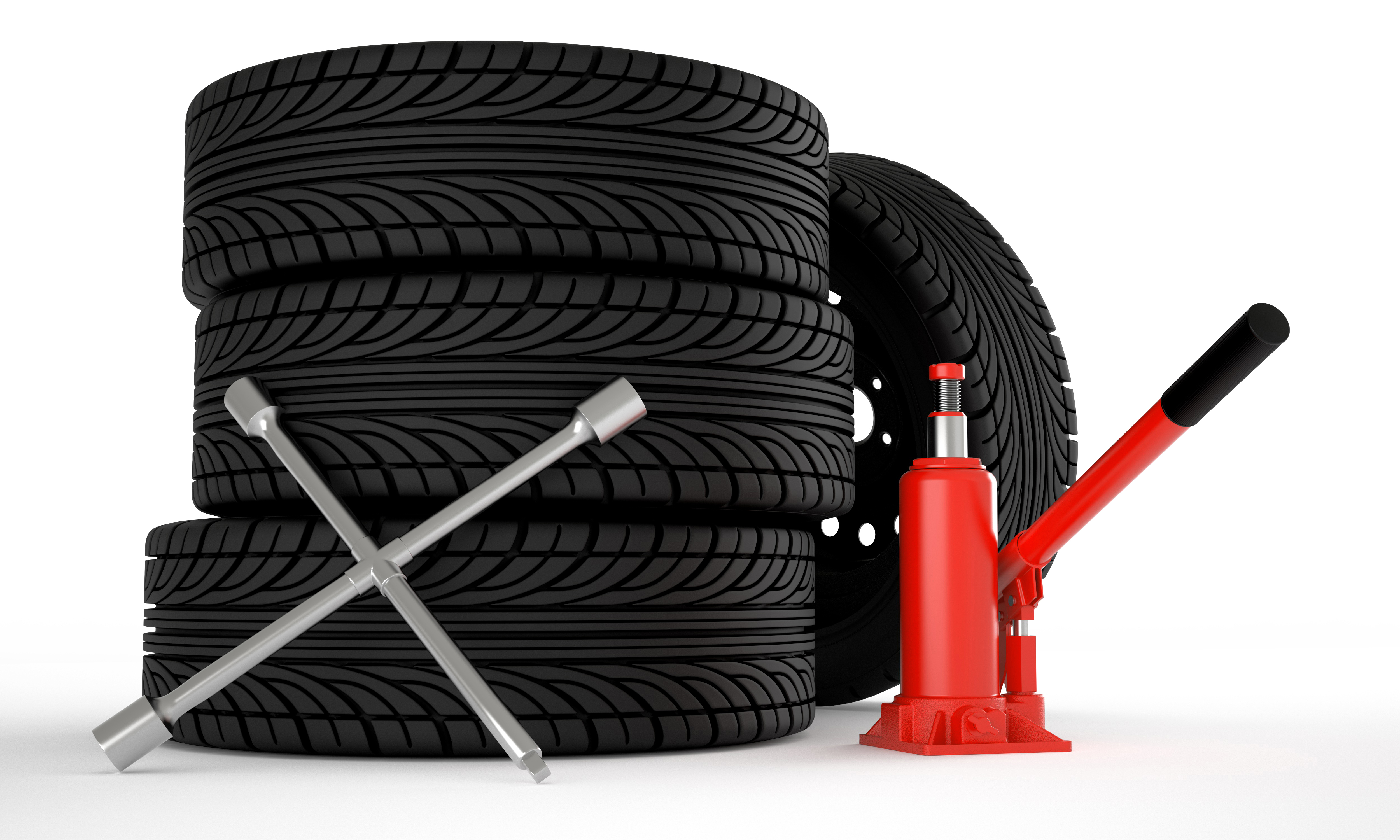
Image source: Getty
Bottle jacks are a type of material handling equipment that rely on force multiplication, based on Pascal’s Principle, to lift heavy loads. They are also known as “hand jacks,” because a user needs to move the handle or pump lever, or “whiskey jacks,” because the shape of the devices resembles old whiskey bottles.
These devices, also known as car jacks or automobile lifts, became popular in the early 1900s, when the automobile industry was just beginning to take off. They provided a convenient way for drivers or mechanics to lift a vehicle for roadside inspection or service.
The principle, formulated by French mathematician Blaise Pascal in the mid-17th century, states that in a fluid at rest in a closed container, a pressure change in one part is transmitted without loss to every portion of the fluid and to the walls of the container.
Essentially, if in a container two cylinders – one smaller and one larger – are connected by an incompressible fluid, an amount of pressure applied to the small cylinder will be similarly applied to the larger cylinder through the fluid connecting them.
However, because Pascal’s law states that “pressure is equal to the force divided by the area on which it acts,” the second – and larger – cylinder will experience a force multiplication effect. This means that even though the amount of pressure on both cylinders is the same, the force which is produced on the larger cylinder will be proportionally higher, because it has a larger area.
Bottle jacks are most used in the automobile industry, with 1.5- to 5-ton variants being the usual range used to lift vehicles. But some models, particularly industrial-grade bottle jacks, can have a capacity of up to 100 tons. Large-capacity jacks may be used in the repair of building foundations.
Changing wheels on a car is one of the primary uses of a bottle jack. The jack is positioned under the car at the correct point to raise it, then the jack is pumped up with the lever handle. This raises the vehicle and allows the wheel to be changed.
In industrial applications, they can be used as pipe benders for plumbing projects, in cable slicers for electrical projects, and as material lifts within warehouses.
They can also be used to repair large agricultural or construction machinery.
In construction, multiple bottle jacks can be used to lift structures such as houses, or specifically house foundations, under certain conditions.
Compared with other jacks, like floor jacks, bottle jacks are compact and upright, so they are more portable and take up less storage space.
This portability is an advantage as bottle jacks can be easily carried to the scene, especially during emergencies.
Bottle jacks have a wide range of capacities, ranging from 1.5 tons to 100 tons. This gives bottle jacks more power than floor jacks, which have a range between 1.5 tons and four tons only and are limited to automotive uses. Bottle jacks can lift heavier vehicles, such as heavy-duty trucks, and can even be used in construction.
Bottle jacks are easy to use, thanks to Pascal’s principle and the invention of hydraulic oil.
There are even low-profile bottle jacks – units that are shorter in height than usual models – that allow a user to get the jack underneath vehicles or loads with a low ground clearance.
Bottle jacks are generally less expensive than other types of jacks.
The feature most highlighted in bottle jacks is the vertical shaft that directly bears the weight of the object as it is lifted. In larger models, the shaft supports a platform, or bearing pad.
Bottle jacks have several components:
Also known as the buffer tank, the reservoir holds the hydraulic fluid or pump oil which applies pressure from the pump to the ram.
The pump is typically a piston pump that is mechanically activated by moving the pump lever or handle up and down. This action moves hydraulic fluid or oil through two cylinders.
The plunger is first drawn back, which opens the suction valve ball within and draws oil into the pump chamber. As the plunger is pushed forward, the oil moves through an external discharge check valve into the cylinder chamber, and the suction valve closes, which results in pressure building within the ram cylinder.
The handle is a lever whose movement builds up pressure in the hydraulic fluid, which transfers that pressurized fluid through a check valve and into the main cylinder.
This valve allows pressurized hydraulic fluid to flow into the main cylinder.
The main cylinder, sometimes referred to as the ram, is driven upwards, extending out of the hydraulic jack body due to the pressure of the hydraulic fluid. This creates the force that lifts the load.
A release valve releases the pressure so that the ram can retract and the load can be lowered.
While not a structural element, hydraulic oil is an essential component of a bottle jack.
Hydraulic oil with ratings of ISO 32, ISO 46, or ISO 68 are appropriate for use in a bottle jack because they have the appropriate level of viscosity. Users must determine the proper rating of hydraulic oil to use for their specific model of bottle jack.
The viscosity of the fluid determines the oil temperatures within which the hydraulic system can safely operate. Oils with too high a viscosity may not flow or lubricate properly during cold days. Similarly, oils with too low a viscosity may not be able to maintain the required minimum viscosity or be able to lubricate adequately during the hottest days of the year.
Power steering fluid may be used as an alternative bottle jack oil because it is a hydraulic fluid and can produce, though temporarily, the level of viscosity that a bottle jack needs.
However, using motor oil as a substitute for hydraulic oil may lead to safety hazards since motor oil does not have the appropriate viscosity for hydraulic jacks.
Hydraulic bottle jacks used in house repair projects and the size as well as number of jacks used depends on the size and configuration of the house.
Some construction experts say that if only a portion or corner of a house needs to be lifted, a 12-ton hydraulic jack placed on a set of beams and lifting against a beam run perpendicular to the floor joists should raise a corner or side of a house. Work should be slow, aiming to lift the corner about 1/8 inch per day to prevent cracks to drywall or plaster and other more serious structural damage.
An entire small house that is square or rectangular could also be lifted with jacks, but at least four 12-ton bottle jacks would be needed.
A big caveat, however, comes from home repair experts like those at The Spruce who say that “An ordinary hydraulic jack is no match for a house… A house is constructed of thousands of pieces of lumber, nails, screws, wire, metal, masonry, and countless other types of building materials. All these materials are interlocked, like a jigsaw puzzle. Contrary to what one might expect, a house does not raise or lower like a giant box.”
In summary, for lifting houses, hydraulic jacks should be used only as supplemental equipment and if so employed, 20-ton bottle jacks or 40-ton models would be a better bet than 12-ton ones.
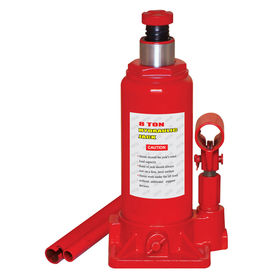
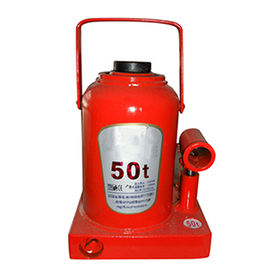
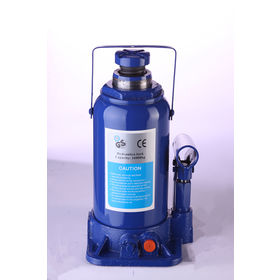
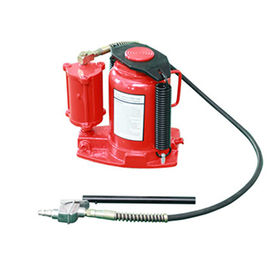
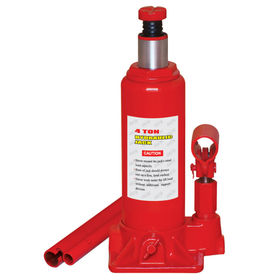
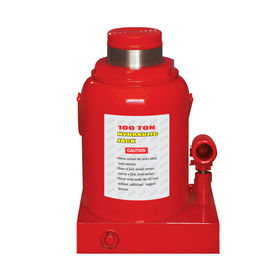
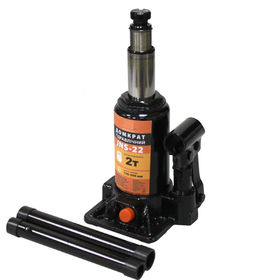
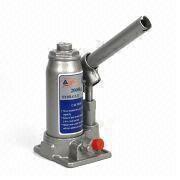
Here is just a small sample of the range of bottle jacks available for sourcing from Global Sources’ verified suppliers:
More Sourcing News
Read Also

关注 “环球资源外贸” 官方微信,获取实时外贸资讯
iOS & Android
iOS & Android(Mainland China)
Copyright © 2026 Publishers Representatives Limited. All rights reserved.