Download App
Better Online and Trade Show Sourcing Experiences.Scan the QR code to download.
Learn More
Hot Topics
Apple's latest iPhones, equipped with the well-received “3D touch” feature, have spurred rapid adoption of the new display technology.
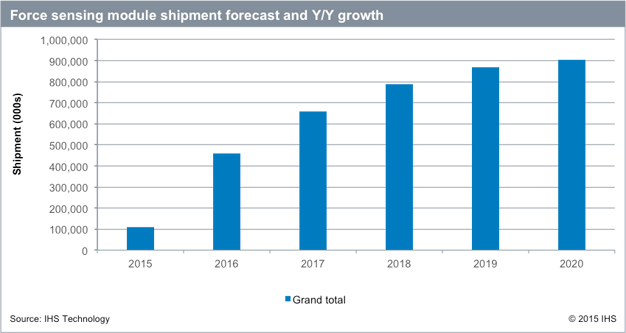
Growth of pressure-sensitive display modules will jump in 2016, after which growth will slow,
but sales will still rise to 900,000 units in 2020 (Image from IHS)
Nearly a quarter of smartphone shipments in 2016 will have pressure-sensitive displays, according to a report by IHS, making the technology yet another thing Apple will have helped bring into mainstream adoption. The projections come from an expected increase of 317 percent for these display modules, rising to 461 million units. In-cell and on-cell touch displays are also on the rise. These will make up 40 percent of all phone touch panel shipments in 2015, jumping to 50 percent by 2018. IHS notes that touch controller IC makers accounted for 45 percent of the market for major consumer electronics products in the first half of 2015. Most of those makers are in Taiwan and China.
Touch panels have exploded in importance over the last few years. The emergence of pressure-sensitive displays adds a new way for consumers to interact with their phones and, likely, a new way to boost profit margins until prices for the technology is driven down by new competition. While Apple got the most attention for including the technology in its iPhone 6s and 6s Plus, China’s Huawei beat Apple to market with a similar pressure-sensitive screen. The challenge for Huawei is that the company had to build in controls for the new technology as a custom version of Android, as Google does not yet support the technology in the stock version of Android. Apple arguably has better support for pressure-sensitive displays for now, but that will change—likely with next year’s version of Android—now that adoption is expected to spike.
More Sourcing News
Read Also

关注 “环球资源外贸” 官方微信,获取实时外贸资讯
iOS & Android
iOS & Android(Mainland China)
Copyright © 2026 Publishers Representatives Limited. All rights reserved.