




Over the past few years, AI in B2B marketing has exploded from a niche experimentation tool into a mainstream business imperative. The numbers tell a compelling story: according to ON24's latest research, 87% of B2B marketers are now using or testing AI, with 84% planning deeper integration into their strategies. Leaders across industries believe AI in B2B drives revenue growth, efficiency, personalization, and better buyer experiences—making it a competitive necessity rather than a passing trend.
But beneath this widespread adoption of AI tools for B2B marketing lies a complex reality. The same research reveals a troubling gap: while 85% of organizations agree that businesses using AI will see stronger revenue performance, the actual execution tells a different story. According to The Growth Syndicate's recent survey of 110 B2B marketing leaders, only 26% rate their team's ability to leverage AI as high, despite 86% believing strongly in its potential benefits.
This is the "belief-execution gap"—and it represents both a challenge and an opportunity for forward-thinking B2B professionals seeking to harness artificial intelligence in B2B marketing.
The Current Landscape of AI in B2B Marketing
AI Adoption in B2B Marketing: The Numbers Don't Lie
AI adoption in B2B marketing is now firmly mainstream. ON24's survey of over 500 B2B marketers found that more than half (53%) report using AI significantly, while 34% are currently testing and building a roadmap. Only 4% have no plans to adopt AI at all.
| Metric | Percentage |
|---|---|
| B2B marketers using or testing AI | 87% |
| Planning deeper AI integration | 84% |
| Using AI significantly | 53% |
| No plans to adopt AI | 4% |
The impact on performance is equally striking. According to ON24's State of AI in B2B Marketing report, marketers using AI are 7x more likely to beat their targets than those who don't. Among marketers currently leveraging AI, 64% have surpassed their organizational goals, compared to just 29% of non-AI users achieving the same.
The Gap Between Belief and Execution in AI Marketing
Yet the same data reveals a striking disconnect. The Growth Syndicate's research shows that 91% of marketers use AI for content creation, but only 31% use it for lead scoring—a strategic function that could directly impact pipeline and revenue. Similarly, AI personalization applications lag at just 25%.
This pattern reveals what experts call the "capability chasm." As David Arnoux, Fractional CxO and Co-Founder at Humanoidz, explains:
The teams that have been able to augment themselves will greatly surpass those that haven't. As long as you have the right guardrails and maintain taste and strategic thinking, it's a powerful tool. I don't think the gap here is linear. I think it's going to be exponential."
Where AI in B2B Marketing Creates Value—and Where It Falls Short
The most cited use cases for AI in B2B marketing today reveal a clear pattern of tactical rather than strategic deployment:
| Use Case | Adoption Rate |
|---|---|
| AI content creation | 91% |
| AI productivity tools | 79% |
| AI analytics and measurement | 59% |
| AI promotional content | 63% |
| AI for webinars and events | 45% |
| AI lead scoring | 31% |
| AI personalization | 25% |
This concentration on execution rather than transformation helps explain the growing concern about differentiation. According to The Growth Syndicate's survey, 63% of marketers worry that AI increases noise and reduces differentiation as output volume rises.
The insight here is critical: AI in B2B marketing excels at execution but cannot replace human judgment. As one expert noted:
"Bad thought leadership starts with bad thinking, not bad writing. An interesting insight will always survive a poor articulation. A hollow insight doesn't improve with better articulation. AI amplifies whatever you put in, value or slop."
The Skills Gap Holding Back AI Marketing Success
Why AI Tools for B2B Marketing Aren't Delivering Full Potential
Perhaps the most revealing finding across both reports is the nature of the barrier to deeper AI adoption in B2B marketing. According to The Growth Syndicate's research:
60% of marketers cite the need for new training as the primary barrier
47% point to a lack of internal expertise
Only 25% identify budget constraints as the main issue
The constraint is capability, not capital. Yet the way teams are learning reveals another disconnect:
Learning Method Percentage
| Learning Method | Percentage |
|---|---|
| Learning by doing | 72% |
| Following experts on LinkedIn | 64% |
| Learning from ChatGPT | 55% |
| Formal training programs | 38% |
The AI marketing skills gap persists because learning remains informal and unstructured.
Trust and Governance in AI Marketing
Marketers' trust in AI outputs remains moderate at best. The Growth Syndicate survey found an average trust rating of 5.8 out of 10, with most teams operating under a "trust but verify" mindset. This skepticism is appropriate—but it also points to gaps in governance and infrastructure:
- ~50% have no formal AI usage policies
- ~20% report no clear owner for AI adoption
- ~60% have no dedicated AI budget line
- ~70% cannot measure current AI ROI
Without clear policies, ownership, and measurement frameworks, AI in B2B marketing becomes fragmented. Individual team members experiment with different tools. Practices vary by person. Institutional learning accumulates slowly because there's no central mechanism to capture and distribute what works.
The Human Element in AI-Powered B2B Marketing
Across all the research, one theme emerges consistently: AI is an amplifier, not a replacer. The most successful B2B AI marketers are those who master what AI cannot do.
Two Skills That Separate Leaders in AI B2B Marketing
Skill 1: Master what AI cannot do
These are appreciating assets that compound over time:
- Taste: Knowing what's good versus mediocre. AI can execute but cannot judge quality.
- Creativity and originality: Original thinking, not iteration. AI recombines existing patterns; it doesn't create new ones.
- Strategy and first principles: Reframing problems, not just finding better solutions. AI works within parameters; humans set the parameters.
- Judgment and pattern recognition: Experience creates pattern libraries AI cannot replicate. Knowing when to intervene and what matters most.
Skill 2: Become technically fluent in AI
This is technical fluency, not basic ChatGPT usage:
- Prompt engineering and workflow design
- Process mapping and automation architecture
- Quality assessment and human oversight
- Managing AI agents, not just using AI tools
The Dangerous Middle in AI B2B Marketing
The gap between individual contributors and leaders is widening. As The Growth Syndicate report warns:
"Most marketing people are going to have a difficult awakening because they're neither strategic, creative, or original enough to be on the strategy side, and they're not technically inclined or practical enough to really adopt these tools."
The data confirms this pattern: 86% have strong confidence in AI's benefits, about 50% rate their AI knowledge as high, and only 26% rate their current team's ability to actually use AI as high.
If you can't articulate your brand's taste better than AI, and you can't design workflows or manage AI agents, you're in the dangerous middle. And the middle is disappearing.
| Path | Strategic Leader | Technical Executor | The Dangerous Middle |
|---|---|---|---|
| What you master | What AI can't do | How to use AI | Neither |
| Your value | Taste, strategy, judgment | AI orchestration, automation | Generic execution |
| Future role | CMO, VP Brand | AI Marketing Engineer | Role eliminated |
Beyond Software: The Rise of AI-Powered Products
AI in B2B Is Moving from Software to Hardware
While the current conversation focuses on AI tools for B2B marketing—content generators, analytics tools, chatbots—a new wave of innovation is emerging that will have an even more profound impact on B2B buyers and businesses: AI-powered hardware.
Think beyond the screen. Consider:
- AI glasses offering augmented reality for field service technicians
- AI wearables tracking health data and providing real-time insights for corporate wellness
- AI toys and pets that adapt to learning styles and provide interactive companionship
- AI personal care products delivering bespoke skincare and wellness regimens
- AI devices streamlining daily tasks across industries
These are the products that will define the next decade of AI in B2B commerce.
The Sourcing Challenge for AI Products
For B2B buyers, this represents both a massive opportunity and a significant challenge: How do you find, vet, and partner with the manufacturers building these cutting-edge AI products?
According to McKinsey's research, 19% of B2B decision-makers are already implementing AI in B2B sales use cases, with another 23% in the process. But sourcing the actual AI products that drive business value requires a new approach.
This is where the sourcing landscape must evolve.
The Solution: Global Sources AI+ Products Hall
Introducing the AI+ Products Hall
At Global Sources, we recognized that while the B2B world was talking about AI, there was a missing link: a physical marketplace where buyers could connect with the innovators building the future. This is why we're launching the AI+ Products Hall at our Hong Kong Shows Phase 2, from April 18–21, 2026.
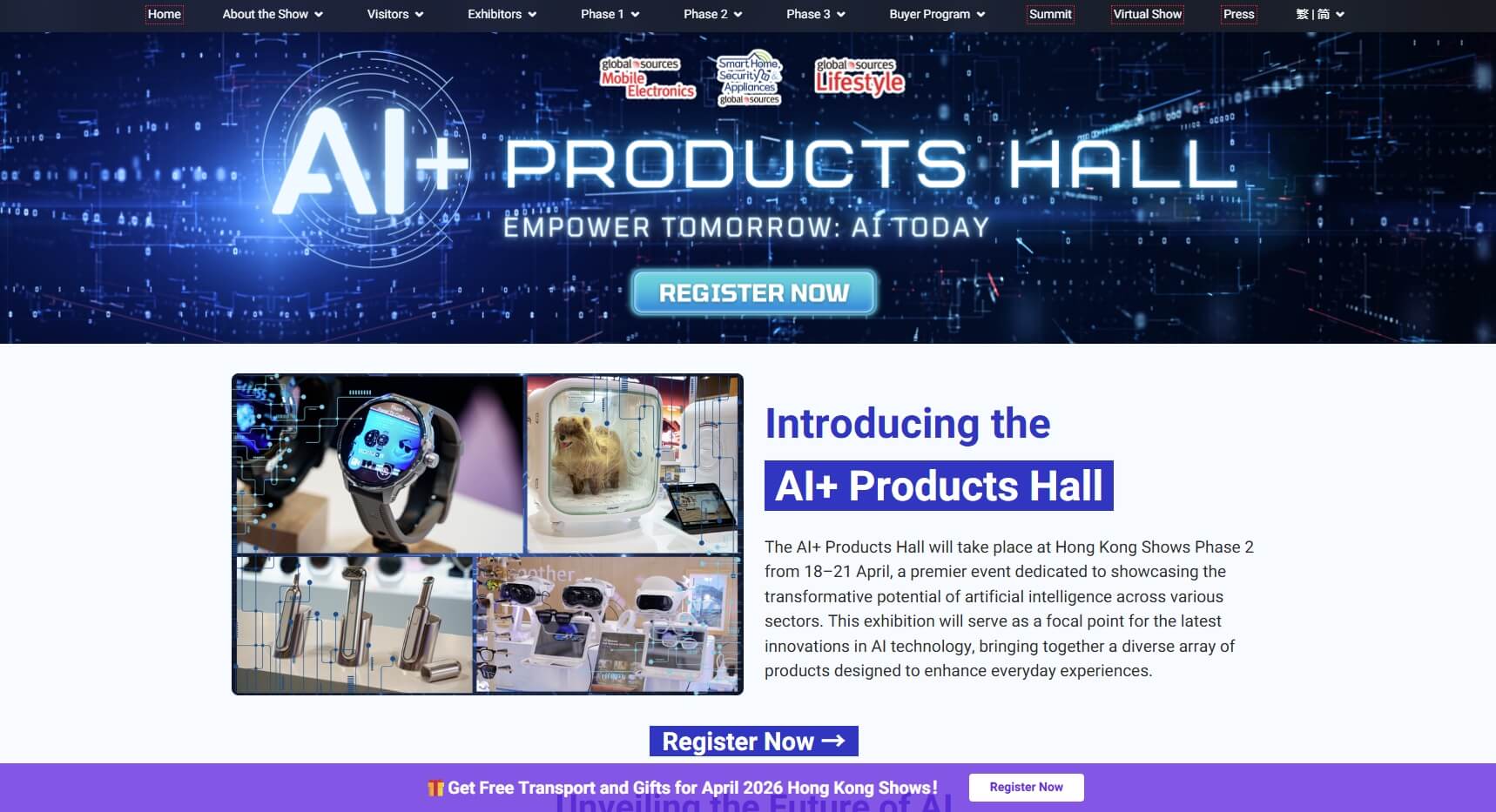
The AI+ Products Hall is the premier destination for B2B buyers, marketers, and business leaders to discover, experience, and source the next generation of AI-powered products. It's not just an exhibition—it's a bridge from the theoretical to the tangible.
What You'll Find at the AI+ Products Hall
| Category | What to Expect |
|---|---|
| AI Devices | State-of-the-art technologies streamlining daily tasks |
| AI Glasses | Augmented reality solutions for field operations and training |
| AI Wearables | Smart devices for health tracking and workplace connectivity |
| AI Pets & Toys | Intelligent products adapting to learning styles |
| AI Personal Care | Tailored wellness solutions powered by AI |
| AI Lifestyle Products | Smart home and consumer products for modern living |
Why B2B Buyers Need to Attend
1. Experience AI Products Live
You can't buy the future from a PDF spec sheet. At the Hall, you'll see live demonstrations of how these AI products work, giving you the confidence to make informed sourcing decisions.
2. Connect with Verified AI Suppliers
We've curated a list of premier and verified manufacturers, including industry leaders like Shenzhen Sostar Electronic Co. Ltd, Brava Technology Co., Ltd, and many others. You'll meet factory-direct suppliers with proven track records in AI product manufacturing.
3. Get Ahead of AI Trends
In a fast-moving market, timing is everything. By attending Phase 2, you'll be among the first to see the innovations that will dominate the market—allowing you to get ahead of the competition.
4. Bridge the Gap from AI Hype to Reality
The B2B world is saturated with talk of AI in B2B marketing. This is your chance to turn that talk into action. The AI+ Products Hall is where the abstract concept of AI becomes a tangible, sourceable product you can bring to your market.
What the Experts Say About AI Product Sourcing
The importance of seeing AI in action cannot be overstated. As Ricardo Ghekiere, Co-Founder at BetterPic, notes:
"People think AI is perfect and should be perfect. It's not. It evolves over time, and it's something you need to start perfecting your craft for today, not tomorrow."
The same principle applies to sourcing AI products. The teams that succeed will be those who move beyond reading about AI and start experiencing, testing, and sourcing it.
The Future of AI in B2B Marketing and Sourcing
The data is compelling. According to ON24's research, 85% of organizations believe AI-driven businesses will achieve stronger revenue performance, and marketers using AI are 7x more likely to beat their targets. As AI models grow more sophisticated—with larger context windows, built-in computer use, and seamless tool integration—the gap between AI-powered organizations and traditional competitors will only widen.
But the future extends beyond software. AI-powered hardware—smart glasses, wearables, intelligent toys, and personal care devices—is transforming what B2B buyers source and sell. Success now requires balancing immediate AI adoption with lasting capability, and sourcing innovative products from verified manufacturers is becoming a critical competitive advantage.
The organizations that thrive will master two capabilities: human judgment, taste, and strategy that AI cannot replicate, alongside technical fluency in AI orchestration and workflow design. Events like Global Sources' AI+ Products Hall bridge the gap from AI hype to tangible value, connecting buyers directly with the innovators building tomorrow's AI-powered world.
Conclusion
The state of AI in B2B marketing has moved decisively from hype to reality. The evidence is clear: 87% of marketers are using AI, and those who do are 7x more likely to beat their targets. Yet the true opportunity lies not in simply adopting AI tools, but in bridging the belief-execution gap that holds most teams back. Success demands mastering what AI cannot replace—taste, strategy, and human judgment—while developing the technical fluency to orchestrate AI systems effectively. As AI moves beyond software into physical products—from smart glasses to intelligent wearables—B2B buyers face a new imperative: sourcing innovation from verified manufacturers who are building the future.
Global Sources' AI+ Products Hall answers this need, providing a physical marketplace where buyers can experience AI products firsthand and connect with the partners who will shape the next decade of commerce. The AI revolution is no longer coming—it is here. The question for your business is simple: will you be a spectator, or will you join the innovators at the forefront? Register now for the AI+ Products Hall and turn AI hype into tangible business advantage.

