China suppliers expect to sustain exports in first-half 2014 [Survey]

Global SourcesUpdated on 2024/05/21

Hot Topics

Global Sources Exhibitions

Path: Sourcing News & Advice >> Surveys >> China suppliers expect to sustain exports in first-half 2014 [Survey]

China suppliers expect to sustain exports in first-half 2014 [Survey]

Posted: November 27, 2013

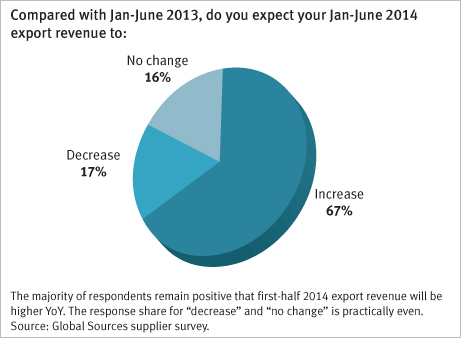
China suppliers believe they can sustain export revenue in the first half of 2014, although optimism is marginally lower than it was for the last six months of 2013. This is according to the latest Global Sources survey of 529 exporters.

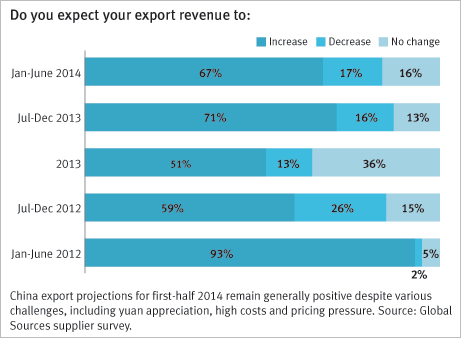
Sixty-seven percent of respondents expect export sales to increase in January to June 2014 compared with the same six months in 2013.

This is the second-straight half-year cycle that the heavy majority expected an increase in earnings from international deliveries.

In the supplier survey prior to this, more than 70 percent answered the export revenue forecast question in the affirmative. That poll focused on July to December 2013 projections.

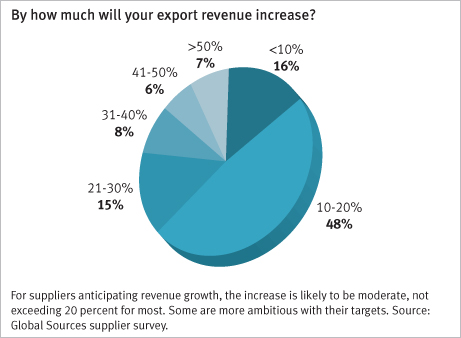
For the first-half 2014 survey, most of the manufacturers expecting higher export sales are tempering their optimism when it comes to growth rate estimates. Among these companies, 48 percent placed the increase between 10 and 20 percent. Sixteen percent said the uptick will not exceed 10 percent.

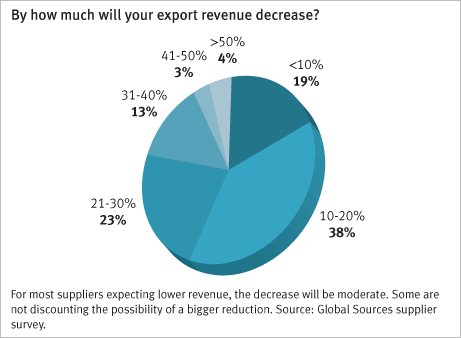
Meanwhile, among suppliers that forecast earnings to decrease, 43 percent expect declines of more than 20 percent. Within this subgroup are several companies that believe revenue loss will exceed 40 percent.

Compared with second-half 2013 survey results, it can be said that suppliers are actually expecting a recovery of sorts. In that particular poll, 52 percent anticipated decreases of more than 20 percent.

When classifying survey results by industry, the most positive response comes from hardware and automotive parts. Close to 75 percent of suppliers in this segment see export growth and only 8 percent are bracing for a decline.

Even the rosiest industry, however, is cautious. Of the companies that said revenue will rise, 44 percent estimated the increase at 10 to 20 percent, approximating the overall sentiment.

Projections of home and gift products suppliers are the most somber, with 21 percent anticipating lower earnings in first-half 2014. Thirteen percent think they can keep revenue stable.

Rising yuan tops export woes

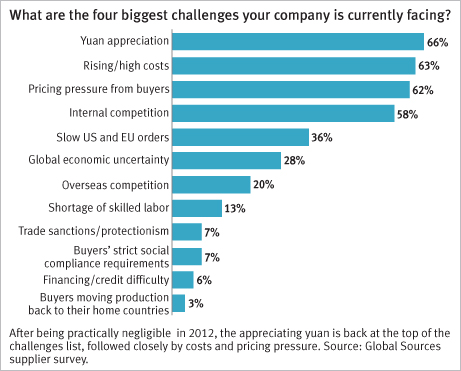
This cycle, yuan appreciation replaced production and labor costs as the primary exporting difficulty. Higher expenditure topped the challenges list in the last three Global Sources supplier survey.

Trading at about 6.09 to $1, the yuan has gained more than 2 percent against the greenback in 2013 alone, the highest among 11 major currencies in Asia that Bloomberg tracks. This is undermining export competitiveness, especially of small and midsize suppliers.

The fact that the yuan's movement is tied only to the dollar and not reflective of other currencies is cause for concern.

China exporters focusing on emerging markets, for example, have it bad. The currencies of many of these countries have depreciated against the US dollar since the second quarter of 2013, making China products even more expensive there.

Zhang Monan told the South China Morning Post that the yuan has been unable to mirror movements in the values of the currencies of China’s other major trading partners. Zhang is the deputy chief of the economic forecasting department of the State Information Centre.

These developments add weight to the need for reforms that will secure and sustain China’s long-term export competitiveness.

In the SCMP article, Yale University professor and former Morgan Stanley Asia chairman Stephen Roach said such reforms should leave China committed to "an increasingly flexible and ultimately convertible yuan."

Alicia Garcia-Herrero, chief economist for emerging markets at Banco Bilbao Vizcaya Argentaria, told Global Sources that yuan internationalization can facilitate China’s trade with emerging markets.

Pressure from both sides

The cost/price balancing act continues as China suppliers strive to protect thinning margins without compromising what propelled them to the top of many importers' sourcing lists: low prices.

The rising cost of production and labor has been the proverbial thorn for exporters that have participated in previous supplier surveys and this cycle's poll is no different. Sixty-three percent of participants identified high expenditure as one of the biggest challenges they are currently facing.

Comparing responses by industry, climbing costs trouble labor-intensive segments such as garments, textiles and fashion accessories the most.

China worker salaries have increased continually over the past several years to the point that the minimum wage in the coastal areas is now in the midrange Asia-wide. China Labour Bulletin has estimated that while China factory workers still earn less than laborers in Japan, South Korea and Singapore, they are making significantly more than their counterparts in Bangladesh, Vietnam and Cambodia.

This is the very reason why garments, textiles and fashion accessory makers expressed the most concern over competition from low-cost production hubs. This option in the challenges list received a 37 percent response rate from the subgroup, the highest among all the industries surveyed and nearly double that of the overall.

With high costs come high prices and the challenges that go along with it.

In our latest survey, 62 percent of China suppliers said they are facing pressure from buyers to keep quotes low, naturally wanting to get more out of their sourcing budget.

The task, however, is easier said than done, Aside from rising costs pulling up prices, China is progressing from cheap to upscale manufacturing and, as author Shaun Rein has advised, "Companies sourcing from China should expect to pay higher prices."

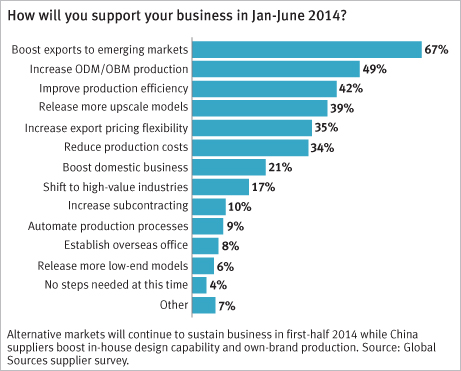
This change is in line with survey results. Companies indicated that the first six months of 2014 will see them climbing the value chain further and shifting from being “mere” contract manufacturers to design-savvy companies with their own brand.

As for pricing flexibility, this option dropped two places to 5th in the list of measures to support export business in the six months between this and the second-half 2013 poll.

Increased deliveries to emerging markets, meanwhile, remain the most popular strategy among respondents when it comes to bolstering revenue in the months ahead. This is because demand from the US and the EU, although improving, is still comparatively weak.

Breaking down survey answers by industry, anemic business in the US and the EU has the biggest impact on consumer electronics. Slow US and EU orders received a 44 percent response rate from suppliers of electronics and components, 8 percentage points higher than the overall result.

Favorites still

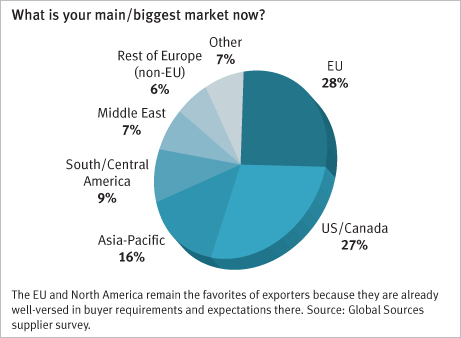
The US and the EU are still the top export markets of China-made products.

Business to these destinations actually improved in October. Shipments to the US rose about 8 percent and EU deliveries jumped more than 12 percent. Businessweek quoted UBS Securities China economist Wang Tao as saying in a report that "Exports to the EU rose at their strongest pace in two years."

The popularity of the EU is reflected in our survey. The area was selected by 28 percent of participants as their biggest market currently, narrowly beating out the US at 27 percent.

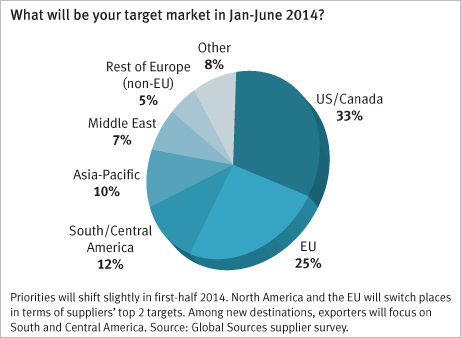
Priorities will shift in first-half 2014 with one-third targeting the US and 25 percent the EU. The latter has been losing some of its luster as it continues to struggle with recession, which is going on its fourth year. The EU recently lowered euro-area growth projections for 2014 and raised unemployment estimates.

Business to the US is not without issues, however. Conducted in October, a Global Sources survey showed that China exporters were already feeling the effects of the US government shutdown by the time the crisis was resolved on the 17th of the month.

In the same poll, respondents expect future business to be affected as well although many will simply monitor developments further before acting on slowing business.

As for emerging markets, suppliers will be focusing on South and Central America in the first six months of 2014. Companies are targeting the Asia-Pacific region this second-half 2013 October 2013 figures show exports to the ASEAN region growing at a significantly slower pace than earlier this year. In a research note, the Royal Bank of Scotland chief China economist Louis Kuijs said this reflects "the economic slowdown there as countries are trying to reduce current account deficits."

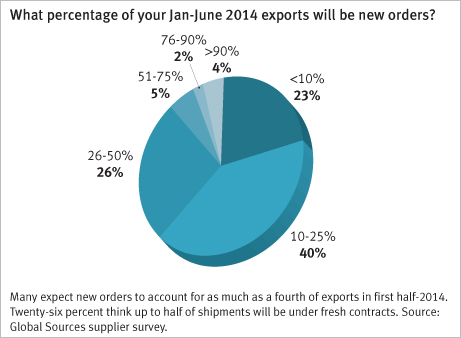
Classifying orders by frequency, meanwhile, show China suppliers expanding their business contracts further. For many survey participants, new orders will account for as much as 25 percent of exports in coming months. Among 26 percent of respondents, the share of new business will be even more substantial at 26 to 50 percent.

Survey overview

The sample selected for this supplier survey is representative of China’s export manufacturing industry in terms of location, products and company size.

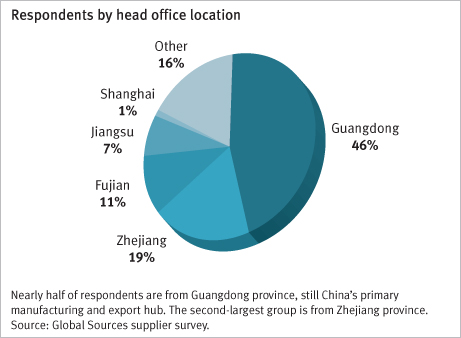
The majority of the 529 participants are based in Guangdong province and a significant number are from Zhejiang, Fujian and Jiangsu provinces. All four are China’s primary export hubs.

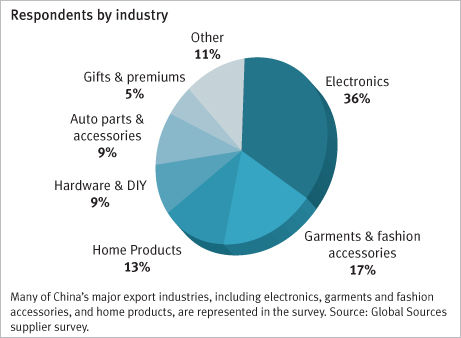
Companies are from several industries, including electronics, garments and fashion accessories, home products, and hardware and DIY.

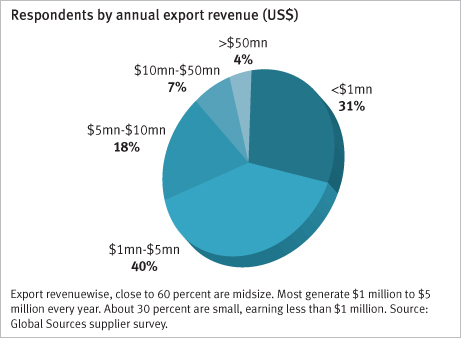
Revenuewise, close to 60 percent of respondents are midsize, earning mostly $1 million to $5 million annually. About 30 percent of participants are small, with export sales not exceeding $1 million. Large enterprises, with revenue of $10 million to $50 million and higher, account for the rest.

Source the latest products from verified suppliers on our global sourcing platform, or install our app. Subscribe to our magazines for more in-depth insights and product discovery.

More Sourcing News

  • Leave us Feedback

  • Download App

    Scan the QR code to download

    iOS & Android
    iOS & Android
    (Mainland China)