Download App
Better Online and Trade Show Sourcing Experiences.Scan the QR code to download.
Learn More
Hot Topics
Alongside fast and wireless trends, EV charging stations take up smart technology in the race to an electric future
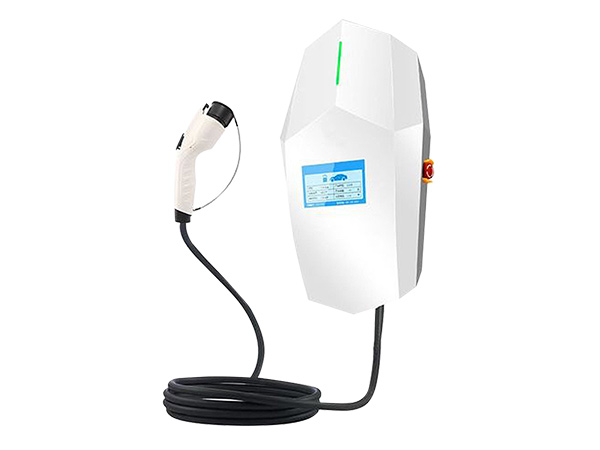
As more than 100 countries have promised to realize carbon neutrality by 2050, greater emphasis has been put on green energy development in recent years. This has fast-tracked the development of electric vehicles and charging infrastructure, with the latter now exploring smart technology while continuing R&D on ultrafast and wireless charging stations.
China, the largest EV market, is keeping its momentum, having installed 650,000 public chargers in 2022, bringing the total to 1.8 million, according to Grid News. “In Guangdong province alone, there are 383,000; that's more than double the number of public chargers in the entire United States.” China’s count does not include installations in homes, which were 2.6 million in 2022.
The same report said that 40 percent of these public installations are fast chargers, with the best with a 20-minute turnaround time. In addition, China’s public chargers allow payment via apps such as WeChat and Alipay.
Statistics from the Ministry of Industry and Information Technology differ, with installed units at 2.593 million in 2022 and the country's total at 5.21 million. This count, however, does not make a distinction between public and private-use units.
To keep pace with ongoing technological improvements and further boost EV adoption, many large Chinese manufacturers of charging stations are eyeing smart types like the ones released by XCharge. This Beijing-based startup company, which introduced a self-service charging station with cloud support, also has a series that uses liquid-cooled Li-ion batteries for EV charging and energy storage. The Net Zero charger, a stand-alone IP54 unit with a modular and intelligent software system, has up to 210kW power output and can charge two vehicles simultaneously. Its charging voltage is 300 to 1,000V, efficiency more than 96.5 percent and operating temperature -25 to 50 C.
Chinese suppliers will also keep working to realize higher power that enable fast charging. The target is 350kW to shorten charging to 10 minutes. Current products usually have a rated power of 60 to 100kW and charging time of 1 to 1.5 hours.
Wireless charging will remain on the agenda because it is seen as a trend of the future. Current technological barriers are limiting Chinese companies when it comes to undertaking R&D. SAIC Motor is among the few that has ventured into this category. It recently launched charging stations that can provide enough power to a vehicle within one hour to let it cover a distance of 70 to 80km.
Globally, electric car sales soared by about 60 percent in 2022, pushing past the 10-million mark in terms of volume, according to the World Economic Forum in an article published in collaboration with Quartz. The International Energy Agency’s report puts EVs at one per seven passenger cars bought in 2022, compared to one in every 70 in 2017. The upward trend will continue in the coming years, with Statista projecting EV market revenue to hit $457.6 billion in 2023 and $858 billion or 16.21 million units by 2027.
EV charging stations, meanwhile, will post a CAGR of 31.12 percent from 2022 to 2028 worldwide, with value to reach $120.6 billion by then, according to SkyQuest Technology Consulting. By number, the report said that there were more than 2.3 million units as of November 2022, and will exceed 16.83 million by the end of the forecast period.
In a report released by the Ministry of Industry and Information Technology, the total number of new energy vehicles that China produced in 2022 was 7.058 million, a 96.9 percent jump over the previous year. This places the country at the top spot for eight consecutive years and will likely stay there based on growth projections in the next two years.
Production of EV charging stations is therefore expected to continue rising as well, as Chinese companies make further investment. Yingjie spent $44 million for such an expansion after doubling its profits in 2022. The facility, which covers a total area of 50,165sqm, is scheduled to begin mass manufacturing in two years. Its target annual output is 412,000 units or 400,000 AC and 12,000 DC types.
Hundreds of suppliers of EV charging stations can be found in China, including those from the US and Europe.
While the majority of Chinese manufacturers are small and midsize operations, the top-tier ones have a strong global presence, exporting most of their output. These include the East Group, Nari, Tgood, Kstar and Xuji Electric. The East Group is among the top 500 new energy enterprises in the world. This Dongguan-based company has R&D centers in Guangzhou, Shenzhen, Xi’an, Nanjing and Chengdu and over 200 sales offices and service centers worldwide.
Many suppliers are located in Shenzhen, Dongguan, Suzhou, Nanjing, Changzhou and Ningbo, with a few in central parts of China.
Commonly available EV charging stations in China are wall- and floor-mount AC and DC types. AC units come in 3, 7, 11 and 22kW variants and DC kinds in 30, 60 and 120kW. They have a rated voltage of 200 to 500V, 350 to 700V or 500 to 950V, a rated current of 16, 32, 40, 80, 100, 125, 160, 200 and 240A and built-in safety features from overcurrent, -voltage, -load, -temperature, undervoltage and lightning. Typical IP ratings are IP54, IP55 and IP65, although higher can be made.
These EV chargers comply with relevant standards such as CE, FCC, RoHS, TÜV and UL.
Manufacturers source control modules, smart meters, charging plugs, LED, circuit breakers and housing domestically or overseas, depending on buyers’ requirements. So far, costs and product prices have been stable and will remain so until the end of 2023.
The products in this gallery have been handpicked by our China-based market analyst for representing current trends in EV charging stations from Chinese makers.
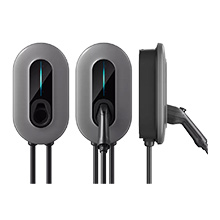
Company: Guangdong Bekey Technology Co. Ltd
Model BE-EV-11KEU-002 from Guangdong Bekey is a three-phase EV charging station with 11kW charging capacity, 400VAC±20 percent, 50/60Hz, 16A input and output, and -30 to 55 C operating temperature. This wall- or pole-mount unit, with an IP65 rating, uses a 5m Type 2 cable.
MOQ: 1 unit
Lead time: 5 days
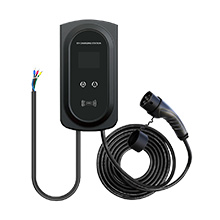
Company: Guangzhou Laimao Electronic Technology Co. Ltd
Rated at 250V±20 percent and 8, 10, 14, 16 or 32A, the VCW-7000S6 EV charging station from Guangzhou Laimao has a mechanical life span exceeding 10,000 cycles and built-in protection from leakage, lightning, over- and undervoltage, overload and -heating and ground faults. Its rated power is 7.6, 11 or 22kW.
MOQ: 3 units
Lead time: 7 days
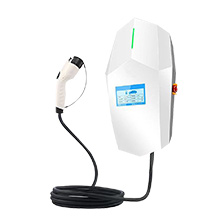
Company: Jiangsu Bomern Energy Technology Co. Ltd
This IP54-rated EV charging station from Jiangsu Bomern, the BMEW07AC-4-3979, has a rated power and current of 22kW and 32A. It has built-in protection from overvoltage and -current, lightning, electric leakage, short circuits and voltage fluctuations, and meets CE, FCC and RoHS requirements.
MOQ: 1 unit
Lead time: 7 days
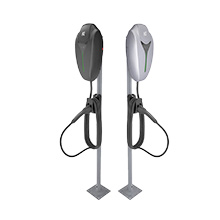
Company: Nanjing Kangni New Energy Auto Part Co. Ltd
Nanjing Kangni’s EHP-e-32A5 01-5980 EV charging station has 7kW and 32A rated power and current, and built-in protection from overcurrent, -voltage, leakage, temperature, ground faults, short circuits and electrostatic discharges. It has an IEC 62196-2 Type 2 plug with an electronic safety lock feature, and meets CE and RoHS requirements.
MOQ: 5 units
Lead time: 15 days
More Sourcing News
Read Also

关注 “环球资源外贸” 官方微信,获取实时外贸资讯
iOS & Android
iOS & Android(Mainland China)
Copyright © 2026 Publishers Representatives Limited. All rights reserved.




