Download App
Better Online and Trade Show Sourcing Experiences.Scan the QR code to download.
Learn More
Hot Topics
China contract manufacturers concentrate on small and midsize local, Europe and North America consumer electronics suppliers.
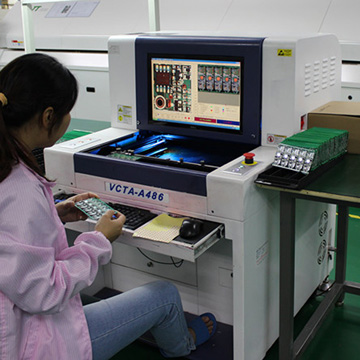
The EMS sector in China continues to zero in on the periphery of the consumer electronics market, catering to small and midsize device suppliers locally, and in Europe and North America. Domestic companies keep emphasis on adaptability to high-mix, low-volume production to strengthen hold on this client base not usually pursued by major players operating there.
For overall competitiveness, homegrown contract manufacturers ensure facilities are up to date, besides conforming to ISO guidelines. Boosting SMT capability stays a priority, although traditional through-hole technology is still in use.
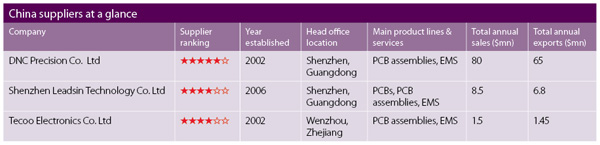
Shenzhen Leadsin Technology Co. Ltd's factory is equipped with a total of five SMT lines consisting of Juki machines, and has a capacity of 8 million points daily. The supplier also maintains three DIP lines, in addition to one for assembly. DNC Precision Co. Ltd runs the same number of lines for SMT and DIP, in addition to three for assembly and packing. Its surface-mount machines are from Yamaha and Fuji.
China enterprises underscore competence in mounting up to 0402, 0201 and 01005 SMD, and SO, SOP, SOJ, TSOP, TSSOP, QFP, BGA and UBGA components. They employ mostly imported automatic optical and in-circuit testing equipment and X-ray machines for strict QC implementation. DNC has the Agilent HP 3070 ICTs and Medalist 5DX Series 5000 automated X-ray units, the Nexscien HV-5000C AOIs, and the Rohde & Schwarz spectrum analyzers.
Besides component placement and testing services, companies emphasize one-stop capability from R&D and sourcing of RoHS-compliant materials and components to final product assembly, QC and packaging, and logistics and aftersales support.
Consumer electronics is the third-largest segment of the global EMS market, after computers and peripherals and telecom products. So, while the majority of China manufacturers prefer to focus on the high-value but not as intensely competitive industrial, medical and automotive fields, they remain open and flexible to the CE segment.
DNC covers consumer electronics, industrial, automotive, telecom and medical industries, and derives about 52 percent of sales from the first. The CE application accounts for between 25 and 30 percent of Tecoo Electronics Co. Ltd's total revenue, and telecom, industrial and medical products the rest. At Shenzhen Leadsin, it has about 10 percent portion of sales, with the bulk coming from industrial, medical, security and automotive products and instruments.
Still the world's EMS center
China continues to dominate global contract manufacturing with a market share staying strong at 60 percent despite the labor cost challenge and the rise of rival hubs in Asia.
The facilities of industry leaders Foxconn, Flextronics, Jabil, Sanmina-SCI, New Kinpo, Benchmark, Celestica and USI remain in place and so are those of rest of the 2,000 suppliers there. The latter group includes mostly local enterprises with small and midsize operations, and a few large makers such as Shenzhen Kaifa said to be on equal footing with international players.
Contributing to the hub's stability is the slowing rate of increase in minimum wages. For 2016, the projected adjustment is at about 10 percent only, which is lower than in 2011 to 2015 that saw averages of 22, 20.2, 17, 14.1 and 14 percent.
Another factor is the depreciating yuan, which will benefit China exporters the most. This will allow them to offer more competitive prices and stay in the line despite the presence of major players there.
Steady market growth
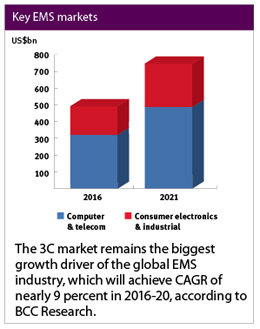
Constant product upgrades will still be the main driver of EMS worldwide, with no change in projections of nearly 9 percent CAGR in 2016-21, according to BCC Research.
The computer, communications and consumer electronics or 3C sector remains the biggest contributor to this growth trend, accounting for more than 85 percent of the service industry's revenue. Collectively, the first two will hit $323.1 billion in 2016 and $485.8 billion by 2021 at 8.5 percent CAGR. The last, combined with the industrial field, will reach $171 billion and $261.9 billion or achieve 8.9 percent CAGR during the same period.
From all this, China's EMS segment will keep expanding by about 10 percent in coming years.
More Sourcing News
Read Also

关注 “环球资源外贸” 官方微信,获取实时外贸资讯
iOS & Android
iOS & Android(Mainland China)
Copyright © 2026 Publishers Representatives Limited. All rights reserved.





