Download App
Better Online and Trade Show Sourcing Experiences.Scan the QR code to download.
Learn More
Hot Topics
Makers are using coconut shells, ferns and fabrics made of abaca and piña fibers to differentiate their designs.
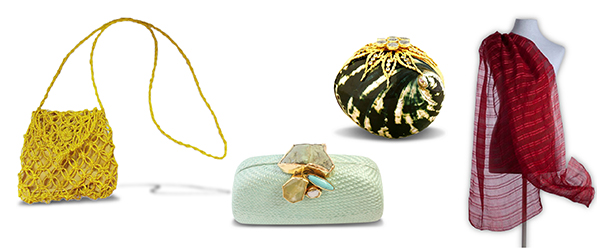
Rising production costs are prompting suppliers of fashion accessories and jewelry in the Philippines to move away from low-value products and target the midrange or high-end segment instead. Others are opting to focus on niche markets, where there is less price competition.
Many makers are leveraging their access to various natural materials to diversify their product range and differentiate their designs.
Abaca fiber is a popular option in releases, with the Philippines being one of the leading producers of the material. Recent trade shows include bags and wallets incorporating "t'nalak" and "inabal," which are abaca-based textiles produced by the T’boli and Bagobo tribes of Mindanao, respectively.
Piña fabric also remains a staple in many fashion accessories from the Philippines. Made of fiber from the leaves of a pineapple plant, the textile is usually sourced from the provinces of Aklan and Palawan.
To boost the competitiveness of the local textiles industry, the Philippine Textile Research Institute of the Department of Science and Technology (DOST) launched neo-ethnic textiles in 2013. Neo-ethnic textiles are made of natural or indigenous materials, sourced or produced in the Philippines using “updated, relevant and green scientific and technological approaches and innovations by spinners, dyers, weavers and artisans,” according to information posted on the DOST website.
Pineapple-based fabrics from Kalibo in Aklan province and the “t’nalak” from South Cotabato were among the textiles presented during the 2013 Neo-Ethnic Philippine Textiles Conference.
In jewelry, capiz and coconut shells are among the popular materials. These are typically procured from Cebu and nearby provinces.
A number of necklaces, bangles and bracelets adopt agsam, a type of fern that grows in low- and mid-altitude areas in Mindanao. Many of these articles of jewelry are accented by semiprecious stones and beads.
To promote the Philippines as a source of quality products, the export promotion arm of the Philippine Department of Trade and Industry (DTI) — the Center for International Trade Expositions and Missions (CITEM) — helps local suppliers showcase their designs in international trade shows such as Maison&Objet in Paris and Ambiente in Messe Frankfurt, Germany.
Challenges
Only a number of companies, however, can participate in overseas trade shows, mainly due to lack of funds. Many suppliers also have limited capital to invest in more advanced machinery that will enable them to expand production capacity.
Consequently, subcontracting remains prevalent among manufacturers, especially in the raw material pre-processing and the finishing stages of the production process. Many exporters of fashion accessories and jewelry still deal with issues on quality control and timeliness of delivery.
To ensure the quality of the raw materials or the products coming from their subcontractors, some companies train their subcontractors on material processing and quality control. Others provide tools and equipment or financing.
Additionally, a number are tapping artisans in local communities for part of the work to better monitor product quality and ensure timely delivery. This action also provides nearby communities with a sustainable source of income.
Another factor dampening the competitiveness of fashion accessory and jewelry manufacturers is the bureaucracy in the importation of metal and plastic components such as buckles, straps and chains, as this causes production delays.
This article and its contents are provided by the Hinrich Foundation, a partner of Global Sources in promoting trade across Asia. The products and the suppliers featured in this article are export assistance program beneficiaries of the Hinrich Foundation.
More Sourcing News
Read Also

关注 “环球资源外贸” 官方微信,获取实时外贸资讯
iOS & Android
iOS & Android(Mainland China)
Copyright © 2026 Publishers Representatives Limited. All rights reserved.