Download App
Better Online and Trade Show Sourcing Experiences.Scan the QR code to download.
Learn More
Hot Topics
As global apparel brands launch clothing after clothing to keep up with current fashion trends, most end up in trash bins, landfills and incinerators.
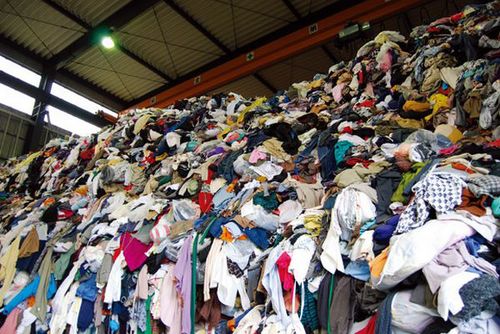
Image source: Pinterest
Fast fashion brands are causing great harm to the environment, a recent investigative report by US news magazine Newsweek revealed.
Garments that are manufactured to get them to the market as quickly as possible to capture current fashion trends are contributing greatly to ecological degradation, with millions of tons of clothing ending up in landfills.
To date, several apparel brands have launched programs that aim to reduce waste by recycling clothes but Newsweek found out that such initiatives are not helping at all.
H&M, for instance, has begun accepting used clothes from customers to recycle them into new clothes for its Close the Loop collection. But in an interview, H&M's Sustainability Manager Henrik Lampa admitted to the magazine that only 0.1 percent of the old garments they receive are actually being reused.
The problem is compounded by the fact that very few secondhand stores or online used clothes retailers accept items purchased from fast-fashion outlets such as Forever 21 because of their poor condition.
It does not help that most brands promote rapid trend turnover to stimulate more sales, leading to recent purchases going out-of-style very quickly.
These situations result in more unwanted clothing being thrown into trash bins. According to the US Environmental Protection Agency, 84 percent of discarded garments end up in landfills or incinerators. The group also said that if US citizens were to recycle all of their unwanted clothing, it would have the same ecological impact as removing 7.5 million cars from the country's highways.
Even the adoption of natural fibers, including silk, linen and cotton, and semi-synthetic variants such as modal, rayon and Tencel does not contribute to environmental preservation as these materials have a similar decomposition process to food, which produces methane, a potent greenhouse gas. The fibers are also impossible to compost because they have already undergone a lot of chemical procedures, including bleaching, dyeing and printing.
Acrylic, nylon and polyester, meanwhile, have a petroleum base, meaning it takes hundreds of years for these fibers to fully decompose.
There are organizations, however, that are attempting to curb the clothing waste.
New York-based Housing Works has been sponsoring a clothing recycling project that has reduce the amount of old garmentsin landfills by 6.4 million pounds since 2011. The clothes the group save are sold in several secondhand shops. But the number is a measly 0.3 percent of the 200,000 tons of garments being discarded in the city annually.
International environmental organization Greenpeace, meanwhile, has been running its Detox Catwalk campaign to urge global fashion houses to eliminate hazardous chemicals from clothes.
But in the end, experts say that clothing production in the US exceeds demand.
"There just isn't adequate demand for clothes in the US to warrant the amount of clothes that are being produced, noted Pietra Rivoli, economics professor at Georgetown University. "People feel like they are doing something good and the problem they run into in a country such as the US is that we don't have people who need [clothes] on the scale at which we are producing," she added.
More Sourcing News
Read Also

关注 “环球资源外贸” 官方微信,获取实时外贸资讯
iOS & Android
iOS & Android(Mainland China)
Copyright © 2026 Publishers Representatives Limited. All rights reserved.




