Download App
Better Online and Trade Show Sourcing Experiences.Scan the QR code to download.
Learn More
Hot Topics

◆ Introduction
◆ About this Book
◆ Malaysia Sourcing
◆ India Sourcing
◆ Thailand Sourcing
◆ Indonesia Sourcing
◆ Vietnam Sourcing
◆ Conclusion
◆ About Global Sources
China has a long-standing reputation as the world’s manufacturing powerhouse – producing half of the goods sold across the globe. With the ongoing US-China trade tension and an epidemic that upended international trade flows and almost completely shut down Chinese production, many importers and buyers realized the importance of diversifying their supply chains. Maintaining a stable supplier network in diverse places can help mitigate risk and sourcing disruption. So it doesn’t come as a surprise that more and more importers and buyers are implementing a “China + 1” strategy. With this approach, there’s no need to scramble to find new suppliers. There’ll be other sources to handle parts of the supply chain, thus – minimizing business disruptions brought by unexpected events. When it comes to sourcing alternatives, Southeast Asia boasts a number of good options, including Malaysia, India, Thailand, Indonesia, and Vietnam. Dubbed the “MITI-V” or “Mighty Five,” each country has its specialties, advantages,
and drawbacks.
discusses options on how to mitigate risks and sourcing disruptions through implementing a China + 1 business approach. The book outlines viable sourcing alternatives in Southeast Asia, their key production strengths, disadvantages, and other factors to consider. Moreover, this book gives valuable sourcing insights on how to avoid pitfalls when considering a new supplier in one of these Southeast Asian countries. Lastly, it also shows how having alternatives can help businesses thrive, especially in this time of the pandemic. this book gives valuable sourcing insights on how to avoid pitfalls when considering a new supplier in one of these Southeast Asian countries 3
Major advantages ◊ Highly trained workforce: Malaysia boasts many very highly skilled workers with extensive training, coming in at 8th place on the Economic Forum’s ranking of workforce skills.
Despite its small population, Malaysia is among the most competitive economies in the world and the third-largest in Southeast Asia. With its openness to trade and investment, Malaysia is certainly a good sourcing alternative to consider. MALAYSIA
◊ Good location and infrastructure: Malaysia’s location on the Strait of Malacca is a major advantage when it comes to shipping. The country has a very well-developed transportation infrastructure and is home to the ports of Tanjung Pelepas and Port Klang – two of the largest and busiest ports in Southeast Asia. ◊ Lower costs: Malaysian exporters benefit from no VAT compared to a 13% tax on exports from China, translating into lower costs for importers purchasing Malaysian-made goods.
◊ Ease of doing business: Among the “Mighty Five”, Malaysia is the easiest to do business with, ranking 12th on the World Bank’s 2019
ease of doing business metric and outranking China.
In addition, the country has made many reforms to make it easier to get permits and trade across borders.
◊ Political instability: a recent concern in Malaysia, this political uncertainty has scared off many foreign investors,
resulting in Malaysian stocks being among the worst-performing in Asia in 2019. ◊ High labor costs: in 2019, Malaysia standardized its minimum wage and set a national rate throughout the country to RM 1,100 monthly, a much higher rate than that of its neighbors in Southeast Asia and China, all of which have tiered wage rates for different regions.
political uncertainty has scared off many foreign investors, resulting in Malaysian stocks among the worst-performing in Asia in 2019
One of the world’s fastest-growing economies, India is another country that’s often cited as a sourcing alternative to China – offering options for a variety of product categories. It is behind Vietnam on some measures, but experts predict considerable improvement in the next five years, thanks to government support.
Advantages Not only is India a big market itself, with a population of 1.38 billion, it boasts a large workforce and highly skilled craftspeople and artisans. English is widely spoken and is one of the country's official languages, so international buyers won’t have a problem with communication, which is often an issue with sourcing from China and Vietnam. Labor costs are also low – lower than China, although India’s minimum wages vary by region, manufacturing sector and worker skill level.
India, unlike Vietnam, is very flexible. Many factories will do small MOQs. But are they too flexible? According to Christine Rai of Buying Agents’ Association of India, “India is much more flexible, but I would say the biggest pitfall is that we are guilty of over-committing and under-delivering… I think it's sometimes too much enthusiasm and not enough reality. So, you know, we never say no. But I'm seeing progress on that side.”
Labor costs are also low – lower than China, although India’s minimum wages vary by region, manufacturing sector and worker skill level. Major exports
Strategically located close to trading partners, including China, Pakistan and Bangladesh, India exported US$322.8 billion worth of goods to the international market in 2019. The country is good at knowledge exports, including IT. But its biggest physical products for export are apparel and textiles, including sheets, towels, carpets, and cotton linen. The country is good at knowledge exports, including IT.
In the kitchen and household sectors, India is strong on décor and functional products. Seafood, marine products, rice and spices are also a large category. Not to mention pharmaceuticals in India is enormous and growing – the country is a large pharmaceutical manufacturing hub. Disadvantages
In India, when it rains, it pours. Its lack of quality infrastructure poses problems in shipments, especially in the rainy season. Building extra shipping time is essential. However, slippage time of one week during the monsoon season is considered sufficient.
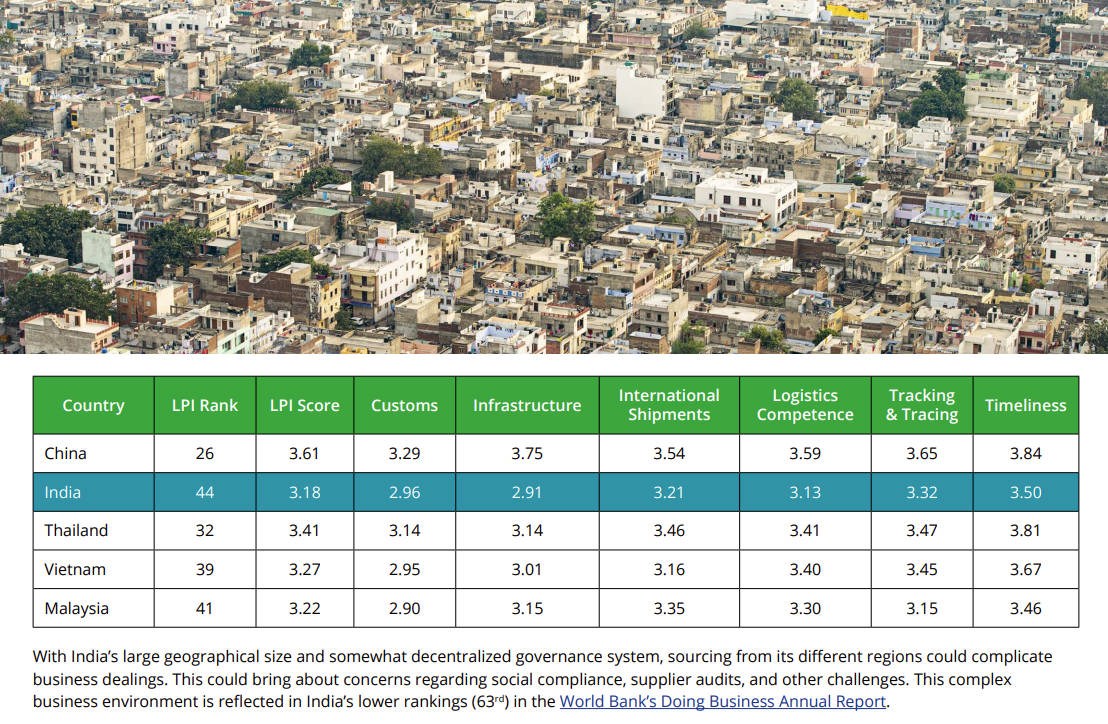
In the World Bank’s 2018 Logistics Performance Index, India ranks below China and that of its competitors in Southeast Asia, including Thailand, Vietnam and Malaysia. 7
With India’s large geographical size and somewhat decentralized governance system, sourcing from its different regions could complicate business dealings. This could bring about concerns regarding social compliance, supplier audits, and other challenges. This complex business environment is reflected in India’s lower rankings (63rd) in the World Bank’s Doing Business Annual Report.
Country LPI Rank LPI Score Customs Infrastructure International Shipments
Logistics Competence
Tracking & Tracing Timeliness
When it comes to ease of arranging international shipments and their timelines, Thailand has a similar framework to China, according to the World Bank. Its long coastline and well-developed logistics infrastructure help ensure the timeliness of cargo and shipments. With the government taking active strides toward upgrading its infrastructure and transforming the country’s manufacturing provinces into a hub of high-tech industries, innovation and logistics, Thailand is poised to establish a position as a regional gateway for trade and investment. Moreover, Thailand’s rich natural resources and easy connectivity with other ASEAN countries, particularly Cambodia, Laos, Myanmar and Vietnam, make it an attractive alternative to China for certain product categories. Lastly, Thailand outranks China in terms of ease of doing business.
As the second-largest economy in Southeast Asia, Thailand is not only a major manufacturer of cars, computer components, rubbers and processed food, but also one of the world’s top producers of hard drives.
Its long coastline and well-developed logistics infrastructure help ensure the timeliness of cargo and shipments. The downside of sourcing from Thailand
Even before the pandemic hit, Thailand’s economy was already in trouble. Export volumes are down as a result of an aging manufacturing sector and the impact of the US-China trade tensions – with its goods linked to China’s supply chain. Thailand also has a relatively high minimum wage, which makes it a less attractive China sourcing alternative for some buyers. In recent years, the country’s wages have risen significantly – higher than those of Vietnam and smaller provinces in China. Major exports
As another large exporter in Southeast Asia, Thailand’s largest export category is machines and electronics. In addition to a vast local supply of rubber, the country also produces a wide range of automotive parts, gold and jewelry. Key info about Thailand
the country also produces a wide range of automotive parts, gold and jewelry
While Indonesia’s population of 274 million people isn’t as large as China’s or India’s, importers looking to source in this part of Asia will benefit from the country’s large workforce. The general population is also young, with the median age being just 28 years old. A diverse archipelago nation of more than 300 ethnic groups, Indonesia is home to the largest economy in Southeast Asia and the world’s fourth-largest population. The country’s export industry is mostly agriculture and raw commodities. However, manufacturing has increased in recent years – leading to a relatively stable economy. Disadvantages
Indonesia’s manufacturing industry is not as well-developed as its neighboring Asian countries. Most production plants are small, which makes large-scale projects very difficult. Indonesia’s location in the Indo-Pacific’s “Ring of Fire” also presents a disruption risk to both production and logistics – especially with the number of earthquakes and tsunamis that occur. At 73rd, Indonesia still ranks poorly in terms of ease of doing business in the World Bank’s Doing Business Annual Report. More improvements in streamlining regulations are needed to support augmentation in infrastructure and to make the country a more competitive China sourcing alternative. Indonesia’s labor costs are relatively low, with the average monthly salary ranging from Rp 1,570,922 ($110.67) to Rp 3,940,973 ($277.64), depending on the region. Moreover, Indonesia offers a much more stable political climate compared to Malaysia and Thailand.
importers looking to source in this part of Asia will benefit from the country’s large workforce
Vietnam is arguably the most popular sourcing alternative to China, often dubbed the “new China.” What makes Vietnam a preferred sourcing destination?
Buyers looking to diversify their supplier base can benefit from Vietnam’s close geographical location to China. Sharing a border, Vietnamese manufacturers can source many raw materials and components from China. With not as much bureaucracy as in China, buyers can take more control of the supply chain. Lower labor costs
Labor costs in Vietnam are generally lower than in China. And, with a young workforce, the country can be a good option for products that are more labor-intensive. Strong manufacturing sector
Vietnam’s manufacturing base, while not as diversified as China’s, is still fairly diverse for its size. Its largest exports are electronics and machines, mainly due to the large multinational brands like Samsung and Panasonic that have operations there. Global buyers can also tap into Vietnam’s influx of know-how and production capabilities. The country boasts thousands of factories that are owned by Chinese, Japanese, Korean and Taiwanese companies – capable of producing a variety of products, including textiles, footwear and furniture.
The country has implemented foreign-friendly reforms, including allowing foreigners to own majority holding in Vietnamese companies. Vietnam also has a number of trade agreements to boot, including with South Korea, ASEAN, Japan, Australia, New Zealand, and the US. It is currently a star among emerging markets, thanks to trade liberalization, resulting in a lower cost of doing business and investments in human capital and infrastructure.
Although Vietnam’s transport infrastructure does not rank high as Thailand’s or Malaysia’s, it is still fairly developed, especially in sea transportation. The country has 44 seaports dotting its more than 2,000-mile coastline.
Vietnamese factories usually won’t take small orders of say, 100 pieces, even if it's a test order with a promise of more later – though it still depends on the client. Slower response time
Buyers often have to chase factories in Vietnam to get a quote, according to Jim Kennemer of Cosmo Sourcing. Additionally, Vietnam’s ports are already clogged with exports and their relatively small workforce of 90 million limits their production capability. Ease of doing business
Despite the many reforms Vietnam has implemented over the past decade, it still ranks lower than China, Malaysia and Thailand in ease of doing business. Its lower ranking could be attributed to the time needed for border compliance for exports, which takes 55 hours compared to 25.9 hours in China.
What are some of the downsides to sourcing from Vietnam?
The country has 44 seaports dotting its more than 2,000-mile coastline.
Whether you’re an experienced importer or new to the business, your sourcing strategy should not be a one-size-fits-all approach. While sourcing goods from a new place has the potential to pose challenges, such as shipping delays, longer lead times, increased costs, or poorer product quality, finding alternative markets can also benefit your business. Diversifying your supply chain allows you to minimize risk and cope better with disruption. Broadening your supply chain will give you a competitive advantage – and Southeast Asia offers several alternatives. Each of the countries in the region has something different to offer. However, in the end, the key to finding the country to source from boils down to your unique sourcing needs.
| ABOUT GLOBAL SOURCES
Driving global trade
As a world recognized B2B company, Global Sources is your
trusted partner to move your business forward. The Company has been driving authentic trade and providing market intelligence and tailored sourcing solutions for 50 years. Committed to facilitating trade between Asia and the rest of the world, Global Sources bridges suppliers with more than 1.5 million buyers in 240 countries, including 95 of the world’s top 100 retailers, through trade shows, online marketplace (GlobalSources.com), magazines, and apps.
Our mission
To connect global buyers with Asian suppliers through highly
efficient online-to-offline sourcing platforms that adapt to changing market needs.
Maintaining a stable supplier network in diverse places can help mitigate risk and sourcing disruption. So it doesn't come as a surprise that more and more importers and buyers are implementing a "China + 1" strategy. With this approach, there's no need to scramble to find new suppliers. There'll be other sources to handle parts of the supply chain, thus – minimizing business disruptions brought by unexpected events.
When it comes to sourcing alternatives, Southeast Asia boasts a number of good options, including Malaysia, India, Thailand, Indonesia, and Vietnam. Dubbed the "MITI-V" or "Mighty Five," each country has its specialties, advantages, and drawbacks.
Our newest ebook, Sourcing Beyond China and Alternative Marketsdiscusses options on how to mitigate risks and sourcing disruptions through implementing a China + 1 business approach. The book outlines viable sourcing alternatives in Southeast Asia, their key production strengths, disadvantages, and other factors to consider. Moreover, this book gives valuable sourcing insights on how to avoid pitfalls when considering a new supplier in one of these Southeast Asian countries. Lastly, it also shows how having alternatives can help businesses thrive, especially in this time of the pandemic.
Download Sourcing Beyond China and Alternative Markets now (PDF link)
Source the latest products from verified suppliers via Global Sources online, and subscribe to our magazines for more in-depth insights and product discovery.
More Sourcing News
Read Also

关注 “环球资源外贸” 官方微信,获取实时外贸资讯
iOS & Android
iOS & Android(Mainland China)
Copyright © 2026 Publishers Representatives Limited. All rights reserved.




