Download App
Better Online and Trade Show Sourcing Experiences.Scan the QR code to download.
Learn More
Hot Topics
Clothing labels provide important details about a garment, giving manufacturers a potentially useful tool to bolster revenue.
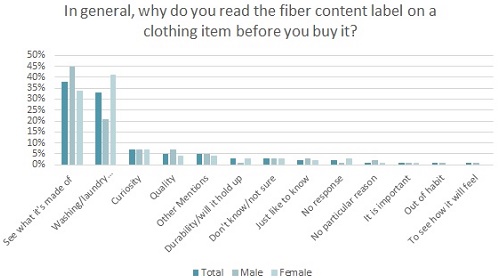
Image Source: Cotton Incorporated Lifestyle Monitor Survey
A recent Cotton Incorporated Lifestyle Monitor Survey revealed more than 40 percent of US shoppers read clothing labels before making a purchase. Of these, 38 percent said they check labels to see what the garment is made of while a third is interested in care instructions. Among all respondents who check for fiber content, a clear majority stated they are looking cotton-based apparel.
Cotton remains the fabric of choice for most consumers, with almost 80 percent opting for apparel made of the textile and its blends. Sustainability, softness, comfort and authenticity are the top reasons why shoppers choose cotton garments, gathering 84, 81, 80 and 80 percent of responses, respectively.
Polyester ranked a very distant second, being favored by only 3 percent of those surveyed. The man-made textile was followed by silk at 2 percent, and rayon, spandex and wool all at 1 percent.
With this finding that consumers do have a fabric preference, industry experts believe that it would be beneficial for clothing manufacturers promote textile contents on their labels.
“Quality of cloth is something we assess with both our fingers and our eyes, and this knowledge is now mostly with older generations,” Timo Rissanen, assistant professor of fashion design and sustainability at Parsons the New School for Design in New York, pointed out. “Brands that do consistently source and use high-quality fabrics, and invest in quality construction should actively tell their customers about it.”
But according to the survey, companies wanting to promote fiber contents on labels have a lot to improve on in terms of readability. Forty percent of respondents remarked that the font size used on labels is too small while about 30 percent said it is difficult to read. One-fifth commented that there is too much information, making them overwhelming to read.
More Sourcing News
Read Also

关注 “环球资源外贸” 官方微信,获取实时外贸资讯
iOS & Android
iOS & Android(Mainland China)
Copyright © 2026 Publishers Representatives Limited. All rights reserved.