Download App
Better Online and Trade Show Sourcing Experiences.Scan the QR code to download.
Learn More
Hot Topics
Continuing device enhancements have given rise to substrate-like PCBs or SLPs, which push the limits of HDI technology further
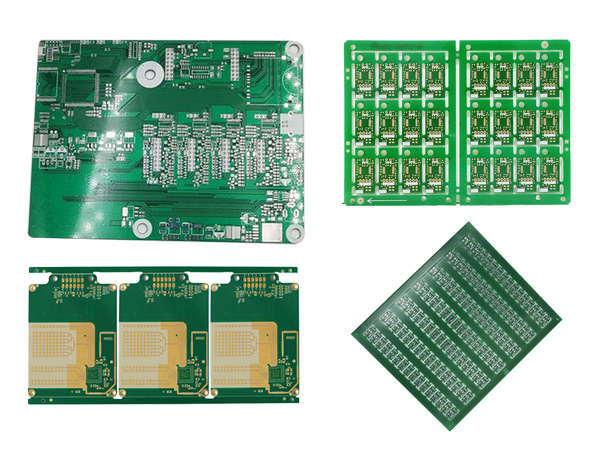
The global gaming market will remain on an upward trend for the foreseeable future, driven by the widespread use of the internet, the popularity of esports and a broad range of devices. Games have long expanded from TV and handheld consoles and PCs to smartphones and tablets, making access widely available to all ages. Based on projections by Knowledge Sourcing Intelligence LLP, the gaming industry will reach $258.734 billion by 2027 from $151.524 billion in 2020 at a CAGR of 7.94 percent.
In upstream electronics, specifically in PCBs, upgrades are underway to match the need for higher density in the ever-smaller circuitry of devices used for gaming. This is to yield more space to components as data handling in devices increases and requires more battery capacity.
HDI PCBs have been the go-to solution for their densely routed layers that can enable complex interconnections in ultrasmall devices. They are widely used in midrange and high-end applications such as mobile devices, wearables, CPUs, memory cards, GPS equipment and automotive electronics.
Continuing device enhancements, however, have given rise to substrate-like PCBs or SLPs, which push the limits of HDI technology further. These boards are said to be a cross between a conventional HDI PCB and an integrated circuit substrate. Their key difference is in the production process used, with SLPs based on the additive technique compared to the subtractive method in typical PCB fabrication.
SLPs, touted the next-generation PCBs, can reduce current HDI minimum line width and spacing of 40μm to 30 or even 20μm. They are used by Apple, Samsung and Huawei in their smartphones, with other brands likely to follow suit.
The SLP market is projected to realize a 12 percent CAGR between 2022 and 2027, according to Mordor Intelligence. It was in the scale of $6.7 billion in 2018 and rose to $27.4 billion in 2022 as reported by Zhanxin PCB Industry Research Center, a Chinese market research company.
HDI PCBs, in the meantime, will continue to be in demand. This is expected to raise production value to $15 billion in 2026 from $11.8 billion in 2021, according to Prismark.
In China, the SLP category has already attracted the attention of large PCB manufacturers, including Goworld and Eagle Electronics.
Avary Holding Shenzhen, meanwhile, has announced that it is investing $617 million in an HDI PCB and SLP expansion project, which will be completed in five years. By then, the company will have an annual output of 5 million square feet or 464,515.2sqm. It is a subsidiary of Zhen Ding.
More key Chinese PCB players are expected to allocate R&D and production resources to this endeavor in the coming years.
Globally, the market is dominated by industry leaders, including Kinsus Interconnect, Ibiden, Compeq, Daeduck, Unimicron, Zhen Ding, Meiko Electronics, TTM and AT&S.
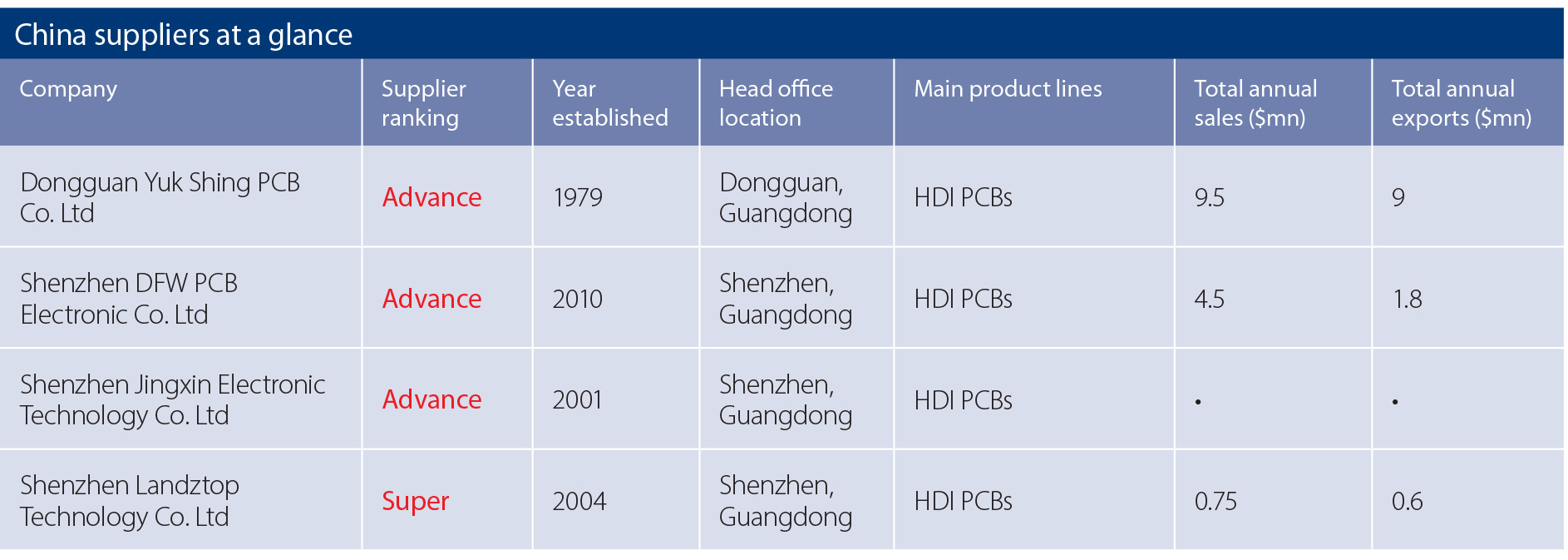
Between 200 and 300 manufacturers of HDI PCBs gather in China. More than half of these companies are domestically owned, most of which offer entry-level products. Besides Goworld and Eagle Electrics, the other major Chinese suppliers include Multek, Victory Giant, Bomin and Kinwong.
HDI PCBs for gaming applications represent 10 to 30 percent of shipments, according to manufacturers interviewed by Global Sources.
In addition to HDI PCBs, the majority of these manufacturers provide single- and double-sided, multilayer, flexible and rigid-flex boards. A number also have capability for PCB assemblies. They mainly export their products to the Asia-Pacific region.
These HDI PCB suppliers are found in Shenzhen, Dongguan, Zhongshan, Shantou, Kunshan, Suzhou and Changzhou.
HDI PCBs are usually sourced from large Chinese manufacturers. They are mostly 1+N+1, 2+N+2 and every layer interconnect or ELIC types, with midrange and high-end 2+N+2 units comprising the mainstream supply for gaming applications.
Typical specifications are 3mil minimum line width and spacing, 0.3mm minimum buried hole size and 0.1 to 0.15mm blind hole size. These boards have immersion gold, tin or silver, OSP or HASL surface treatment. They are CE-approved, UL-listed and RoHS-compliant.
HDI PCB production requires mainly FR-4 and Rogers base materials, copper foil and fillers. Chinese suppliers source them domestically or overseas, depending on buyers’ preferences. Costs have not changed much in the past 12 months except that of copper, forcing many manufacturers to raise their product prices by 5 percent. In the coming months, they are expected to stabilize.
The products in this gallery have been handpicked by our China-based market analyst for representing current trends in HDI PCBs from Chinese manufacturers.

Company: Dongguan Yuk Shing PCB Co. Ltd
This HDI PCB from Dongguan Yuk Shing, the FR-4 P1-0224, uses an FR-4 base material, an immersion gold or lead-free HASL surface finish, 1 to 6oz copper thickness, and has as small as 0.2mm holes and 4mil minimum line width and spacing.
MOQ: 1,000 units
Lead time: 15 days

Company: Shenzhen DFW PCB Electronic Co. Ltd
The 2-N-2 HDI-1-1 10 from Shenzhen DFW is an HDI PCB for mobile phones, digital cameras, notebooks, gaming devices and automotive electronics.
MOQ: 10 units
Lead time: 3 days
Company: Shenzhen Jingxin Electronic Technology Co. Ltd
Model JX PCB-039 from Shenzhen Jingxin is an HDI PCB made using an FR-4 base material and has 1/2, 1, 2 or 3oz copper thickness and HASL, lead-free HASL, chemical tin or gold, immersion gold or silver, or OSP surface finish. It has 4mil minimum line width and spacing, 0.25mm minimum drilled holes, ±0.076mm PTH and ±0.05mm NPTH tolerance, and 0.4 to 4mm board thickness.
MOQ: 10 units
Lead time: 7 days
Company: Shenzhen Landztop Technology Co. Ltd
For consumer electronics, communications, computer and medical applications, the PCB-22-4-9-3 from Shenzhen Landztop is an HDI board made using an FR-4 base material.
MOQ: Negotiable
Lead time: 10 days
More Sourcing News
Read Also

关注 “环球资源外贸” 官方微信,获取实时外贸资讯
iOS & Android
iOS & Android(Mainland China)
Copyright © 2026 Publishers Representatives Limited. All rights reserved.




