Download App
Better Online and Trade Show Sourcing Experiences.Scan the QR code to download.
Learn More
Hot Topics
Rising requirement spurs R&D on latest types. The mainstream selection remains dominated by units with dissimilar and aluminum substrates.

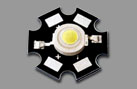
The enhanced performance of high-power LEDs that use patterned sapphire and ceramic wafers has accelerated adoption in recent years, attracting the attention of diode makers in China. While non-PSS and aluminum types are still widely produced, the output share of sophisticated variants will climb in coming years as a bigger number of companies develop such units. At present, fewer than 10 suppliers can offer PSS variants, while about 100 companies turn out ceramic kinds, which account for 5 to 20 percent of their yield.
At Everluck Optoelectronic Technology (Shenzhen) Co. Ltd, ceramic models represent between 30 and 40 percent of production. The ratio will exceed 40 percent with rising demand and as the manufacturer bolsters shipments overseas. Everluck expects to maintain 5 percent sales growth from the category by year-end.
High-power LEDs based on PSS technology boast elevated luminance output and efficiency, surpassing non-PSS counterparts by nearly 23 percent and 41 percent. These have better reliability and stability, with luminous decay of 0.4 percent after 1,000-hour aging at 350mA and almost 3 percent at 700mA.
Compared with aluminum, ceramic substrates such as alumina or Al₂O3 and aluminum nitride or AlN bonded with copper foil exhibit greater electric insulation, heat conduction, strength and corrosion resistance. Almost similar in thermal expansion coefficient to silicon chip, these have reduced thermal resistance and longer life span. The thermal resistance of ceramic wafers with a 25 to 35µm-thick insulation layer can be as low as 0.06 C/W, while that of aluminum versions having 60µm insulation is 1.7 to 3.2 C/W.
Driven by the expanding LED lighting industry, China manufacturers of high-power diodes will continue to bolster overall production and R&D for advanced varieties.
The green technology will own up to 40 percent of the global illumination sector by 2016 from 7 percent in 2010, according to McKinsey. By 2020, this will reach 60 percent. The same boom is happening in China, where LED lighting is expected to have more than 20 percent share of the local illumination segment by end-2015 from 14 percent in the previous year and about 9 percent in 2013, said CSA Research.
In terms of market scale, LED lighting will hit $25.7 billion in 2015, representing 31 percent of the worldwide total, according to LEDinside.
There are about 200 suppliers of high-power LEDs in China, including foreign-invested companies. Over two-thirds are locally owned businesses, with an aggregate market share exceeding 50 percent.
The key production areas are the coastal provinces of Guangdong, Fujian, Jiangsu and Zhejiang, specifically major cities such as Shenzhen and Dongguan in the first, Xiamen in Fujian and Suzhou in Jiangsu.

More Sourcing News
Read Also

关注 “环球资源外贸” 官方微信,获取实时外贸资讯
iOS & Android
iOS & Android(Mainland China)
Copyright © 2026 Publishers Representatives Limited. All rights reserved.