Download App
Better Online and Trade Show Sourcing Experiences.Scan the QR code to download.
Learn More
Hot Topics
ABI Research doubles down on its assessment of Amazon’s tablet strategy following strong sales at the end of 2015.
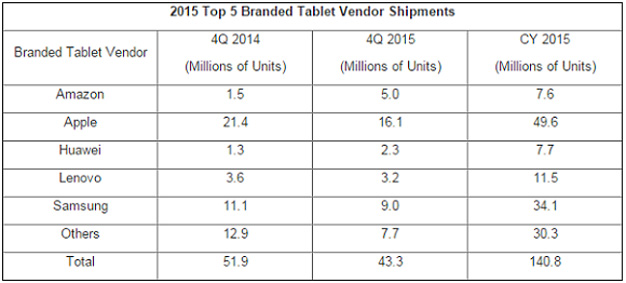
Although Amazon is not selling as many tablets as its competitors, it is one of only two top vendors who saw growth in tablet sales in the previous holiday season (Image: ABI Research)
Amazon's $50 Fire tablet is hastening the commoditization of hardware, according to ABI Research. The strategy of selling hardware at low margins or at a loss and making up for it in services and content is not new. Amazon has been following this strategy for a while now with the Kindle. Meanwhile, China makers such as Xiaomi and OnePlus have been doubling down on low-margin devices, partly because it has become a piece of the companies' identities. If people want expensive hardware, they turn to Apple or Samsung. Yet, Amazon seems to be succeeding in this where others are still struggling, and it is reshaping the tablet market in the process.
Sales are declining, and tablets taking the biggest hit are ones that are only good for consuming content. That is all the Fire tablet is good for, yet Amazon sells them in six-packs and evidence suggests people are buying them. ABI Research estimates Amazon sold 5 million tablets in the last quarter of 2015, up from 1.5 million a year earlier. Amazon is not selling nearly as many tablets as companies such as Apple and Samsung, but its tablet shipments are climbing unlike those other makers. The only other top vendor to see tablet sales climb during the same period is Huawei.
China suppliers are watching Amazon, hoping to replicate its strategy. Huawei is primarily a hardware vendor, but competitors such as LeEco got into hardware for the explicit purpose of selling its content. LeEco started out as LeTV, an online video company, and rebranded recently to better emphasize the company's new direction. Smaller manufacturers in China have long been part of the commoditization of hardware, especially in smartphones and tablets. If companies such as Amazon and LeEco succeed with this business strategy, China manufacturers win by the higher sales volume, since their profitability relies so much on economies of scale. Other retailers will want to make sure they can rely on similar strategies: sell at scale or get consumers to buy into value-added services.
More Sourcing News
Read Also

关注 “环球资源外贸” 官方微信,获取实时外贸资讯
iOS & Android
iOS & Android(Mainland China)
Copyright © 2026 Publishers Representatives Limited. All rights reserved.