Download App
Better Online and Trade Show Sourcing Experiences.Scan the QR code to download.
Learn More
Hot Topics
Huawei shipped more than 100 million phones last year, finding success overseas and beating Xiaomi at its own game.
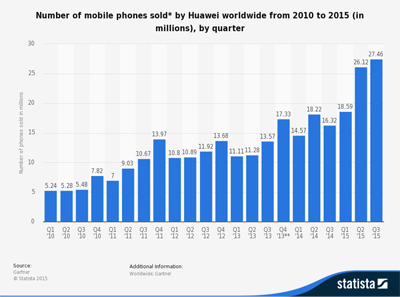
By the end of the third quarter, Huawei had shipped more than 72 million phones.
The company said in early December it reached 100 million units (Image from Statista)
As a closely held corporation, Huawei tends not to be very detailed about its finances beyond a few figures released each year. However, at the end of 2015, the company did take time to point out that its revenue rose 35.3 percent for the said year, and it saw “solid increase in profits and cash flow,” the Wall Street Journal reported. Additionally, Huawei shipped more than 100 million phones in the same period, a 33 percent increase over the previous year. Even as China’s economic growth has slowed and its smartphone market has matured, Huawei had a great year. This seems to have come at the expense of Xiaomi to some extent, as Huawei became the top China smartphone manufacturer by shipments earlier in the year. Xiaomi was aiming to reach 100 million units shipped in 2015 as well but analysts expected the company to miss the mark by more than 20 million, possibly winding up with less than the China smartphone giant's low-end estimate.
Huawei’s triumph comes from having a better strategy abroad, increasing its brand awareness in Europe, and high-end hardware. Xiaomi’s successful business model of selling online directly to consumers and controlling its supply to keep costs down has been adopted by its larger competitors, possibly leaving Xiaomi at a disadvantage in the smartphone market. There are also signs that Xiaomi’s brand image is losing some of its luster in the shadow of Huawei’s rise.
Huawei’s great 2015 signals that even in saturated markets, smartphone companies can succeed with great hardware and marketing. The company was even able to achieve this growth as it faces challenges in the US because of security concerns thanks to the company's ties in China. These problems are unique to Huawei, though, as provider of other networking hardware. By comparison, ZTE, another China brand, has done relatively well in the US and is now the fourth-largest smartphone brand there. Xiaomi has also shown that there are still routes to success for small companies, even if it turns out to have missed its 2015 goals. The company has seen an unprecedented rise over the last five years. OnePlus is known for having a similar business model but largely targeting overseas markets, gaining a lot of press coverage as a result. OnePlus also has the advantage of being owned by the larger Oppo Electronics, which is under its parent company BBK Electronics.
The competition that now exists in saturated markets is showing the best way to succeed by giving people a good deal on upgraded hardware. Phones with 4- or 8-core processors, 64GB of storage and 3 to 4GB of RAM will likely start to become the norm. Apple and Google are already offering 128GB of storage in their flagship phones. The Nexus 6P does not even have a 16GB option, which has typically been the least expensive option for many smartphones. Lower end specifications will still play an important role in developing markets, of course, where feature phones are still common. Huawei, though, had to adapt to a China that is now a mature smartphone market and it succeeded without the hype of Apple or Xiaomi.
More Sourcing News
Read Also

关注 “环球资源外贸” 官方微信,获取实时外贸资讯
iOS & Android
iOS & Android(Mainland China)
Copyright © 2026 Publishers Representatives Limited. All rights reserved.