Download App
Better Online and Trade Show Sourcing Experiences.Scan the QR code to download.
Learn More
Hot Topics
France-based company Terabee worked with CERN, which wanted faster technology to help robots recognize and avoid obstacles when inspecting the Large Hadron Collider.
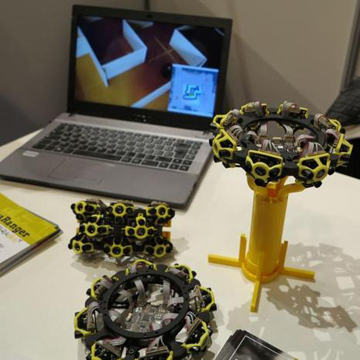
The TeraBee One, spider and box versions, and a rotating lidar
(Source: EE Times)
Working deeply with CERN (European Centre for Nuclear Research) in 2012, startup Terabee has taken IR-based time-of-flight (ToF) to centimeter-level, boasting update frequencies up to 1kHz for fast-moving robots and drones.
The France-based company's lead product, TeraRanger One, is a 35x29x18mm standalone device weighing only 8g. Because the ToF unit packs three eye-safe IR LEDs and a centrally designed IR sensor to stream calibrated distances in millimeters, the static design is more reliable than bulkier rotating laser lidars typically used in Simultaneous Localization and Mapping (SLAM) robotic applications. Several static sensors are already designed into arrays, linear or circular, for a wider field of view (3 degrees per unit), and a single unit was even mounted onto a motor spindle to emulate a lidar.
"The original product idea came up from a joint project at CERN, to automate the visual inspection of the Large Hadron Collider's 27km+ tunnel", Commercial Manager Greg Watts told EE Times Europe. The researchers evaluated a number of collision-avoidance technologies to mount on top of a small drone but soon realized that none of what was available on the market was fast and accurate enough to meet their needs, flying through the tunnel and over their complex installations.
With a detection range of 20cm to 14m (6m outdoors on the Type A first generation sensor, but now 14m with Type B) and its fast acquisition speed, the TeraRanger One found many other applications since then and is currently being tried by hundreds of customers, according to the company.
This article was originally published on EE Times. To read the rest of the article, please click here.
More Sourcing News
Read Also

关注 “环球资源外贸” 官方微信,获取实时外贸资讯
iOS & Android
iOS & Android(Mainland China)
Copyright © 2026 Publishers Representatives Limited. All rights reserved.