Integration, miniaturization and low cost are expected to push wider adoption of MEMS automotive sensors
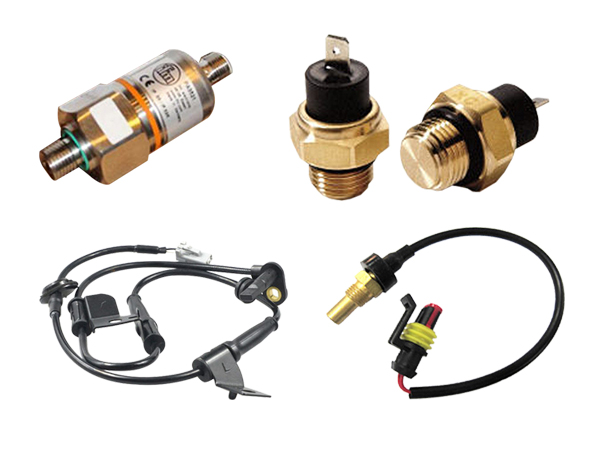
Sensors ensure the smooth and safe operation of vehicles and are the automation-enabling components in today’s smart cars. There are more than 100 kinds in the automotive industry. They are found in the engine, chassis, body and lighting, used in monitoring temperature, pressure, flow, position and velocity, and for distance and light intensity detection.
As more safety, security and comfort features are introduced to vehicles, the number of sensors increases, requiring enhanced levels of sensitivity, reliability and stability without size and weight constraints. Manufacturers’ answer to this is MEMS technology because it offers all the benefits of integration, miniaturization and low cost.
The global MEMS market, valued at $11.5 billion in 2020, will reach $16.9 billion by 2026 at a CAGR of 6.7 percent, according to Global Industry Analysts. The automotive industry’s share was 15.1 percent, with a projected CAGR of 5.9 percent by 2026.
In China, the automotive MEMS market is expected to be on the scale of $3.9 billion in the same year. It is dominated by foreign suppliers such as Bosch, Delphi, Infineon, Honeywell and Toshiba, with only a handful of Chinese companies involved. The latter includes QST and Senodia, but other large-scale manufacturers are anticipated to venture into this category in the coming years.
Growing sensors market
Automotive, industrial and communications are the top three applications for sensors, each having over 20 percent share globally, according to Sohu News.
The fast development of new energy vehicles and advanced driver assistance systems has created a huge demand for sensors. The automotive sensors market, which reached $24.3 billion in 2020, is projected to hit $47.5 billion by 2026, achieving a CAGR of 13.6 percent, according to the latest report from MarketsandMarkets.
China’s hub status
China will be the largest production base for sensors by 2024, with a share of as much as 38.51 percent, according to the Puyang Optoelectronic Industrial Technology Research Institute, a state-run firm based in Henan Province.
In 2022, the Chinese automotive sensors market was estimated to have realized $416 million and 15 percent CAGR since 2017, according to the China Auto Industry Association. The same growth rate is expected in the next two years.
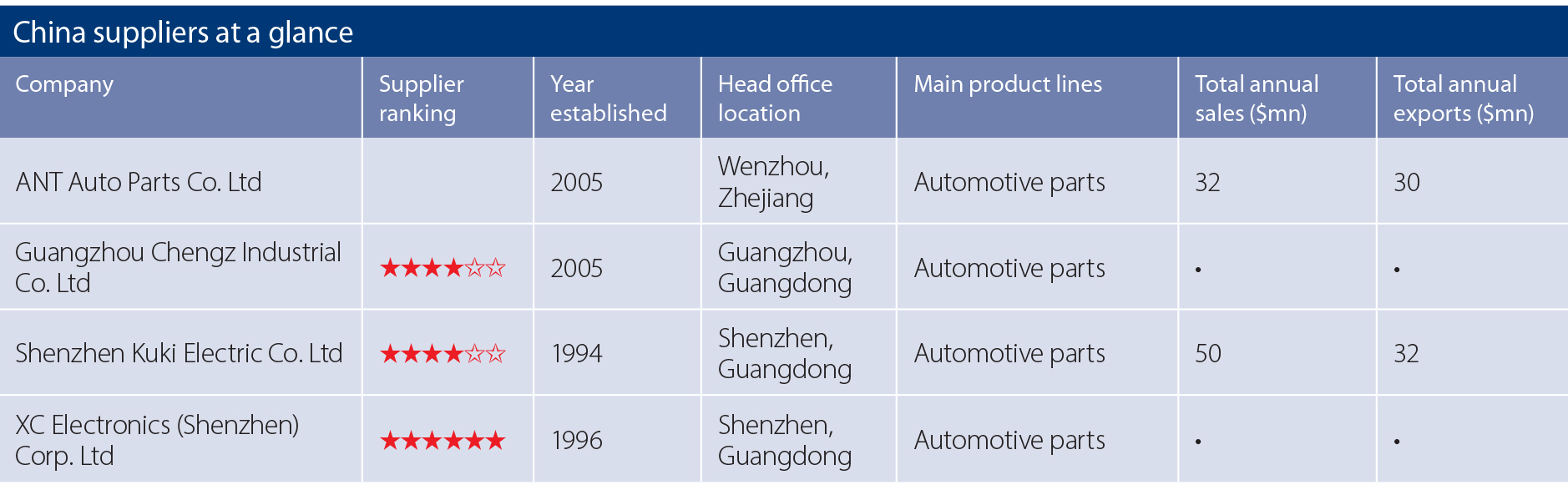
In response, some Chinese companies are investing in these sensors. Ruian Kefeng spent $216 million in 2021 for its smart auto sensors project in Wenzhou, Zhejiang. The production base has an area of 308,000sqm, with the first phase of mass production already in full swing and the second was scheduled to have commenced in late 2022. This will enable the manufacturer to turn out 40 million sets annually, with total production value of $305 million.
There are about 300 suppliers of automotive sensors in China, mostly small- and medium-scale businesses offering entry-level and midrange products. The major Chinese players include Baolong, HGTECH, Olive and Jewel Technology.
The majority of Chinese suppliers also have sensors for other applications such as industrial and communications equipment, consumer electronics devices and medical products. Automotive sensors account for 10 to 50 percent of their shipments.
Many factories are in Jiangsu, Guangdong and Shanghai and others in Beijing, Zhejiang, Shandong and Fujian.
Typical automotive sensors
In mainstream supply in China are pressure, positioning, gas, temperature and image sensors, accelerometers and gyroscopes. These are shock- and vibration-resistant and have a water resistance rating above IP65.
Typical pressure sensors have 0 to 5MPa pressure, 5VDC or 12 to 36VDC input voltage, 0.5 to 4.5 or 4 to 20mA output current, 500ohm load impedance, ±0.5 or ±0.3 percent FS precision, less than 1ms response time and -20 to 125 C operating temperature. They can withstand use of over 90 million cycles.
To ensure entry into the automotive market, most Chinese manufacturers follow AEC-Q and IATF 16949 requirements. They purchase chips from foreign providers such as ON Semiconductor, Sony, NXP, Infineon and TI, while some turn to domestic companies such as Calterah Semiconductor, SenasIC and Invent Chip to lower costs.
Sensing components, passive components, PCBs and cases come from domestic or foreign sources, depending on customers’ preferences.
The cost of these manufacturing inputs, especially ICs, rose slightly in the past year, resulting in a 5 percent increase in sensor prices. The situation may change in the months ahead.
The products in this gallery have been handpicked by our China-based market analyst for representing current trends in automotive sensors from China makers.
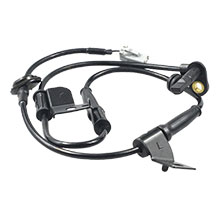
ABS sensor, 9 to 16VDC
Company: ANT Auto Parts Co. Ltd
The ABS-1611 from ANT is a sensor for anti-lock brake systems with an operating voltage of 9 to 16VDC. An order of at least 30 units has a lead time of seven days.
Inquire now
ABS sensor, front wheel hubs
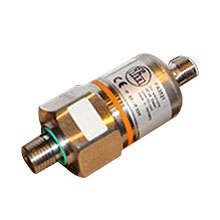
Company: Guangzhou Chengz Industrial Co. Ltd
Designed for placement at front wheel hubs, this ABS sensor from Guangzhou Chengz, the 3148000056, meets CE and RoHS standards. The negotiable minimum order has a five-day lead time.
Inquire now
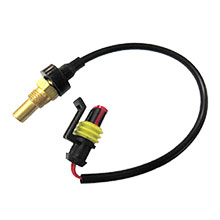
Temperature sensor, 1 to 320kohms at 25 C
Company: Shenzhen Kuki Electric Co. Ltd
This NTC temperature sensor for automotive electronics from Shenzhen Kuki, the JXW-101-2, has 1 to 320kohm resistance range at 25 C, at least 100Mohm insulation resistance at 500VDC between glass and lead wire, 1,800VAC/3sec withstand voltage at 1mA cut-off current with no breakdown or flashing phenomenon and -40 to 200 C operating range. A minimum order of 500 units is for delivery within 30 days.
Inquire now
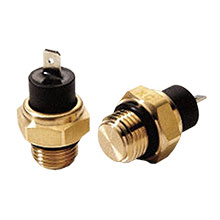
Temperature sensor
Company: XC Electronics (Shenzhen) Corp. Ltd
Suitable for use in automotive radiator grilles, XC’s QC/CG-3-5584 temperature sensor has 24VDC voltage, 10A current, 1,000VAC voltage resistance at 50Hz for 30sec, less than 50mohm contact resistance and 10mohm insulation resistance at 500VDC. At rated load, it has 100,000-cycle life span. Its closed loop temperature is 60 to 120 C. The negotiable MOQ has a lead time of seven days.
Inquire now