Download App
Better Online and Trade Show Sourcing Experiences.Scan the QR code to download.
Learn More
Hot Topics
MIT researchers used millimeter waves to create a wireless VR headset prototype that can run high-performance games.
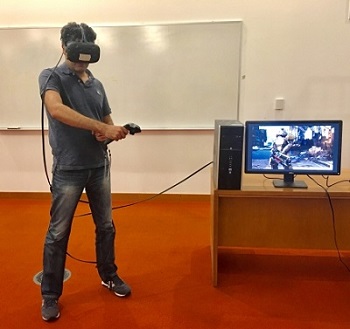
MIT said its MoVR technology could ensure VR video game players do not get tangled up in wires (Source: MIT)
The biggest drawback to powerful virtual reality headsets today is that the devices have to be plugged into powerful computers or gaming consoles. Mobile VR headsets exist, but they use smartphones and are therefore limited in their capability. While companies such as Facebook, HTC and Sony are betting on PC-connected VR headsets.
Google is convinced that for VR to go mainstream, it must be accessible through smartphones. That is why the company introduced Daydream. Perhaps, VR will be limited to smartphone headsets in the future, but people who want more powerful headsets also want the device to be wireless. Massachusetts Institute of Technology researchers have some good news for the latter group. A prototype called MoVR at the university uses millimeter waves to push through the high bandwidth required for upscale VR headsets such as the Oculus Rift and HTC Vive, making them completely wireless. Given that this technology currently only resides in a university, it will be a while before it makes it to market. However, early signs are promising, in spite of the limitations of millimeter waves.
As the name makes clear, millimeter waves have very short wavelengths. These high-frequency waves are fast, but they are easily blocked. This means the technology does not work through walls and can even struggle in high humidity, according to Wired. The researchers, however, devised a way to work around this. A box that monitors where the headset is using laser tracking allows for quick rerouting of the millimeter waves.
The prototype works, but it is not perfect. There are no doubt plenty of kinks to work out, but the researchers also want to make the boxes that reroute the signals even smaller. The size of the boxes right now is described as that of "one or two smartphones." The researchers envision smaller boxes that can be easily attached to a wall. Power consumption, and therefore battery life, also needs to be improved.
The fact that the MoVR technology appears to be so far along makes it easy to imagine millimeter waves showing up within a few more generations of VR product development. Of course, what works in a lab and in everyday use are far from the same thing. Still, millimeter waves could work well with what other technology makers are using to help VR headset users stay mobile. PC backpacks, for example, would pretty much ensure the waves are not blocked. It seems in the future of wireless VR, consumers will have many options.
More Sourcing News
Read Also

关注 “环球资源外贸” 官方微信,获取实时外贸资讯
iOS & Android
iOS & Android(Mainland China)
Copyright © 2026 Publishers Representatives Limited. All rights reserved.




