Download App
Better Online and Trade Show Sourcing Experiences.Scan the QR code to download.
Learn More
Hot Topics
by Cecile de Veyra (Managing Editor)
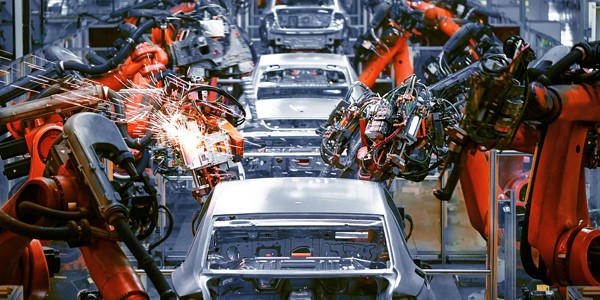 Image from Shutterstock
Even as the pandemic, in addition to the US-China trade war, impacted the automotive and the electrical/electronics markets, industrial robotics fared well enough to finish at about $10.6 billion in 2020, according to Igate Research. And from 2021 to 2025, the sector is expected to surge on the basis of “cost reduction, improved quality, increased production and improved workplace health and safety.”
Service robotics, meanwhile, posted $20.4 billion in 2020 and will keep growing during the forecast period thanks to increasing adoption in the medical, defense and agriculture industries, logistics, inspection and maintenance, rescue and security, construction and professional cleaning. The expanding use of personal and domestic robots for household tasks, entertainment and leisure is also a key catalyst in this segment.
The dynamism of the robotics industry can be seen in ongoing research too. The International Federation of Robotics (IFR) has released an updated report on government-funded R&D plans recalibrated for post-pandemic reopening. These programs include Made in China 2025, Japan's New Robot Strategy, the Intelligent Robot Development and Supply Promotion Act in Korea, Horizon Europe, Germany's High-Tech Strategy 2025 and the US' National Robotics Initiative.
There have also been notable recent mergers and acquisitions in the robotics space. In addition to 89 such transactions in 2019, about 60 were recorded the following year, according to an article by Eugene Demaitre in The Robot Report. Based on this trend, Analytics Insight is betting on an accelerated pace for such consolidations in 2021, which has already seen quite a few. They include the acquisition by Accenture of Pollux, Verizon of InCubed IT and Teledyne of FLIR.
In China – the largest robotics market with the fastest growth in total sales, according to IFR – the number of installations is the highest in the world. In 2019, up to 140,500 industrial robots were installed, far exceeding Japan's 49,900 units. However, in terms of robot density, China tallied 187 robots per 10,000 workers that year, compared to 855 in world leader South Korea and 364 in second-placed Japan, according to Statista's report based on IFR data.
Still, industry analysts are not discounting a key role in robotics for China. In its survey of the top countries in robotics implementation in 2021, IFR describes China's robot density as a development that “continues dynamically.” Taking new patents as a gauge, the country is said to have accounted for 44 percent of applications published worldwide in 2019, according to HRG International Institute of Research and Innovation, as quoted by Robotics & Automation News.
By market scale, China's robotics industry reached $10.46 billion in 2020, rising 17.2 percent YoY, according to market research firm China Industry Information. By application, industrial robots had a 66 percent share, service robots 25 percent and special robots the remainder. In 2021 and 2022, this upward trend is predicted to continue at a rate of more than 15 percent.
More Sourcing News
Read Also

关注 “环球资源外贸” 官方微信,获取实时外贸资讯
iOS & Android
iOS & Android(Mainland China)
Copyright © 2026 Publishers Representatives Limited. All rights reserved.




