Download App
Better Online and Trade Show Sourcing Experiences.Scan the QR code to download.
Learn More
Hot Topics
Mobile phone growth will slow to 1.6 percent this year, making new features such as VR critical to future expansion.
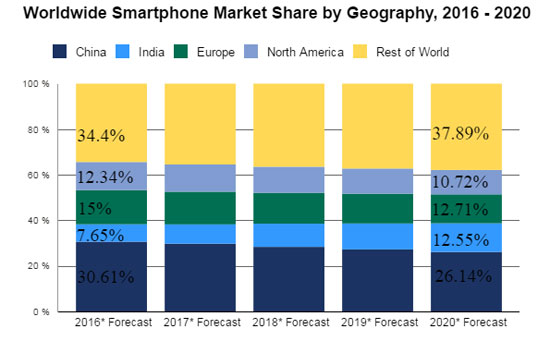
North America, Europe and China are declining in importance as smartphone
shipments rise in India and the rest of the world. (Source: IDC)
Future smartphone growth will have to rely on new features as market saturation has now solidly taken hold, according to IDC. The research firm is now projecting the smartphone market will grow just 1.6 percent year-over-year in 2016. This is down from 10.4 percent in 2015, showing the market has become saturated very quickly. North America and China will see their global share of smartphone shipments decline through 2020. The former will lose less than 2 percentage points but China will see its share decline by more than 4 percentage points. Europe will also see a dip of a little more than 2 percentage points. India is still growing, however, as is market share in the rest of the world. India is expected to have 12.55 percent of the smartphone market by 2020, up from 7.65 percent this year. If IDC's projections pan out, India will have a similar market share as Europe. The rest of the world is expected to grow from 34.4 percent to 37.89 percent.
Although opportunities still exist in less developed markets (IDC predicts a 5.4 percent CAGR for emerging markets in the next 4 years), global smartphone growth has still slowed dramatically. IDC sees future growth relying heavily on new features. Fortunately for mobile phone companies, it might not be long before a new slate of features makes upgrading much more enticing. The industry is currently trying to use buy-back and trade-in programs to get users to upgrade, but the next 12 to 18 months might see significant improvements in augmented and virtual reality features that make new smartphones critical to participating in these experiences.
One big upgrade for VR in smartphones is Google's Daydream and Daydream-ready phones. These handsets are expected to have display resolutions much higher than full-HD, which budget China smartphone makers have so far relied on to keep costs down. When users have smartphones directly in front of their eyes, the difference between full-HD and quad-HD or higher becomes much more apparent.
IDC also expects phablets to continue to increase in popularity and prices will come down in response. Xiaomi and other China smartphone makers have already been pursuingthis strategy. IDC expects the average selling price of phablets to reach $304 by 2020, down 27 percent since 2015.
More Sourcing News
Read Also

关注 “环球资源外贸” 官方微信,获取实时外贸资讯
iOS & Android
iOS & Android(Mainland China)
Copyright © 2026 Publishers Representatives Limited. All rights reserved.




