




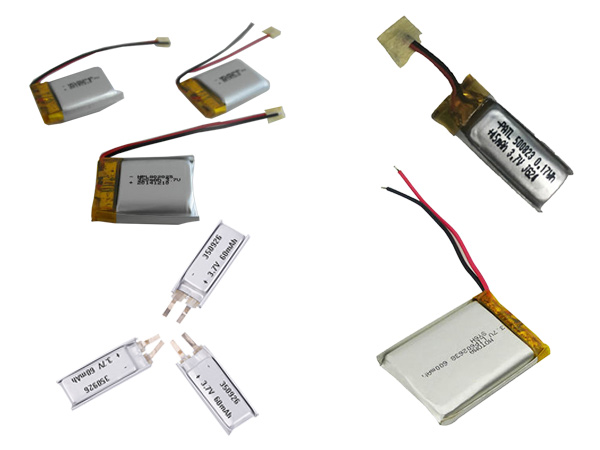
The wearables market has regained its footing, with shipments expected to grow by 6.3 percent in 2023 after a slump in the previous year due to satiated demand. The International Data Corp.’s Worldwide Quarterly Wearable Device Tracker, released in March, is projecting that the volume will reach 523.2 million devices, with earwear accounting for 62.1 percent, smartwatches 31 percent, wristbands 6.5 percent and other devices 0.4 percent. The report also states that the shipment volume will be 644.5 million units in 2027, with 5.4 percent CAGR from 2022.
This upbeat forecast will be a boon to the lithium battery manufacturing industry, which has been benefiting from the wearables market in recent years. In China, shipments for this application totaled 3.5GWh in 2020, increasing nearly 30 percent from the previous year, according to SPIR, a Chinese market research company. In 2025, this will go up further to 6GWh.
Most Chinese suppliers of Li-polymer batteries, looking forward to higher demand, are gearing up for production expansion. They are also counting on a captive market, with China being a major manufacturing base for wearables. IDC reported that the country shipped more than 160 million such devices in 2022 or an 18.5 percent increase over 2021, and projects sustained two-digit growth in 2023 and 2024.
Everpower built a facility dedicated to Li-polymer batteries for wearables, with a $30.88 million investment in the project. The factory, with an area of 20,100sqm, began mass manufacturing in 2022 and has a daily output of 500,000 batteries. Annually, this will have a total production value of $51.47 million.
Battery in fiber form
R&D initiatives have been underway as well. One breakthrough has come from Fudan University, which developed lithium-ion fiber batteries that have an energy density of more than 85Wh/kg and can be woven into fabrics.
“The one-meter-long fiber developed by the research team has proven capable of powering wearable electronics, including smartphones, smart bracelets and heart rate monitors continuously for a long period of time,” reported Xinhua Net. “Its capacity retention remains about 90.5 percent after 500 charge-discharge cycles and over 80 percent of capacity can be maintained after bending the fiber for 100,000 cycles.” The research team is still working to increase the batteries’ energy density and improve their weaveability in high-comfort and fashionable textiles.
LiPo batteries from China
Chinese manufacturers will continue to build on the inherent advantages of Li-polymer batteries in terms of capacity, safety, size, shape and weight. These batteries are 40 percent lighter than Li-ion types with the same capacity and can be as thin as 1mm, fully meeting the requirement in wearables.
Widely available for the wearables market are batteries with a rated voltage of 3.7V, capacity ranging from 45 to 1,000mAh, life span exceeding 500 cycles, and charge and discharge temperatures of 0 to 45 C and -20 to 60 C. They have built-in safety features such as short-circuit, overcharge, -discharge and -current, and shock and vibration resistance.
All manufacturing inputs used, including cathode and anode materials, electrolyte, insulators, foil and cases, come from domestic sources.
Chinese companies accept requests for customization, which accounts for 20 to 60 percent of their shipments.
Most ensure product compliance with safety standards such as CE, RoHS, UN 38.3, IEC 1233 and UL, and provide an MSDS or SDS.
Manufacturing hubs
The Pearl River Delta and the Yangtze River Delta are the main hubs for Li-polymer battery manufacturing, playing host to more than 70 percent of suppliers in China. Guangdong is the largest base, with many factories in Shenzhen, Dongguan, Zhongshan, Guangzhou, Huizhou and Zhuhai. Other key cities elsewhere include Suzhou, Changzhou and Ningbo. There are also companies found in Sichuan and Shaanxi provinces.
Sunwoda, Eve, Great Power, Ganfeng, Apower, ATL, Aucopo, Everpower and BYD are among the homegrown leaders. Their foreign counterparts, with factories in China, include LG Chem and Samsung SDI. The rest of the manufacturing pool consists of small and midsize Chinese enterprises. All these companies offer Li-ion batteries as well.
3.7V, 45mAh Li-polymer battery
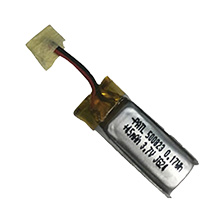
Company: Dongguan Perfect Amperex Technology Ltd
Intended for use in Bluetooth earphones, smart watches and wearables, online banking USB keys and medical applications, Dongguan Perfect’s PATL004-500823 Li-polymer battery has 3.7V and 45mAh voltage and capacity. It conforms to CE, UL, MSDS, UN 38.3, RoHS and IEC 61233 standards.
MOQ: 3,000 units
Lead time: 15 days
3.7V, 320mAh Li-polymer battery
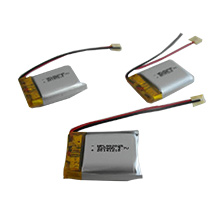
Company: Shenzhen Hypercell Co. Ltd
From Shenzhen Hypercell, the HPL802025 320mAh Li-polymer battery has 4.2V and 64mA standard charge voltage and current, 3.7V voltage, 320mAh capacity and 1.8Wh energy. The standard discharge current is 0.5C (160mA), the maximum discharge current 1C (320mA) and the impedance ≤180ohms. This unit has 0 to 45 C charge and -20 to 60 C discharge temperatures. It meets UL, IEC, UN 38.3, CE, FCC, CB, KC, PSE and EN 62133 requirements.
MOQ: 2,000 units
Lead time: 30 days
3.7V, 600mAh Li-polymer battery
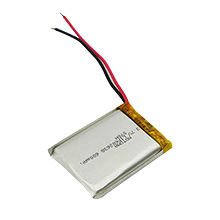
Company: Shenzhen Motoma Power Co. Ltd
This Li-polymer battery from Shenzhen Motoma, the 3.7V-LIP602638-600mAh, has 3.7V and 600mAh voltage and capacity. Its standard charge and discharge rate is 0.2C, maximum continuous discharge rate 1C and pulse discharge rate 1.5C. The cut-off voltage is 3 or 2.75V, the life span up to 500 cycles, and the charge and operating temperatures are 0 to 45 C and -40 to 60 C.
MOQ: 1,000 units
Lead time: 20 days
3.7V, 60mAh Li-polymer battery
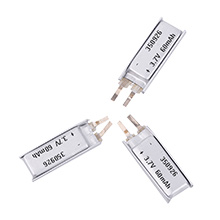
Company: Shenzhen Sujor Energy Technology Co. Ltd
Shenzhen Sujor’s Li-polymer battery, the Sujor-3.7V 350936 60mAh-9130, has 3.7V and 60mAh voltage and capacity, 500mohm initial impedance, and 0 to 45 C charge and -20 to 60 C discharge temperatures. It weighs 1.3g.
MOQ: 5 units
Lead time: 20 days

