Download App
Better Online and Trade Show Sourcing Experiences.Scan the QR code to download.
Learn More
Hot Topics
Concussions are the latest medical use of virtual reality, which could potentially help athletes and soldiers.
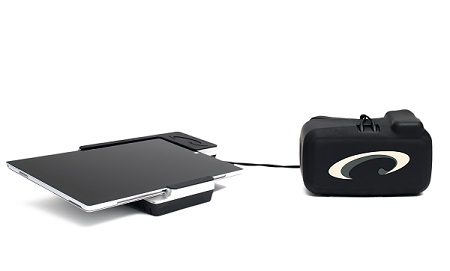
Eye-Sync connected to a Microsoft Surface (Image: SyncThink)
People are already betting on wearables to have a big impact on health care, but virtual reality could also play an important role. Boston-based SyncThink now has an FDA-approved medical VR headset called Eye-Sync.
The company says the device, using integrated software, can determine whether someone is exhibiting abnormal eye movements in less than a minute. This could be a sign of someone suffering a concussion, making it potentially useful for the National Football League in the US. The NFL has been criticized recently for not being forthcoming about how common the condition is among football players. On its website, SyncThink shows the headset linked to a Microsoft Surface, which is the "official tablet" of the NFL.
According to the company, Eye-Sync works by recording eye movements during circular visual stimulus for 15 seconds before repeating. The results will show how unsynchronized brain activity is by tracking the eye movements during this test. SyncThink says the process has been proven "highly reliable."
Of course, sports players are not the only people who suffer concussions, and there are other professional settings in which this kind of technology could be used. SyncThink cites the military as one potential market for the headset. Eye-Sync has already been tested on 10,000 soldiers and athletes, according to the company.
There are other medical applications for VR. As Fast Company pointed out, it can be adopted to help the visually impaired, treat PTSD patients and assist with surgical training. Some of these uses conflate VR with augmented reality. Google Glass has been used in medical settings, for example, to help with surgery.
China suppliers have eagerly gone after the VR headset market. Currently, there are no local manufacturers that are targeting explicitly the health care segment, but as VR software improves in this area, some of it could become device agnostic as what happened with certain software for mobile devices.
More Sourcing News
Read Also

关注 “环球资源外贸” 官方微信,获取实时外贸资讯
iOS & Android
iOS & Android(Mainland China)
Copyright © 2026 Publishers Representatives Limited. All rights reserved.