Download App
Better Online and Trade Show Sourcing Experiences.Scan the QR code to download.
Learn More
Hot Topics
The shift to health and fitness has allowed wearables to stay relevant.
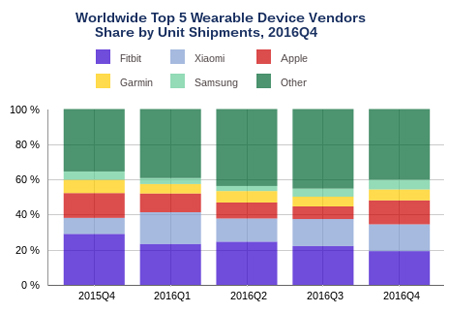
Fitbit, Xiaomi and Apple made up nearly half of the wearables market in the fourth quarter
(Source: IDC)
The demise of the wearables market has been greatly exaggerated. Although smart watches have not taken off the way many believed and hoped, a shift in the market has allowed it to persist. Numbers from IDC show wearables shipments grew 16.9 percent to 33.9 million units in the fourth quarter of 2016. This brought total shipments for the year to 102.4 million units, up 25 percent from 2015.
Anyone who has been paying attention to the market probably knows the biggest shift that has allowed wearables to maintain growth: health and fitness. Most new devices coming out these days have some kind of focus on those areas. Android Wear 2.0 even emphasizes this more in the OS.
Another trend is making smart watches that work independent of smartphones. This trend is relatively nascent, although these kinds of devices are not new. Smart watches with SIM cards that are effectively smaller, “wearable smartphones” have been around for years. At one point these were referred to as watch phones. Such devices primarily came from China makers trying to catch the next big thing, but it seems they were a bit too early. The biggest issue with these devices is that cell data connections eat up a lot more power than just a Bluetooth connection. Now, there is a renewed focus in this area as companies search for something new in the wearables space.
The top brands in wearables have not changed much and are mostly familiar by this point. Fitbit maintained its top position, but year-over-year growth declined 22.7 percent in the fourth quarter. Xiaomi, now the second-largest wearables maker, grew 96.2 percent. This allowed the affordable China brand to grab 15.2 percent of the market compared with Fitbit's 19.2 percent.
Apple came in third with 13.6 percent of the market, which is impressive when its only wearables remain the Apple Watch devices. Garmin and Samsung round out the top five at 6.2 and 5.6 percent of the market, respectively.
Xiaomi's biggest strength is in affordable fitness trackers, but it is still struggling to expand beyond China. Moreover,many China manufacturers are able to play the same game as Xiaomi. While Fitbit may be king of wearables in more developed markets, those areas are becoming saturated. The lower ends of the market might soon be looking for more affordable options, presenting an opportunity for China brands such as Xiaomi.
More Sourcing News
Read Also

关注 “环球资源外贸” 官方微信,获取实时外贸资讯
iOS & Android
iOS & Android(Mainland China)
Copyright © 2026 Publishers Representatives Limited. All rights reserved.




