Download App
Better Online and Trade Show Sourcing Experiences.Scan the QR code to download.
Learn More
Hot Topics
Older millennials and younger Gen Xers are most interested in keeping track of notifications and their health using a device strapped to their wrist.
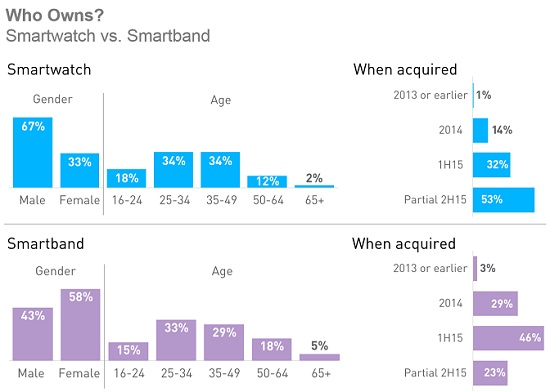
Smart watch buyers skew mostly male while women prefer smart bands. Most purchases
have happened this year, showing more products and awareness are helping the industry grow.
(Graphic from Kantar Worldpanel)
About 68 percent of smart watch owners are between 25 and 49 years old, with notifications and health tracking as the primary usage drivers, according to data compiled by Kantar Worldpanel. The company surveyed nearly 11,000 people aged 16 and older, asking whether they owned smart watches and how they used them. While the survey found that only 3 percent of the US population owns a smart watch or a smart band, it also revealed some interesting demographic information about who is purchasing such technology.
About 34 percent of smart watch buyers are 25 to 34 years old and another 34 percent are 35 to 49. Smart band owners skew a little younger, with 33 percent in the 25 to 34 range and 29 percent in the 34 to 49 range. It also turns out that women prefer smart bands while men choose smart watches. Among those surveyed, 67 percent of smart watch owners were male while 58 percent of smart band owners were female. This also means women are spending less money on these kinds of wearable devices, as 70 percent of smart band owners spent no more than $150 on their wearable.
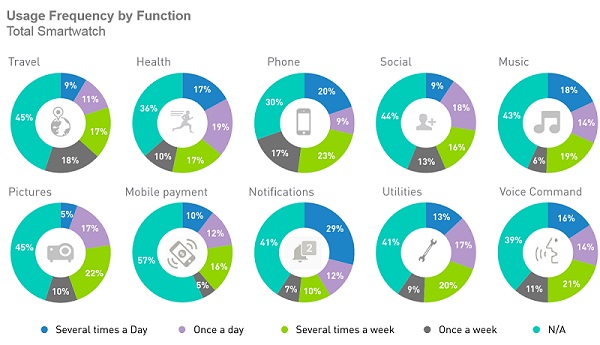
Graphic from Kantar Worldpanel
Notifications and health tracking were the most popular uses of smart watches and smart bands. Men prefer using the devices for notifications much more, with 65 percent employing the feature daily compared with 48 percent of women. The latter segment is more likely to use health tracking, however, with 46 percent using the feature daily versus 34 percent of men. Men were a little more likely to use fitness tracking specifically, with a ratio of 40 percent of men versus 37 percent of women using it daily. It is also notable that 57 percent of owners used their devices for mobile payments, but the feature was not utilized as frequently as others.
While the market segment currently remains small, understanding who is buying the technology today could be a key to helping the market grow. Of the 4 percent who said they planned on buying a smart watch or smart band in the next 12 months, 55 percent were using an Android smartphone and 39 percent were using an iPhone. Only 16 percent were willing to change phones to use a specific smart watch, so the platform agnostic approach, as used by Pebble and many smart band manufacturers, looks increasingly wise.
More Sourcing News
Read Also

关注 “环球资源外贸” 官方微信,获取实时外贸资讯
iOS & Android
iOS & Android(Mainland China)
Copyright © 2026 Publishers Representatives Limited. All rights reserved.