Download App
Better Online and Trade Show Sourcing Experiences.Scan the QR code to download.
Learn More
Hot Topics
The higher number and complexity of onboard electronics spurs the release of smaller and lightweight interconnects.

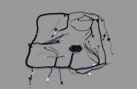
Increasing emphasis on safety, comfort and environment friendliness is raising the requirement for automotive wire harnesses, encouraging China suppliers of the product to bolster development and manufacture. Companies target key applications infotainment and power systems, and are eyeing prospects in the expanding electric vehicle or EV market as well.
On the product agenda are types that are smaller in diameter and lighter in weight, besides having high electromagnetic compatibility and being RoHS-compliant, to match the trends in car electronics. The last include lighting, telematics, air bags, engine control, in addition to infotainment.
At present, copper is mainly used as conductor, although in some units, stainless steel is added to it for enhanced strength and reduced weight. Other kinds replace copper with aluminum, which is about 30 percent lighter. Advanced models for infotainment systems employ optical fiber. For improved performance and safety, most wire harnesses come with heat-shrinkable tubing for insulation and protection. More-compact plugs in 090, 040 and 025 sizes are widely adopted.
For the EV sector, local manufacturers are looking to turn out a greater number of high-voltage variants rated at 300V to suit engine systems. The typical selection consists of 12V units.
The growing complexity of onboard electronics requires a higher number of wire harnesses. On average, more than 60 sets are used and this may exceed 70 in the future. As such, China suppliers plan to raise the output share for the automotive industry, which is currently between 5 and 50 percent.
Xiamen Oseisy Industry & Trade Co. Ltd allocates the bulk of yield for the application. The ratio is 60 to 70 percent. In terms of sales, the maker aims to hit $1 million by year-end from $80,000 in 2014. It expects the same rate of increase in the coming year as orders climb.
Suntek Electronics Co. Ltd ventured into the line early this year. The category represents 5 percent of its revenue at present, but this will go up amid the uptick in orders locally and abroad.
Automotive industry's steady advance
The global vehicle market remains in an upturn, with 2.6 percent annual volume increase in the years ahead. The estimated number of units sold will climb to 103.2 million by 2021 from 87.9 million in 2015, according to AlixPartners. Worldwide demand for green cars, meanwhile, will have a two-digit jump in the next two or three years.
In China, the projected production expansion of the car industry doubles that of the world at 5.2 percent from 2015-18. As for EVs, there will be 3.2 times more units rolling out of factories this year than in 2014, or a total of78,500 units. By 2016, this will surge to 200,000 units, according to the China Automobile Industry Association, presenting a huge opportunity for local interconnects suppliers.
From these developments, the global automotive wire harnesses market is anticipated to garner a sales value of $80.5 billion in 2021 from $45.4 billion in 2014, according to TMR. The CAGR approaches 9 percent.
Foreign versus China players
There are about 200 suppliers of automotive wire harnesses in China. Over two-thirds are local businesses but collectively own less than 30 percent of the domestic market. This is due to the domination of international companies with manufacturing facilities there, which include Sumitomo and Delphi.
The two together with Yazaki form the industry's triumvirate, which has an aggregate share surpassing 50 percent of the worldwide market. Leoni, Lear, Furukawa, Fujikura and Coroplast are among the other major foreign makers.
Based on shipment, Asia accounts for more than half of the total, and most comes from Japan companies.
In China, the key suppliers include the THB Group and Shenzhen Deren. The former, based in Hebi in Henan province, is the largest manufacturer of automotive wire harnesses. The second, in cooperation with the Krombery & Schubert Group, formed Shenzhen Gaorun for $11.1 million. The new company focuses on the production of high-end automotive connectors and wire harnesses.
The majority of suppliers are also engaged in the production of other types of connectors and cable assemblies.
The production hubs are in the coastal provinces of Guangdong, Jiangsu and Zhejiang. The key city locations are Shenzhen and Dongguan in the first area, and Suzhou and Yueqing in the last two. More enterprises are expected to swell the current pool.
Download a comparison table PDF of six verified power transformers suppliers. Contact suppliers directly from the PDF.
More Sourcing News
Read Also

关注 “环球资源外贸” 官方微信,获取实时外贸资讯
iOS & Android
iOS & Android(Mainland China)
Copyright © 2026 Publishers Representatives Limited. All rights reserved.