
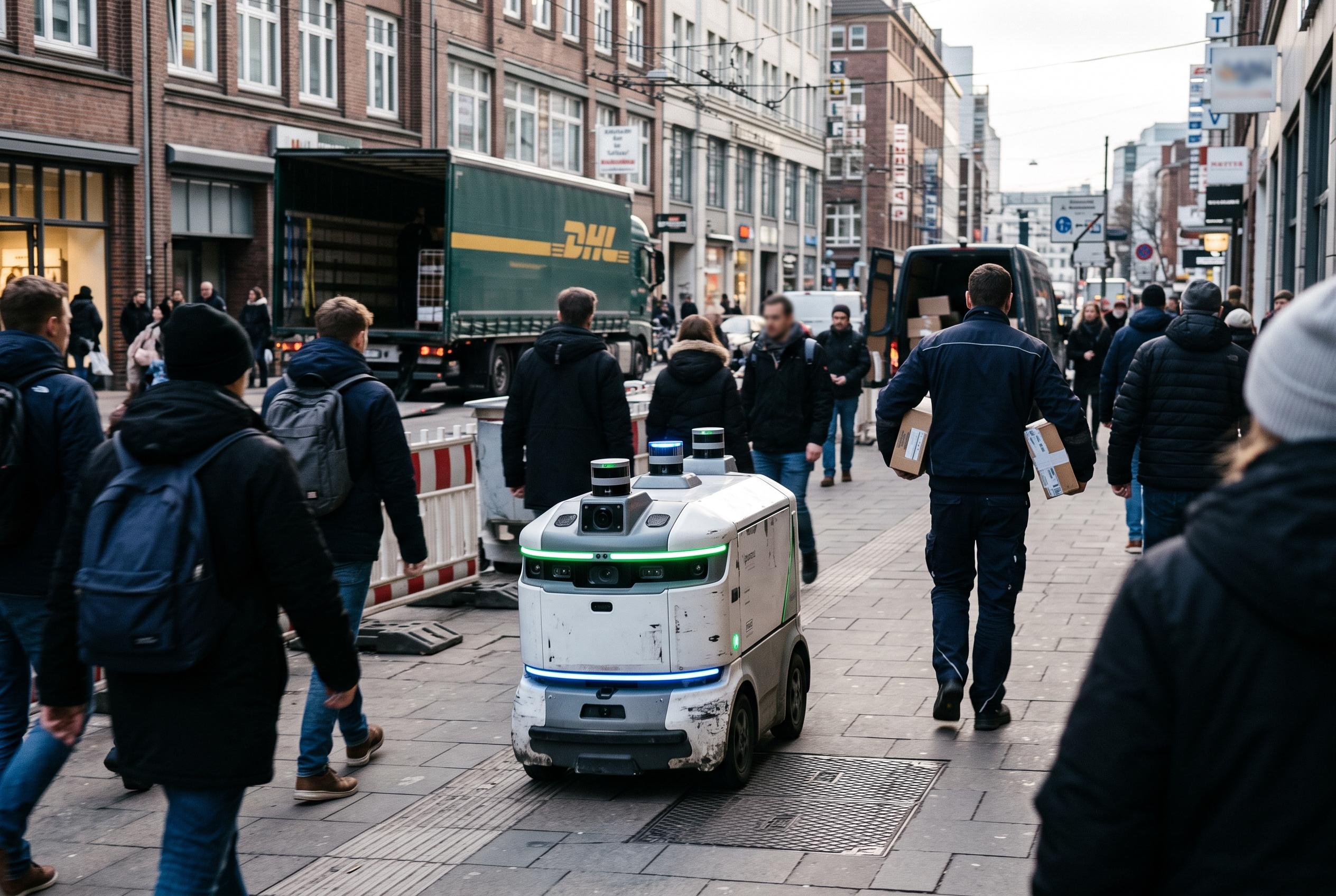
- Robots require stronger visual understanding to navigate complex, real-world settings
- Coordination among perception, planning, and control is vital for effective autonomy
- Future robotics will depend on integrating large models and lightweight AI for adaptability
Robots already serve a broad role in today’s industry and everyday life. They work in warehouses, assist with surgeries, clean floors, and help with exploration missions. Still, researchers say that the next major leap in robotics will go beyond task-specific automation. To become more useful and versatile, robots will need stronger visual understanding, systems that allow them to recognize their surroundings, make decisions, plan movements, and act safely without always needing humans to guide them.
That challenge is growing more critical as robots start operating in environments that aren’t as predictable. A warehouse robot might work in a carefully organized space, while a floor-cleaning robot might have to navigate around furniture, people, and changing conditions. Platforms used for exploration face their own uncertainties, and surgical tools need to operate with extremely high accuracy. Across these different uses, the ability to see and interpret the world around them is closely tied to how well a robot can do its job.
This central idea is highlighted in a recent review by researchers at Hunan University. Published on May 9 in the journal Visual Intelligence and shared via EurekAlert, the paper examines advances in robotic visual perception, decision-making, path planning, and control. It also points out the technical hurdles that still stand in the way of creating more capable autonomous robots.
Rather than viewing robotics as a single technology, the review describes it as a layered process. First, a robot must collect information about its environment. Then, it needs to interpret what that information means, decide on a course of action, and finally translate that decision into physical movement. Each step contributes to the overall outcome, but problems can arise at any stage if data is incomplete, misunderstood, or doesn’t transfer smoothly to the next step.
Why visual intelligence is so important
The concept of visual intelligence gives robots a way to understand what they’re seeing around them. Vision systems can recognize objects, obstacles, and other relevant features. This information becomes the basis for decisions about where a robot can move, which path it should take, and how it should respond when the environment changes.
It’s more than just capturing images. A robot has to use visual data in practical ways. It needs to identify relevant features amid background clutter, recognize obstacles, and connect what it sees with the action it’s supposed to perform. The review emphasizes the link between perception and action, underlining that a robot’s ability to operate independently depends on more than detecting objects.
For example, recognizing an obstacle is just the start. The robot then has to figure out whether that obstacle blocks its intended route, whether an alternative is available, and whether that alternate path is feasible and safe. After that, it has to convert the plan into motor commands. If any of these steps falter, the robot might not finish its task as expected.
This makes visual intelligence a critical part of autonomous robotics. Without reliable perception, a robot might lack the information needed to reason about its environment. Without effective planning, it can’t translate perceptions into a suitable route. And even with a solid plan, poor control might prevent it from moving correctly, highlighting how these systems must work together.
A connected system
According to the review from Hunan University, robotic systems can be described as linked layers: perception, planning, and control.
Vision systems identify what matters, objects, obstacles, and features. Planning then uses this information to determine how the robot should move. It has to assess whether a route is practical, physically possible, and safe. Finally, the control layer turns that plan into motor commands that the robot can carry out in the real world.
The authors argue that one of the biggest challenges in robotics is ensuring these layers work seamlessly together. Information has to pass smoothly from one stage to the next without losing vital details or causing errors. The perception system might correctly identify the environment, for example, but the planning phase still needs to interpret and use that data properly. Likewise, even with a good plan, the control system must execute it accurately, especially in real-world conditions.
The review emphasizes that improving the system as a whole, fostering better coordination, is more important than enhancing one individual algorithm. Making each component support the others is vital for future, more capable robotics.
Large models and embodied AI
Hengcan Shi, a professor at Hunan University and primary author of the paper, wrote that robots are moving beyond tightly controlled environments as large models and embodied AI develop. In these settings, he said, robots need perception systems that are more precise, adaptive, and dependable.
With the shift toward more open and less predictable environments, the standards for robotic systems are rising. In controlled setups, robots might deal with familiar objects, predictable layouts, and limited variation. In less structured environments, robots must be ready to interpret conditions that aren’t perfectly organized or known beforehand.
That’s where adaptability becomes crucial. While accuracy still matters, robots also need to respond well when things don’t go exactly as expected. Reliability is equally important, since a system that works only under perfect conditions isn’t very useful in the real world.
The review from Hunan University doesn’t present robot intelligence as the result of one breakthrough. Instead, it describes the integration of improvements in perception, reasoning, planning, and control.
Decision-making and path planning in focus
A robot’s actions depend on decisions made after it processes its surroundings. Making those decisions involves understanding the environment, while path planning is about figuring out how to move toward a goal.
The review notes that path planning must consider whether a route is physically feasible and safe. A seemingly straightforward route might be impossible to follow because of the robot’s size, obstacles, or environmental conditions. Likewise, a route could exist but still be unsafe.
The connection between planning and control is critical. Planning sets the course, a route or set of directions, while control executes it through motor commands. The robot has to translate an abstract plan into real movement. If that translation isn’t accurate, the original decision’s quality becomes less meaningful.
The challenge isn’t just finding a route; it’s ensuring that the route is followable and that the robot’s control system can make real-time adjustments as needed. The layered approach underlines how intertwined these responsibilities are.
The future of coordination
Yaonan Wang, a corresponding author of the paper, believes that robot intelligence doesn’t come from just one algorithm. Instead, it hinges on smooth coordination among sensing, reasoning, planning, and physical action.
This perspective puts a strong emphasis on integration. Sensing produces data, reasoning makes sense of it, planning selects a course, and action creates the physical response. If these parts are disconnected or don’t communicate well, even highly capable individual components may fail to deliver effective results.
The review also mentions future work on collaborative intelligent systems for cooperative swarm robots and lightweight AI systems that can operate quickly with fewer resources. A system that is too computationally demanding might be too slow or require too many resources, limiting its usefulness.
This push toward efficiency is about more than speed; it is also about resource management. AI that can run quickly with fewer resources could make robots more adaptable and scalable. But the review presents this as an ongoing area of development, not an established solution.
Across industries and in daily life
The push for smarter and more capable robots fits with their use across different sectors, including manufacturing, healthcare, agriculture, exploration, disaster response, and service tasks. The National Science Foundation has highlighted how robots can improve productivity, precision, and safety across these areas.
These varied applications underscore why perception and coordination are so vital. In manufacturing, robots need to perform tasks accurately. In healthcare, robotic tools operate in sensitive environments. Agriculture requires dealing with changing outdoor conditions, while exploration robots may have to work in harsh or inaccessible environments.
As robots take on more diverse roles, their ability to understand and respond to their surroundings becomes increasingly important.
The researchers from Hunan University say the ultimate goal is to develop robots that can understand complex environments, work alongside one another, and handle challenging tasks in a human-like way. Achieving this depends on improvements across the entire robotic system, visual perception, decision-making, path planning, and control.
The key message from the review is this: creating smarter, more autonomous machines requires more than better hardware or a single breakthrough. It depends on reliable cooperation among the systems that let robots see, think, plan, and act. As robots enter more complex environments, visual intelligence could become a fundamental building block for safe, effective operation.
Key takeaways
- - Visual intelligence helps robots connect what they see with decisions and physical actions.
- - Effective robotics depends on coordination among perception, reasoning, planning, and control.
- - Large models and embodied AI may help robots operate in less predictable environments.
- - Lightweight systems could make advanced robotics more practical where computing resources are limited.
- - Future progress will likely depend on improving complete robotic systems rather than one isolated algorithm.
Disclaimer: This article may have been created with AI assistance and reviewed by our editorial team. It is provided for general informational purposes only. Readers should verify information independently before relying on this content.
Sources:
