
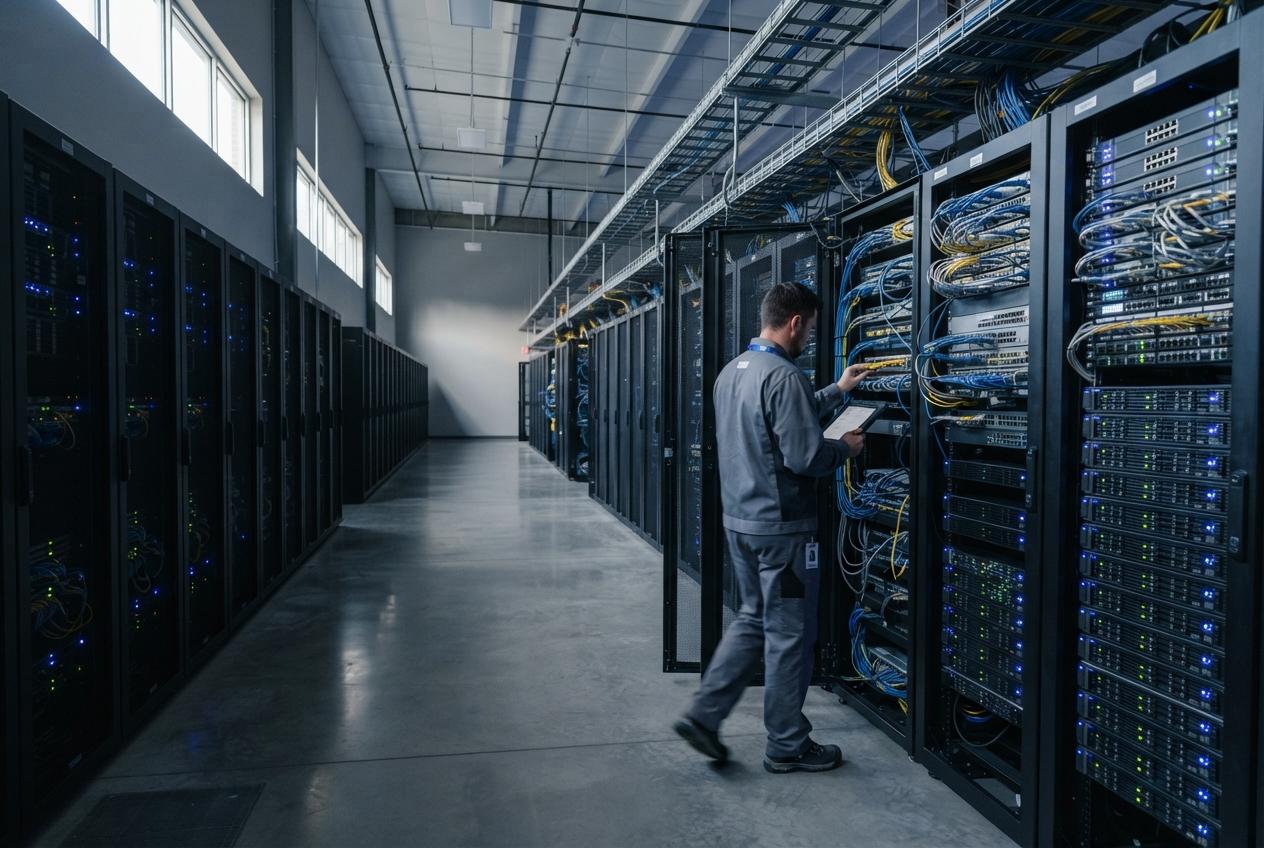
- AI systems now require seamless data flow to optimize performance
- Networking and storage are critical as AI workloads diversify across environments
- Edge inference and full-stack design are reshaping AI infrastructure strategies
AI Infrastructure Is Becoming a Data-Movement Challenge
AI infrastructure is increasingly being judged by something a bit more fundamental than just the number of accelerators: how well data can move through the entire system.
For years, a lot of the conversations around AI hardware focused on GPUs, custom chips, and ever-expanding computing clusters. Those elements, of course, remain important, but they’re no longer the only ways to gauge infrastructure performance. As AI systems spread across cloud platforms, traditional data centers, and even edge environments, networking and storage are now playing a bigger role in whether large technology investments actually pay off.
This shift is changing what infrastructure leaders, enterprise tech teams, and electronics procurement folks need to prioritize. The question isn’t solely about how many accelerators an organization can get or install. It’s also whether the supporting systems can move data reliably, handle congestion, meet security standards, and respond quickly enough to support real-world workflows.
In essence, AI infrastructure is starting to look more like a logistics puzzle, almost as much as a compute challenge. The location of data, the path it takes, the storage involved, and the timing of each transaction can all significantly influence how well an AI application performs.
AI Traffic Is Different From Traditional Enterprise Traffic
AI workloads don’t typically behave like most traditional enterprise applications. A single request might need to retrieve information from multiple sources before it can generate an answer.
That info could include documents stored in corporate repositories, records in vector databases, and language models running across different parts of an organization’s system. Plus, the system might need to apply security checks, verify user permissions, and still return results within a tight timeframe.
This creates a more complex pattern of data movement. Instead of relying on just one application server or a fairly predictable database transaction, an AI request could traverse several systems and locations. Each step adds latency or presents a potential congestion point.
And for end-users, that’s noticeable. An AI assistant that feels sluggish, a search system that’s slow to respond, or an automated workflow that’s delayed can seem frustrating, even if the underlying model is powerful. In this context, latency isn’t just an IT issue; it’s a business metric directly tied to user experience and operational flow.
The overall value of AI tools depends not only on the quality of the models but also on how quickly and reliably the entire system can gather, process, and deliver an answer. The combined roles of compute power, storage speed, network architecture, and security measures all come into play.
Spending Is Increasing, but Capacity Alone Won’t Cut It
With the AI opportunity booming, infrastructure teams are reassessing budget priorities. Gartner predicts global AI spending will hit about $2.59 trillion by the coming year, with nearly half of that dedicated to infrastructure alone.
But just pouring money into more hardware doesn’t automatically solve the core infrastructure issues. Sure, more equipment can boost theoretical capacity, but it doesn’t guarantee consistent, predictable performance in practice. If data can’t flow smoothly between parts of the system, then extra compute power might sit idle, or results could become unreliable.
As AI workloads become more distributed across different environments, the main challenge is shifting from merely increasing capacity to designing systems that ensure predictable data flow. Buyers should also think about how well components work together, supplier options, ease of integration, and the long-term management of these systems, not just raw performance specs.
Network Fabrics Are Under Increasing Strain
This pressure is already evident at the network level. According to data from TechTarget and TechRepublic, AI cluster traffic is revealing bottlenecks related to fabric design, congestion handling, and interoperability.
These issues happen because AI workloads generate massive amounts of data flying between compute nodes, storage systems, and other hardware components. If the fabric gets overwhelmed, delays happen, which can hurt overall cluster performance.
In June, Dell’Oro Group reported that Ethernet switch sales used in AI back-end networks more than doubled in just the first quarter. While InfiniBand still plays a key role in large-scale training and high-performance computing, Ethernet is gaining ground. That’s because it offers standardization, broader supplier choices, and easier integration with existing infrastructure.
It’s important to note, though, that Ethernet isn’t replacing all other tech; rather, infrastructure buyers are simply considering a broader set of options based on their operational needs, reliability, and compatibility.
Moving Toward Inference at the Edge
The focus is also shifting toward inference, especially at the edge.
IDC predicts that nearly half of all enterprises will deploy AI inference at the edge in the next few years. This means more processing happening closer to where data is generated, like hospitals, factories, retail stores, and branch offices, rather than relying solely on centralized cloud data centers.
Edge setups come with their own infrastructure challenges. Data might need to be processed on-site rather than sent to a core data center or cloud. But it’s not just about having enough accelerators; it’s also about efficiently moving data into and out of those local environments.
Interestingly, server design is evolving in response. Intel, for example, has noted that inference is sharply increasing demand for CPUs, with some deployments now approaching a ratio of one CPU for each GPU.
For those making procurement decisions, this broadens the scope. You can’t just look at accelerators alone. You need to consider processors, memory, storage, networking, and the systems that connect these components together.
The Challenge Is Full Stack for Both Suppliers and Buyers
All these trends are collectively changing the definition of what AI infrastructure really involves. It’s no longer just about a compute race; instead, it’s a full-stack challenge, covering data transfer, latency issues, storage design, and network architecture.
The best deployments won’t only be judged based on peak specifications. They’ll be evaluated on how consistently they move data, how well they handle delays and congestion, and how easily they integrate with existing workflows.
The takeaway for the market? AI infrastructure isn’t just more compute capacity anymore. It’s about crafting a balanced system where compute, storage, networking, and data access all work seamlessly together. As AI technology continues to expand into cloud, data centers, and edge environments, the ability to move data swiftly and reliably might be the deciding factor whether projects succeed or get stuck.
Takeaways
- - AI performance depends on the complete path data takes, not just accelerator speed.
- - Networking, storage, security, and system interoperability should be evaluated alongside compute capacity.
- - Ethernet and other networking options may offer procurement flexibility, but the right choice depends on workload and compatibility requirements.
- - Edge inference increases the importance of local processing, efficient data movement, and balanced electronics design.
- - Infrastructure teams should measure predictable performance, latency, congestion, and integration, not only peak specifications.
Disclaimer: This article may have been created with AI assistance and reviewed by our editorial team. It is provided for general informational purposes only. Readers should verify information independently before relying on this content.
Sources:
