
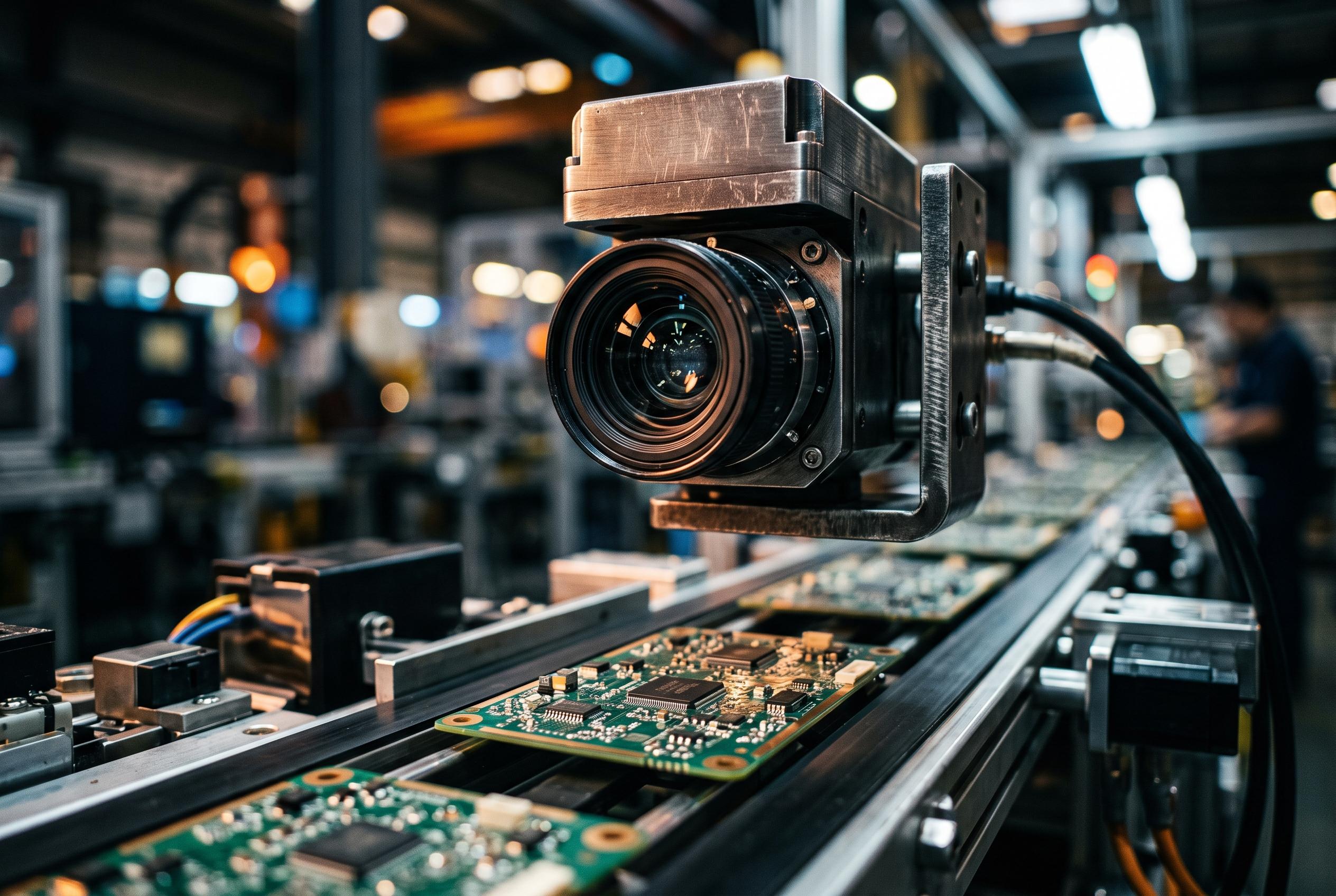
Manufacturers are turning to compact 10GigE cameras when inspection systems need more bandwidth without adding bulky hardware. Basler's matched camera, network card, software, and accessory setup targets demanding work in factories, logistics, robotics, wafer inspection, and semiconductor production, where fast image delivery and dependable processing can make a measurable difference.
More speed, less system clutter
The appeal of a compact 10GigE camera system is straightforward: it moves a lot of image data quickly without forcing every part of the installation to become oversized. Basler's approach combines cameras, network interface cards, software, and accessories into a coordinated setup, giving integrators fewer compatibility questions to wrestle with.
That matters when a production line is already crowded with controllers, lighting, cables, and safety equipment. A smaller, cleaner arrangement can make the whole machine easier to build and service, while stable transmission helps keep inspection results moving instead of waiting in a digital traffic jam. Basler describes its 10GigE platform as a solution for data-heavy industrial applications, according to its camera information.
Why RDMA matters in machine vision
High bandwidth is useful, but speed alone doesn't guarantee a responsive vision system. The data still has to travel from the camera, through the network, and into the application, and conventional transfers can place a noticeable burden on the host processor.
RDMA, or Remote Direct Memory Access, is intended to streamline that handoff by allowing data to reach memory with less CPU involvement. In practical terms, that can help keep processing more responsive, particularly when several cameras are sending images at once. Basler's documentation identifies compatible 10GigE interface hardware built around SFP+ connectivity, an important detail for system designers planning the network path.
A practical fit for multi-camera inspection
A single high-speed camera can be demanding. Add several viewpoints, faster line speeds, or higher-resolution sensors, and bandwidth becomes a design issue rather than a specification-sheet bonus. This is where 10GigE can make sense for inspection cells, robotic guidance, warehouse sorting, and semiconductor equipment.
The system's stated support for GigE Vision 3.0 also gives developers a familiar industrial framework for camera communication. That doesn't eliminate integration work, but matched hardware and software can make the process more predictable. Basler's installation guidance stresses the importance of correct hardware setup and network configuration for GigE camera systems, according to its technical documentation.
Choosing the right camera and network hardware
The camera is only one part of a fast vision chain. Before ordering, integrators should check sensor resolution, frame rate, exposure requirements, lens compatibility, cable length, connector type, and the number of cameras sharing the network. A system that looks fast on paper can still disappoint if the host PC, switch, or interface card becomes the bottleneck.
The network interface card deserves particular attention. Basler lists dedicated 10GigE interface options, including a two-channel SFP+ card, which may be useful when a design needs multiple camera connections or a more flexible fibre and copper networking plan. Product-specific details, including camera variants and configurations, should be checked against the intended application rather than chosen by headline speed alone.
Where the platform could go next
The most interesting part of this setup isn't simply the 10 Gbps figure. It's the attempt to make high-speed vision more manageable by matching the camera, transport hardware, software, and accessories from the outset. That can reduce the quiet costs of integration, troubleshooting, and future expansion.
For factories processing more images, more frequently, that kind of headroom is valuable. It gives engineers room to add cameras or increase inspection detail without redesigning the entire architecture immediately. Basler's product listings show a broader family of 10GigE camera models, suggesting that the platform is intended to support different imaging requirements rather than one narrow use case.
A compact 10GigE camera system won't solve every machine-vision challenge, but it can remove a major constraint: getting large image streams to the processor quickly and consistently. For demanding inspection lines, that's a small footprint with considerable potential.
Disclaimer: This article may have been created with AI assistance and reviewed by our editorial team. It is provided for general informational purposes only. Readers should verify information independently before relying on this content.
