
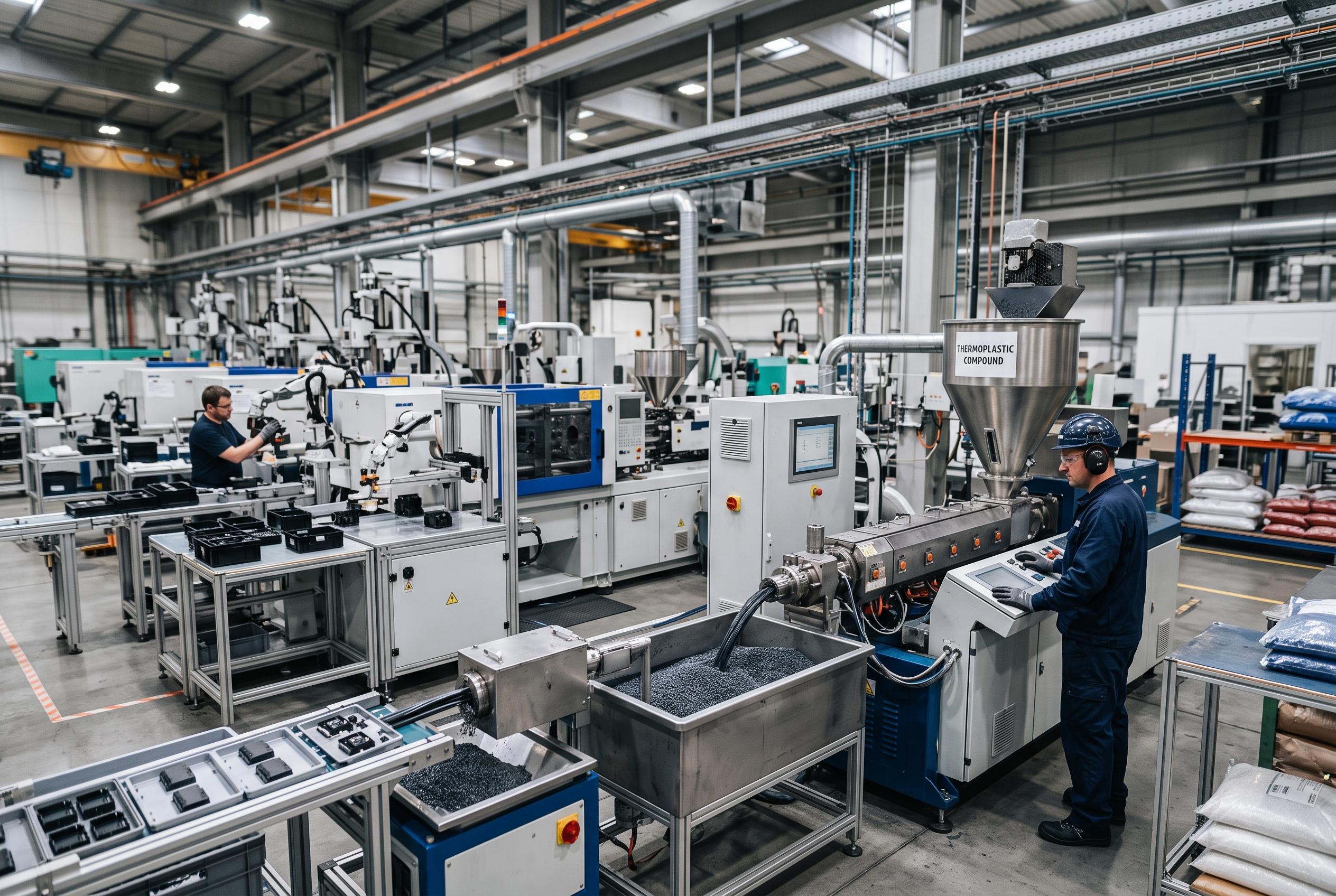
- Market projected to double from $3 billion in 2025 to $6 billion in 2033
- Energy applications expected to grow fastest, driven by batteries and fuel cells
- Asia-Pacific leads market with over half of current revenue and rapid growth
Carbon Nanotube-Reinforced Polymers Are Moving Into a Broader Industrial Growth Phase
Carbon nanotube-reinforced polymers are transitioning beyond their traditional roles as specialty materials and are now contributing to a wider industrial growth story. According to Grand View Research, the market hit around $3 billion in 2025 and is expected to grow to approximately $6 billion by 2033. That projection implies a steady annual growth rate of about 9 percent from 2026 through 2033.
This expansion largely reflects a rising interest in materials that can be lightweight yet electrically conductive, durable, thermally efficient, and versatile in design. These features are becoming increasingly important across sectors like electronics, energy, automotive, aerospace, and industrial manufacturing. As companies search for more efficient materials suitable for connected devices, electric vehicles, energy storage systems, and high-tech components, carbon nanotube-reinforced polymers are gaining recognition as a way to boost polymer performance without adding significant weight.
Additionally, this growth ties into broader manufacturing trends. For instance, electronics manufacturers are on the lookout for materials that can help with electromagnetic interference shielding and control static discharge. Similarly, automotive and aerospace industries keep pushing to reduce weight everywhere they can. Energy companies are also pushing for better thermal management and conductivity in batteries, supercapacitors, and fuel cells. All these demands open new opportunities for suppliers involved in materials research, sourcing, processing, and large-scale production.
Electronics Is Still the Largest Near-Term Application
Right now, the electronics sector is the primary driver for the demand of carbon nanotube-reinforced polymers. Grand View Research reported that this segment made up about 39.3 percent of total market revenue in 2025. That makes sense because the material can provide critical functions while still maintaining many benefits related to processing ease and light weight that plastics are known for.
In the electronics field, carbon nanotubes can help polymers offer electromagnetic interference shielding, electrostatic discharge protection, heat management, and electrical conductivity. These functionalities are relevant for a wide array of components and systems, anything where unwanted electrical noise, static buildup, or heat could compromise reliability.
Furthermore, using conductive polymers supports innovative design flexibility. For example, manufacturers might embed these functional properties directly into molded or processed polymer parts instead of relying solely on separate shielding or conductive parts. Now, while the market data doesn’t specify exactly how quickly specific products are adopting nanotube technology, it’s clear that electronics is already a leading application.
This demand influences sourcing and supply chain plans too. Buyers typically require consistent material performance, predictable processing, and reliable supply. So, suppliers need to focus not just on nanotube content, but also on dispersion quality, conductivity, purity, and compatibility with existing manufacturing methods. It’s worth noting that a material performing well in lab tests isn’t necessarily ready for industrial use if it can’t be processed uniformly at scale.
These considerations affect the entire electronics supply chain, from polymer compounders to component makers and original equipment manufacturers. Confidence that a material will deliver consistent results is paramount, making qualification and testing just as crucial as its initial technical performance.
Energy Is Set to Be the Fastest-Growing End-Use
While electronics tops the list in current demand, energy applications are predicted to grow the most rapidly, with a compound annual growth rate of about 10.1 percent through 2033, according to Grand View Research.
The growth is linked to increased use in batteries, supercapacitors, and fuel cells. These industries are hunting for materials that can deliver high performance, all while being lighter and better at heat dissipation. Carbon nanotube-reinforced polymers fit into this picture because nanotubes can add both electrical conductivity and thermal properties to polymer systems.
Energy storage devices need to operate reliably under tough conditions, they must manage heat, support electrical functions, and still maintain mechanical integrity, all without making the system too heavy. Although the market data doesn't specify exact battery or fuel cell models, it’s clear that these requirements are making energy the fastest expanding end-use market within this field.
Looking ahead, growing energy-related demand will likely put additional pressure on suppliers to keep up with dependable sourcing and production capacity. As more manufacturers evaluate these materials, they'll want to be sure they can move from development to large-scale production without sacrificing quality or consistency. Techniques like dispersion, functionalization, and interfacial engineering will play critical roles here.
Thermoplastics Continue to Lead by Polymer Type
Thermoplastics accounted for the largest share of the market in 2025, representing about 34.6 percent of revenue. Their dominance is largely due to their practicality, easy processing, recyclability, and compatibility with manufacturing in the automotive and electronics sectors.
Processing thermoplastics with existing industrial equipment simplifies scaling up production, which makes their adoption more straightforward. Their relevance in automotive and electronics aligns well with major demand centers for carbon nanotube-reinforced polymers, especially considering that integrating these materials into current manufacturing lines reduces the need for major process overhauls.
Recyclability further boosts thermoplastics’ appeal. Although specific recycling rates aren’t provided, this trait is increasingly important as manufacturers look holistically at a product’s life cycle, from manufacturing to end-of-life management.
Meanwhile, thermosets are also expected to see rapid growth. Aerospace and industrial sectors are seeking high strength, stability, and heat resistance, properties where thermosets shine. Each polymer type serves different needs: thermoplastics excel in processing flexibility and recyclability, while thermosets are favored where strength and dimensional stability are critical.
Dispersion and Functionalization Continue to Be Major Challenges
Across thermoplastic and thermoset systems, improvements in nanotube functionalization, dispersion techniques, and interfacial engineering are crucial for overcoming a key challenge, scaling uniform, affordable production.
Effectively distributing nanotubes within the polymer matrix is essential for getting consistent electrical, thermal, and mechanical properties. Poor dispersion complicates achieving reliable conductivity, heat transfer, or material behavior, all vital for industrial applications. This is especially true for buyers, who need materials that perform reliably across production batches.
Functionalization helps to improve the compatibility of nanotubes with various polymers. It’s about tailoring the nanotubes’ surface to better bond with the surrounding matrix. Interfacial engineering focuses on optimizing the interface between nanotubes and the polymer, which can influence processing and final performance.
While advances in science are promising, they don’t automatically solve commercial hurdles. Achieving uniform mass production remains costly and technically demanding. The future success of this market depends on not only demand but also suppliers’ ability to improve manufacturing efficiency, quality control, and supply stability.
For organizations sourcing these materials, it’s essential to look beyond basic performance specs. For example, batch consistency, process compatibility, technical support, and the supplier’s capacity to scale will influence whether a promising material makes it into regular production or stays in development.
Asia-Pacific Continues to Lead the Market
The Asia-Pacific region dominated the carbon nanotube-reinforced polymer market in 2025, accounting for about 56.1 percent of revenue. It is also forecasted to grow at an impressive rate, around 9.4 percent annually through 2033.
China is the largest single country contributor. India, Japan, and South Korea are also strengthening their positions through activities in electronics, electric vehicles, advanced manufacturing, and energy storage. These markets offer a solid industrial base for turning radical research into real-world applications.
The regional leadership isn’t just about demand, Asia-Pacific’s manufacturing infrastructure gives it an advantage for moving innovations from the lab into commercial production. Its involvement in electronics, automotive, and energy sectors creates multiple pathways for adoption.
Though North America and Europe remain relevant markets, especially for aerospace, automotive, and R&D, Asia’s manufacturing capacity might tip the scales in future sourcing and supply chain decisions. The data doesn’t specify exact trade flows or procurement patterns but shows clearly that Asia-Pacific continues to be central to the market’s growth trajectory.
The Competitive Landscape Focuses on Performance and Reliability
Market competition remains fragmented, but several major players are influencing product development and supply capacity. Notable companies include LG Chem, Cabot, Resonac, Nanocyl, Arkema, OCSiAl, and Toray.
These companies are concentrating on key attributes like purity, conductivity, thermal transport, and processability, factors that determine whether materials meet the stringent qualification standards in automotive, electronics, and aerospace sectors.
For example, Toray’s recent work (as of January 2026) on bonding carbon-fiber-reinforced plastic components highlights how closely related composite technologies are advancing. While not directly about nanotube-reinforced polymers, it illustrates the interconnected nature of composite material development and emphasizes the close relationship between nanotube research and the broader field of high-performance composites.
Similarly, OCSiAl’s expansion into Europe in 2024 underscores the importance of securing a reliable nanotube supply chain as adoption accelerates. As demand grows, the ability to produce large quantities consistently and reliably will be just as important as the raw material’s performance itself.
This fragmented competition offers opportunities for suppliers to stand out through quality assurance, application-specific support, technical expertise, and dependable supply. Buyers, on the other hand, will evaluate multiple sources, factoring in not just price but also the supplier’s capacity to meet long-term requirements.
Market Outlook and Final Thoughts
The carbon nanotube-reinforced polymer sector is entering a phase where technical excellence and industrial scalability are equally vital. The anticipated rise, doubling from $3 billion in 2025 to around $6 billion by 2033, reflects growing demands across electronics, energy, automotive, aerospace, and industrial domains.
Electronics is expected to retain its position as the leading application for the near term, with energy applications poised for the fastest growth. Thermoplastics continue to dominate market share by polymer type, but thermosets are also gaining ground especially where high strength and thermal stability are crucial. Asia-Pacific remains the primary regional driver, both in size and growth rate.
A central challenge remains: achieving consistent, cost-effective production at scale. Suppliers who can improve dispersion, functionalization, interfacial engineering, and overall manufacturing processes will be better positioned to support widespread industrial adoption. For manufacturers, the decision to incorporate these advanced materials hinges not just on their capabilities but also on their ability to source reliably and integrate seamlessly into existing production systems.
Disclaimer: This article may have been created with AI assistance and reviewed by our editorial team. It is provided for general informational purposes only. Readers should verify information independently before relying on this content.
