
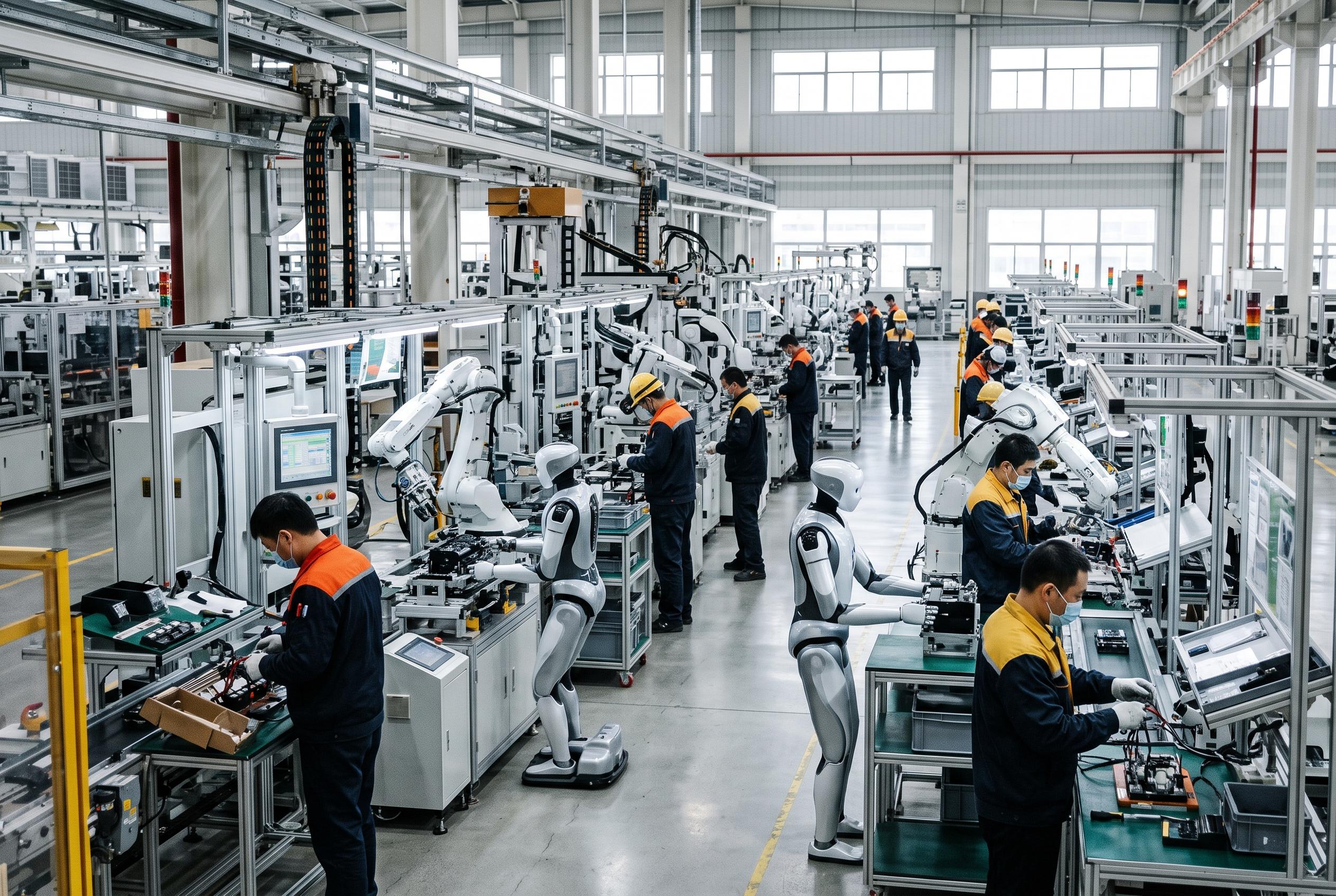
Manufacturers are turning Shanghai's China International Industry Fair into a showcase for practical AI, where wheeled humanoid robots, industrial agents, and connected production systems are moving beyond polished demonstrations. The shift matters because factories are using these tools to cut cycle times, respond faster, and capture expertise that once lived mainly in workers' heads.
Humanoid robots leave the demo floor
The most eye-catching moment at CIIF 2026 was also one of the most practical. A wheeled humanoid robot navigated crowded storage bins, worked out where to grip objects, and placed them without direct human control. It looked less like a science-fiction performance and more like a busy shift compressed into a booth.
According to Xinhua, the system had already been tested at a headlight factory operated by a major auto-parts manufacturer. After adjustments on site, the time needed for each bin-handling cycle dropped from 105 seconds to 28 seconds. That kind of improvement is easier for manufacturers to understand than a flashy stage demonstration because it connects directly to throughput, staffing, and production costs.
The same project also shortened the time needed to prepare the robot for new situations. Deployment fell from a year to 57 days, suggesting that the real advantage may lie not only in the machine itself but in how quickly it can learn a new job.
Industrial AI is starting to make decisions
Physical robots are only part of the story. At the fair, Black Lake Technologies presented more than 10 industrial AI agents designed to handle tasks including quotations, engineering, scheduling, and order tracking.
The important detail is that these systems can share information around a single order. If materials, delivery dates, or production conditions change, later plans can respond instead of waiting for each department to catch up manually. City News Service's coverage of CIIF highlighted the growing role of AI and localized industrial technology across the exhibition.
That sounds quietly revolutionary rather than dramatic. In many factories, delays aren't caused by one machine moving too slowly. They're caused by disconnected decisions, spreadsheets, and handoffs. Connected AI agents target that friction directly.
Shanghai has become a proving ground
Shanghai's industrial base gives these technologies plenty of room to be tested. The city has two national pilot smart factories and 28 national excellence-level smart factories, the highest total among Chinese cities, according to Xinhua.
Its smart manufacturing systems integration industry is valued at more than 60 billion yuan, while smart manufacturing equipment output exceeds 150 billion yuan. The city has also released an action plan built around four major projects and 19 tasks aimed at expanding next-generation smart manufacturing.
The scale helps explain why global companies continue to use Shanghai as a launchpad for industrial technology. Siemens unveiled more than 20 products at the event, including 13 developed in China, and the company's China leadership described the country as a crucial market for future industrial AI. Siemens' wider technology programming also reflects the push to connect automation, software, and industrial data rather than treat them as separate purchases.
Why factory owners care about speed and consistency
For manufacturers, the appeal of AI is becoming increasingly measurable. A robot that can handle parts more quickly may raise output, while an AI agent that keeps schedules aligned can reduce costly interruptions. Just as importantly, systems can store production knowledge and make it easier to repeat successful processes across sites.
The China International Industry Fair was promoted as a global showcase for smart manufacturing, with more than 3,200 exhibitors from 24 countries and regions. PR Newswire's preview described the event as a platform for industrial automation, robotics, digitalisation, and related technologies, while coverage from City News Service pointed to AI and integrated-circuit innovation as major themes.
That broader mix matters. The next generation of factory improvements won't come from robots alone. It will depend on sensors, chips, industrial software, reliable connectivity, and workers who can supervise and refine these systems. The most useful factory may not be the one with the most robots, but the one where every part of the operation can communicate clearly.
China's AI factory push is gathering momentum
The fair sits within a much larger national programme. By the first half of 2026, China had built more than 56,000 basic-level smart factories, over 9,000 advanced-level facilities, more than 500 excellence-level sites, and 15 leading-level smart factories, according to figures from the Ministry of Industry and Information Technology cited by Xinhua.
More than 30 percent of manufacturing companies above the designated size had adopted AI technologies during the same period. Industry research cited in the report also estimated that China had more than 140 humanoid robot developers in 2025, alongside more than 6,000 AI companies.
The momentum comes with plenty of competition and practical challenges. Hardware supply, advanced chips, safety standards, and the cost of adapting systems to messy real-world environments will all shape what happens next. Reporting from Tom's Hardware has underscored the pressure around domestic AI-chip production, while wider analysis in Le Monde has placed China's progress in AI alongside its strength in industries such as batteries, transport, and medicine.
Still, the direction is clear. China's industrial AI market is shifting from isolated experiments toward repeatable tools that can work across factories, orders, and production lines. For workers and consumers, that could eventually mean more consistent products, faster manufacturing changes, and a factory floor that feels less like a fixed machine and more like a responsive system.
The real test now is whether these impressive pilots can become affordable, dependable everyday infrastructure.
It's a small step for a robot, but a major one for the modern factory.
Disclaimer: This article may have been created with AI assistance and reviewed by our editorial team. It is provided for general informational purposes only. Readers should verify information independently before relying on this content.
