
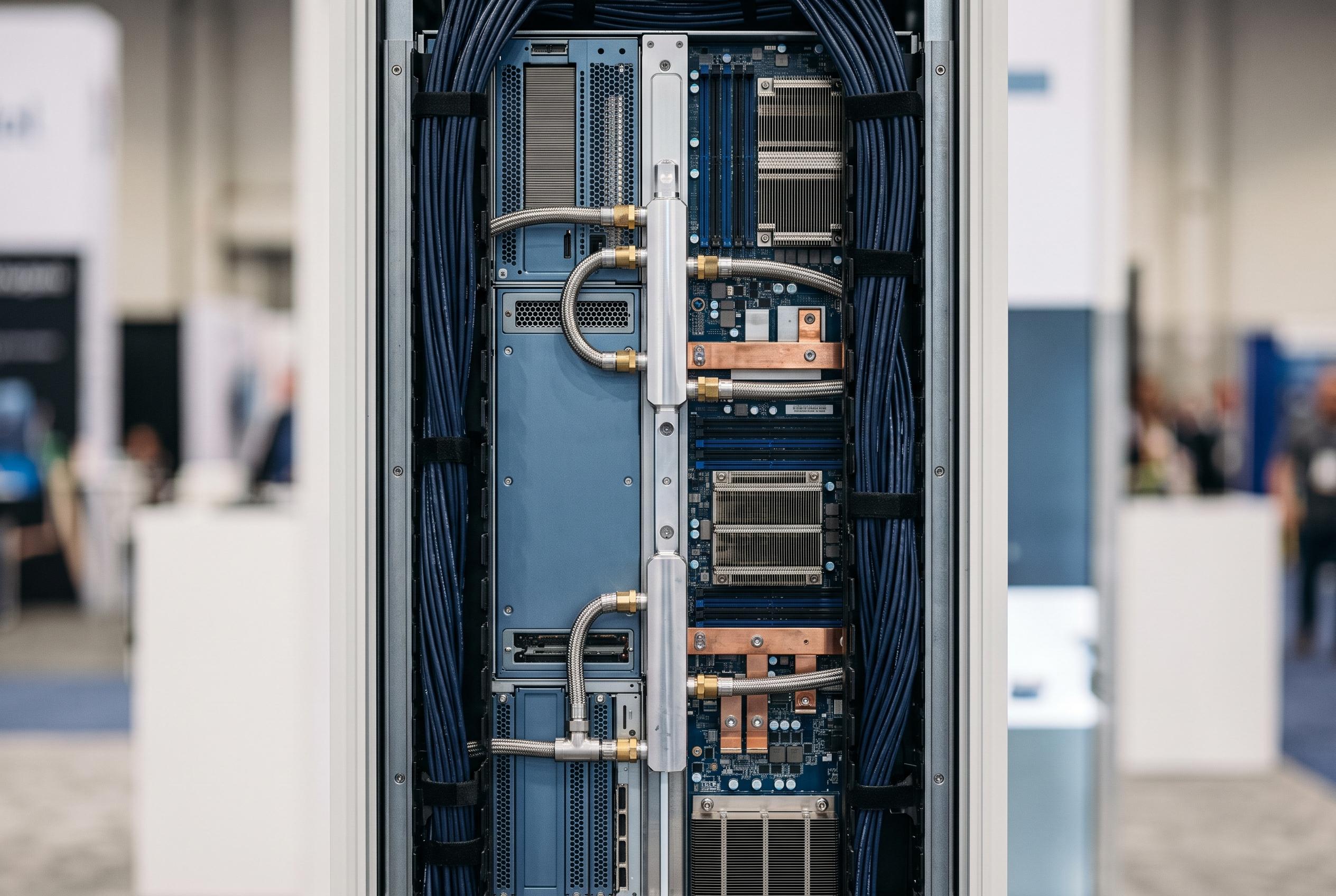
AI server demand is pushing Foxconn deeper into high-density computing, with new NVIDIA Vera Rubin systems, liquid cooling, and rack-level hardware taking centre stage at the 2026 OCP Global Summit. The move matters for businesses watching the next wave of agentic AI, faster inference, and the infrastructure needed to run it reliably.
Foxconn is betting big on high-density AI servers
The headline attraction is NVIDIA's Vera Rubin NVL72 platform, a system designed for the heavier workloads now emerging across generative and agentic AI. Foxconn's Hon Hai Technology Group is presenting the platform through its Hong Bai subsidiary, combining coordinated system design with automated manufacturing. According to Liberty Times Net, the approach is intended to support faster volume production without sacrificing consistency.
That manufacturing angle is important. AI hardware isn't just about placing powerful chips inside a box anymore. As systems grow denser, suppliers must coordinate networking, power delivery, cooling, software compatibility, and factory processes. NVIDIA's Rubin platform is being positioned as a major step in that broader infrastructure shift, according to NVIDIA.
Why liquid cooling is moving from specialist to standard
The quiet revolution in AI data centres is happening beneath the rack lid. More chips mean more heat, and air cooling becomes harder to manage as power consumption climbs. Foxconn is therefore expanding its NVIDIA MGX support beyond conventional server enclosures into rack systems, power supplies, and liquid-cooling equipment.
One of the more striking demonstrations is a Vera CPU rack built around a high-density liquid-cooling design. The configuration can hold up to 256 Vera CPUs and support as many as 22,500 sandbox environments, with workloads including agentic AI, reinforcement learning, and data processing. Foxconn says the design can deliver up to twice the performance for targeted tasks.
For data-centre operators, this isn't merely an engineering detail. Cooling affects energy bills, rack layout, reliability, and the amount of computing that can fit into a given facility. NVIDIA has also described Rubin as part of a full-scale AI infrastructure platform rather than a standalone processor family, reinforcing the idea that thermal management is now central to performance.
Agentic AI needs speed, not just raw power
Traditional AI discussions often focus on training enormous models. The next challenge is making those models respond quickly and repeatedly as they plan, call tools, check results, and complete tasks. That is where Foxconn's Groq 3 LPX rack and compute modules come in, targeting high-bandwidth, low-latency inference for agentic AI applications.
The distinction matters because inference behaves differently from training. Training rewards massive throughput over long runs, while interactive AI services also care about response time and predictable capacity. NVIDIA's announcements around Rubin and its associated systems highlight the same transition toward infrastructure built for increasingly complex, real-time AI workloads.
In practical terms, users may not see a new rack in a server room, but they could feel the difference through faster enterprise assistants, more responsive automation, and smoother multimodal applications. The less glamorous hardware work is what makes those experiences feel instantaneous.
Rubin systems cover training, inference, and enterprise workloads
Foxconn is also displaying an HGX Rubin NVL8 platform aimed at foundation-model training and high-performance inference. Alongside it, a 4U MGX system combines eight NVIDIA RTX PRO 6000 Blackwell Server Edition GPUs with two Intel Xeon 6 processors, targeting enterprise inference, multimodal AI, and visual-computing workloads.
That mix reflects a market moving away from one-size-fits-all infrastructure. A research lab training a foundation model has different needs from a company running document analysis or computer-vision services. NVIDIA's Rubin announcements similarly describe a family of configurations intended to serve multiple stages of the AI pipeline, from model development to deployment.
For buyers, the useful question is less "Which chip is fastest?" and more "Which system matches the workload?" Rack density, memory, networking, cooling, software support, and upgrade paths can matter just as much as headline accelerator performance.
Foxconn's opportunity is expanding beyond assembly
Foxconn's latest push shows how AI server manufacturing is becoming a systems business. The company is supporting NVIDIA's MGX architecture across chassis, compute modules, racks, power delivery, and thermal systems, while also highlighting ultra-dense interconnect technologies such as UDI and ZQD.
That broader role could make Foxconn more valuable as AI customers look for suppliers capable of delivering complete, repeatable infrastructure at scale. NVIDIA has described Rubin as an ecosystem effort involving chips, systems, networking, and manufacturing partners, which gives established hardware builders a larger opportunity than simple component production.
Investors noticed the direction, with Foxconn shares rising in morning trading as the showcase drew attention. Still, the longer-term test will be execution: can these complex systems be produced quickly, reliably, and at a cost that data-centre customers can justify? In AI infrastructure, a spectacular demonstration is only the beginning.
The next AI race will be won in the racks, not just on the chip.
Disclaimer: This article may have been created with AI assistance and reviewed by our editorial team. It is provided for general informational purposes only. Readers should verify information independently before relying on this content.
