
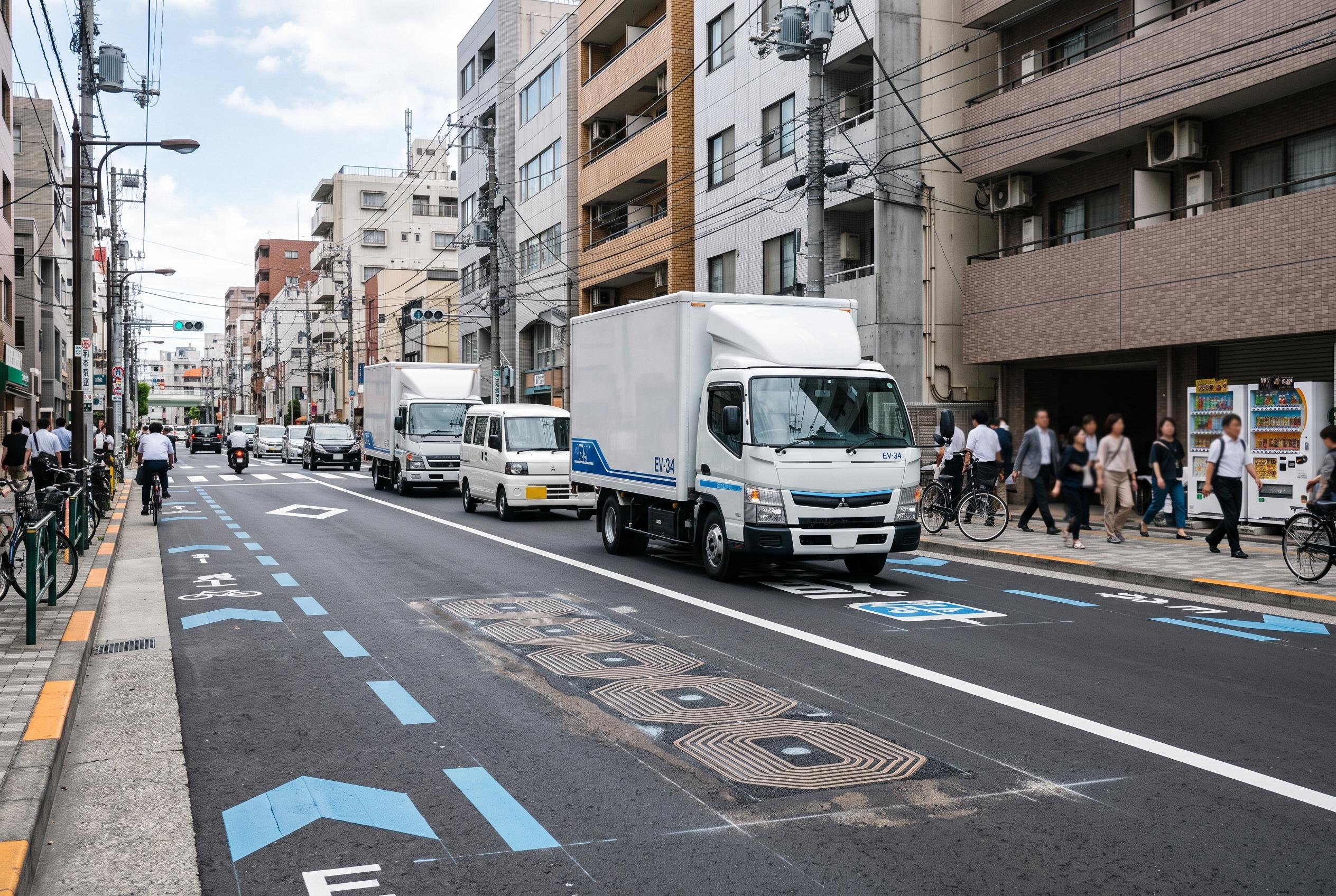
Drivers may one day charge electric vehicles while they travel, thanks to Honda’s wireless EV charging road technology. Developed with Taisei and Taisei Rotec in Japan, the system could first serve freight routes, where keeping heavy vehicles moving matters more than chasing ever-faster charging stops.
Honda wants roads to become charging infrastructure
Imagine joining a motorway with a low battery, then watching the range estimate rise without pulling over. That’s the promise behind Honda’s dynamic wireless power transfer road system, which places charging hardware beneath the surface and a receiving unit on the vehicle’s underbody.
According to TechSpot, Honda has completed development of the core technology with Taisei and Taisei Rotec, but the system hasn’t yet reached everyday road use. A dedicated test lane is expected to provide the next reality check, with engineers measuring power delivery, safety, and durability.
The concept is more sophisticated than burying one enormous charger under the asphalt. Honda describes a ground power supply, a distribution network connecting multiple transmitter units, and a vehicle receiver that passes energy to the battery. It’s a little like turning a stretch of road into a very polite extension cord.
Why trucks may get the first chance
Passenger cars are the obvious audience, but commercial vehicles could benefit more. Long-haul trucks consume huge amounts of energy, and fitting them with sufficiently large batteries adds weight, cost, and charging downtime.
Honda’s proposed system could let electric trucks top up along busy freight corridors rather than relying entirely on enormous battery packs and lengthy charging breaks. Teslant reported that the company is considering power levels of up to 150 kW for heavy commercial vehicles, although that target still needs to be proven on a working road.
That focus makes sense. A wireless charging lane would be expensive and complicated, so putting it where vehicles travel constantly could offer a stronger business case. For a family car that visits a motorway occasionally, the benefit may be modest. For a delivery truck running the same route all day, every minute saved could matter.
The technology has plenty of company
Honda isn’t the first manufacturer or infrastructure group to explore charging while driving. France has tested wireless power beneath a motorway, while projects in Detroit, Italy, and the UK have also investigated roads that can feed energy to moving vehicles.
Carscoops noted that previous demonstrations have used specially equipped cars, buses, vans, and trucks, showing that the idea is no longer confined to futuristic sketches. Some trials have reported impressive bursts of power, but a demonstration isn’t the same as a nationwide network that survives traffic, weather, road repairs, and winter grit.
That distinction is important for shoppers considering an electric vehicle today. Wireless motorway charging could eventually make range anxiety feel quaint, but current EV buyers still need to plan around ordinary plugs, public fast chargers, and the charging equipment their vehicle actually supports.
Honda’s next test will be the real proof
Honda plans to use a purpose-built lane to examine charging performance and strategies for limiting electromagnetic field leakage. Engineers also intend to run long-term loading tests designed to mimic roughly one million wheel passes, using real vehicles rather than laboratory-only equipment.
The company will need to show that transmitter units can survive being buried beneath traffic while continuing to align effectively with vehicle receivers. Cars won’t always travel perfectly over the centre of a lane, and trucks may move differently again, so reliable energy transfer at higher speeds could be one of the hardest engineering challenges.
There’s also the everyday question of efficiency. If too much electricity is lost between the road and the battery, the system could become an expensive novelty instead of useful infrastructure. Honda’s testing should begin to reveal whether the idea feels like a genuine shortcut or merely a clever headline.
The cost question is still parked
The most important details haven’t been settled. Drivers would need compatible receiver hardware, road operators would need to install and maintain underground equipment, and someone would have to create a fair way to measure and bill electricity used on the move.
Those costs may be easier to justify on heavily trafficked freight routes than across every motorway. A targeted network could keep trucks moving and reduce the need for oversized batteries, while a blanket rollout for private cars might struggle to deliver enough value.
Honda is expected to share more at upcoming industry events, but there’s no firm timetable for widespread deployment. For now, wireless EV charging roads remain an intriguing engineering project, with one especially appealing feature: the car keeps going while the battery catches up.
It’s a small glimpse of an EV future where charging could happen beneath your wheels.
Disclaimer: This article may have been created with AI assistance and reviewed by our editorial team. It is provided for general informational purposes only. Readers should verify information independently before relying on this content.
