
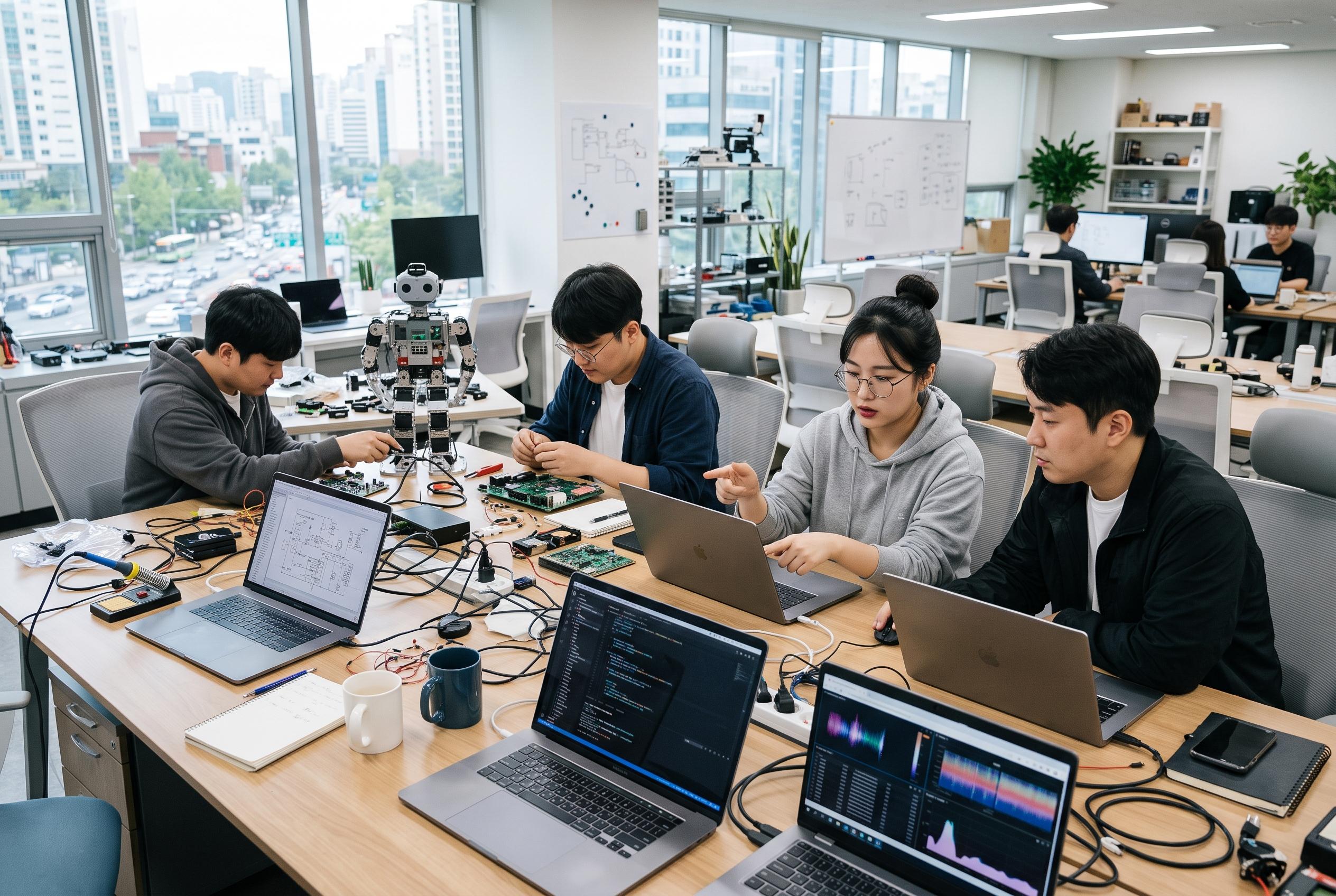
MDS Tech is stepping deeper into physical AI with a roughly 4 billion won contract to supply NVIDIA computing modules, sensors, and related systems for a Korean company’s humanoid home robot project. The deal matters because it turns years of embedded AI expertise into a concrete robotics business, just as home robots move from futuristic demos toward practical development.
A big step from embedded AI to physical AI
The headline number is impressive, but the more revealing detail is what sits behind it. MDS Tech’s contract covers an NVIDIA Jetson Full Package for a humanoid home robot, combining AI computing modules with systems and sensors from global partners.
That makes this more than a component sale. The company is positioning itself as a development partner for robots that need to see, process information, move safely, and respond in real time. According to eToday, the project is the largest single order secured since MDS Tech established its dedicated AI organisation.
The hardware will help power a machine designed to operate in ordinary domestic spaces, where clutter, changing light, pets, furniture, and people make robotics especially challenging. A home robot has to be clever, but it also has to be quietly reliable.
Jetson Orin laid the groundwork for Jetson Thor
MDS Tech supported the project from its early development phase using an AI computing platform based on NVIDIA Jetson Orin. As the programme advanced, the development environment moved toward NVIDIA’s newer Jetson Thor platform, and MDS Tech continued its technical involvement.
That continuity is important. Robotics teams rarely jump straight from an idea to a polished product. They need help selecting hardware, adapting software, validating performance, and tuning systems as the design changes. MDS Tech’s role appears to span that long, sometimes messy middle ground.
The company says its experience with NVIDIA embedded AI edge platforms stretches beyond 13 years. In practical terms, that history can reduce the friction between a robot prototype and a production-ready system, where heat, power consumption, data flow, and reliability all matter.
Why the home robot market needs full-stack support
Humanoid home robots are attracting attention because they promise to handle tasks in spaces already designed for people. But the form factor is only half the story. The robot must interpret its surroundings, connect its sensors, and make fast decisions without relying entirely on remote computing.
That’s why MDS Tech is combining AI computing with vision, sensing, and data-connection technologies. The company has expanded its robotics capabilities through work with SZ Sensing, an NVIDIA partner focused on robotics and vision, and through a collaboration with Unicon on high-speed, non-contact data connections.
Industry coverage from Fnnews and Newspim has highlighted the wider push into physical AI, where software intelligence meets machines operating in the real world. The comparison with traditional AI is useful: a chatbot can recover from a misunderstanding with another sentence, while a robot may knock over a glass.
Training and partnerships are part of the strategy
MDS Tech’s physical AI ambitions also extend beyond commercial contracts. The company began working with Seoul National University on talent development in physical AI and robotics, supporting equipment and student projects through the university’s creative engineering design course.
That kind of investment can look less exciting than a large contract, but it may prove just as valuable over time. Robotics depends on engineers who understand both algorithms and hardware, especially when a system must work outside a controlled laboratory.
The company’s partner network is expanding in parallel. By combining NVIDIA computing, sensors, machine vision, and high-speed connectivity, MDS Tech is building a broader package for customers that need help from early design through testing and manufacturing.
What the deal could mean for MDS Tech
The contract gives MDS Tech a useful proof point as it develops physical AI into a growth business. It also suggests that demand is shifting toward suppliers able to connect several technical layers rather than deliver a single board or sensor in isolation.
For customers, that integrated approach could simplify development. Instead of coordinating separate vendors for computing, sensing, connectivity, and optimisation, a robotics team may be able to work with one partner across more of the project. That can save time, particularly when every design change affects the whole machine.
MDS Tech says it plans to keep expanding support from development and technical verification to system optimisation and mass production. The next test will be whether this first major project leads to repeat orders, broader customer adoption, and robots that feel genuinely useful rather than merely impressive in a demonstration.
The deal is a small but meaningful sign that home robots are moving closer to the workshop floor, and eventually, the living room.
Disclaimer: This article may have been created with AI assistance and reviewed by our editorial team. It is provided for general informational purposes only. Readers should verify information independently before relying on this content.
