
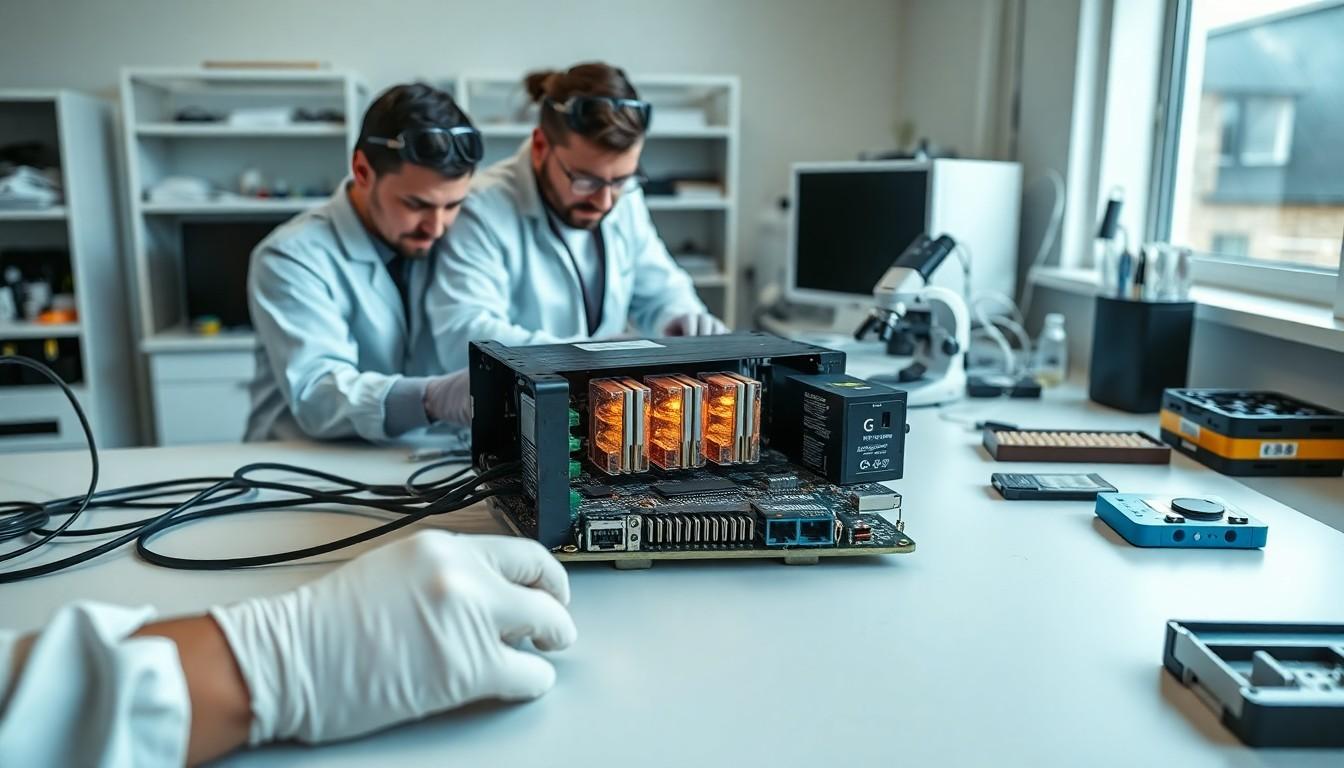
Researchers are rethinking how high-power electronics shed heat, combining advanced materials, microchannels, boiling surfaces, and liquid cooling to keep increasingly compact devices running safely. The push matters for AI hardware, data centers, electric systems, and defense electronics, where a hot chip can quietly become a performance, reliability, and energy problem.
Essential Takeaways
- - Smaller devices create bigger heat problems. Denser electronics pack more power into tiny areas, making hotspots harder to manage.
- - Materials still matter. Boron arsenide, diamond, graphite, copper, and gallium nitride can help move heat away from active components.
- - Microfluidics brings cooling closer. Embedded channels and manifold designs target heat at the chip rather than relying only on distant heat sinks.
- - Boiling can remove intense heat. Carefully engineered surfaces improve liquid replenishment and bubble control, though systems become more complex.
- - Reliability is the real test. A cooling method must survive pressure, temperature cycling, fluid compatibility, maintenance, and manufacturing demands.
Why smaller chips need smarter cooling
The electronics industry has spent decades shrinking transistors and squeezing more capability into less space. That progress is impressive, but it creates an awkward side effect: heat is becoming concentrated in smaller regions, where conventional cooling has less room to work.
Research discussed by Nature Electronics shows why this is a serious engineering challenge. High temperatures can reduce efficiency, accelerate material damage, and shorten device life. In gallium nitride power transistors, for example, operating-channel temperature is closely tied to long-term reliability, particularly under demanding radio-frequency conditions.
The problem is easy to picture. A modern chip may look sleek and almost weightless, yet its most active areas can behave like tiny thermal furnaces. According to work published in Nature Electronics, the answer increasingly lies in designing the device, package, and cooling system together rather than treating cooling as an afterthought.
Advanced materials are becoming part of the cooling system
Some of the most promising approaches begin with the material sitting directly beneath the electronics. Boron arsenide has attracted attention because of its unusually high thermal conductivity, while diamond and engineered copper structures can provide highly effective routes for spreading heat.
That doesn't mean one miracle material will replace every heat sink. Manufacturing cost, wafer compatibility, mechanical stress, and the quality of the interface between layers all matter. A material may conduct heat brilliantly in isolation but perform less impressively once bonded to a device through a resistive interface.
Researchers have also explored boron arsenide cooling substrates integrated with gallium nitride devices. The appeal is straightforward: move heat away from the active layer quickly, before it creates a damaging hotspot. Still, as reviews of thermal management point out, the junction between materials can be just as important as the materials themselves.
Microchannels put liquid where the heat is
Air cooling remains convenient, but it struggles as power density climbs. Liquid can carry away far more heat, and microfluidic systems bring that liquid into narrow channels positioned close to the source.
Manifold microchannels, jet-enhanced channels, and embedded cooling structures are among the designs being studied. Some use jets to direct coolant at the hottest regions, while others divide flow through carefully shaped networks. Recent work has reported cooling approaches aimed at heat fluxes far beyond what ordinary air-cooled electronics can comfortably handle.
This is especially relevant to AI accelerators and data-center hardware. The performance race has made chips more powerful, but it has also made racks heavier on electricity, plumbing, and maintenance. A compact cooling system that controls hotspots without adding excessive pumping power could be more valuable than a spectacular laboratory maximum.
Boiling surfaces offer enormous potential
Two-phase cooling takes the idea further. Instead of merely warming a liquid, the system allows it to boil, using the phase change to absorb substantial heat. The bubbles may look chaotic, but engineered surfaces can make that process more predictable and efficient.
Researchers are testing porous copper, graphite foam, laser-textured diamond, hierarchical microstructures, and even biomimetic designs. These surfaces can help liquid reach hot spots, encourage controlled bubble departure, and delay the point at which boiling becomes unstable.
For anyone wondering how to choose the best cooling method for high-heat-flux electronics, the practical answer depends on the workload. Steady heating, pulsing hotspots, available coolant, pressure limits, and acceptable maintenance all change the calculation. A solution that works beautifully for a laboratory chip may be awkward inside a serviceable commercial system.
The toughest challenge may be packaging
Cooling hardware doesn't operate alone. It must fit around electrical connections, protect delicate components, tolerate vibration, and remain reliable through thousands of heating and cooling cycles.
That packaging challenge helps explain the interest in co-designed electronics and microfluidics. Rather than attaching a cooler after the chip has been built, engineers can plan channels, surfaces, substrates, and electrical pathways as one architecture. The approach could reduce thermal resistance and avoid some of the bottlenecks created by conventional packaging.
But practical systems still need affordable manufacturing and straightforward servicing. Fluids must be compatible with seals and materials, pumps consume energy, and leaks are unacceptable around expensive electronics. Industry reviews on data-center liquid cooling describe the technology as increasingly necessary, but they also highlight infrastructure, cost, and operational hurdles.
Cooling innovation is moving from laboratory to system design
The direction of travel is clear: future electronics will need cooling that is closer, faster, and more precisely targeted. That may mean a high-conductivity substrate under a power device, a microchannel inside the package, or a two-phase surface engineered to manage bubbles almost as carefully as it manages heat.
The most useful breakthroughs won't necessarily be the ones with the flashiest peak number. They’ll be the designs that balance thermal performance with energy use, reliability, manufacturing, and repair. In the end, the quiet plumbing beneath a chip may prove just as important as the transistors doing the visible work.
Better cooling won't make heat disappear, but it could give the next generation of electronics more room to perform.
Source Reference Map
Story idea inspired by: [1]
Sources by paragraph: - Paragraph 1: [2], [4] - Paragraph 2: [3], [5] - Paragraph 3: [6], [7] - Paragraph 4: [2], [4] - Paragraph 5: [6], [7] - Paragraph 6: [2], [4] - Paragraph 7: [5], [6] - Paragraph 8: [2], [4] - Paragraph 9: [5], [7] - Paragraph 10: [2], [6] - Paragraph 11: [4], [5] - Paragraph 12: [2], [4] - Paragraph 13: [5], [6] - Paragraph 14: [2], [4]
