
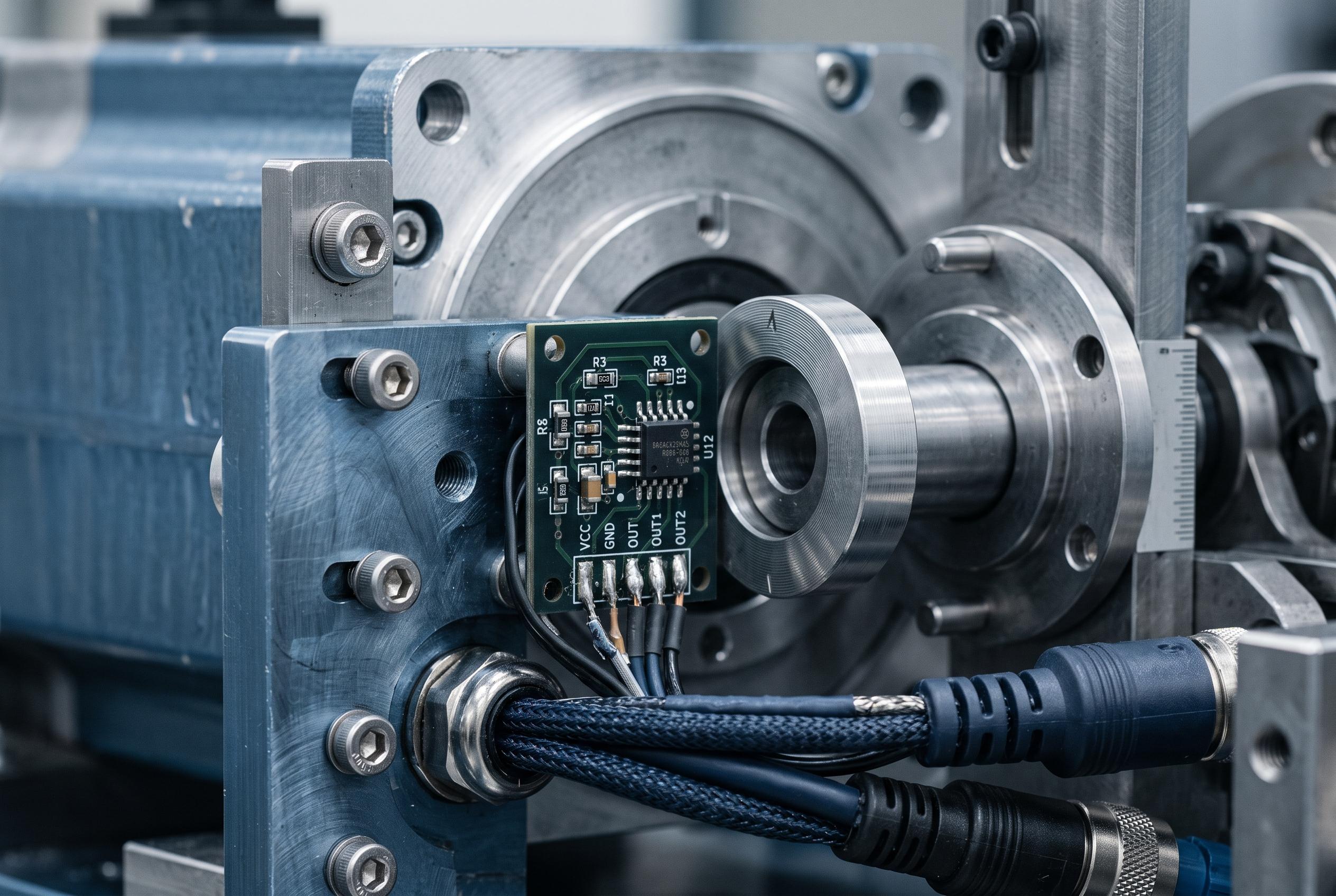
Manufacturers are preparing for a decade of stronger demand for silicon Hall effect sensors, as electric vehicles, factory automation, renewable power and tougher safety requirements push magnetic sensing into more systems worldwide.
Electrification gives magnetic sensing a powerful lift
The strongest force behind the silicon Hall effect sensors market is the steady electrification of transport and industry. These compact chips measure magnetic fields without direct electrical contact, making them useful wherever engineers need isolated current, position or speed feedback.
In an electric vehicle, that can mean monitoring current in a traction inverter, checking battery behaviour or tracking the position of motors and actuators. The sensor itself may be tiny, but its role is reassuringly serious: accurate measurements can support efficiency, thermal management and safety.
IndexBox projects a 7.2% annual growth rate for the market between 2026 and 2035, with the market index reaching approximately 198 by 2035, compared with a 2025 baseline. Broader industry forecasts also point to expanding demand for Hall effect current sensors as electrification spreads across vehicles, charging equipment and power infrastructure, according to SNS Insider.
Cars remain the biggest opportunity
Automotive applications are estimated to represent about 45% of demand, making them the clear centre of gravity. EV production is the headline driver, but the opportunity extends beyond the battery pack. Electric power steering, braking systems, onboard chargers, transmissions and advanced driver-assistance systems all require accurate sensing.
The shift is also changing what buyers expect from suppliers. A low-cost component may work for a simple application, but safety-critical vehicle systems demand stronger reliability, wider temperature performance and diagnostics. Functional safety requirements, including those associated with ISO 26262, are encouraging more sophisticated sensor designs.
For manufacturers, automotive business isn't a quick sale. Qualification can take years, followed by long production runs and close engineering support. That makes early design wins especially valuable, while it also explains why established suppliers with automotive-grade manufacturing and application teams have an advantage.
Factories and renewable power broaden the market
Industrial automation is expected to account for roughly a quarter of demand. Robots, CNC equipment, conveyors, servo motors and variable-frequency drives all depend on feedback that tells a control system what a motor is doing. As factories become more connected, sensors are being asked to provide not just a reading but useful information for monitoring and predictive maintenance.
The energy and power segment is smaller, at an estimated 10%, but its direction is promising. Solar inverters, wind converters, battery storage systems, smart meters and EV chargers need isolated current measurement to manage power conversion and protect equipment.
This is where silicon Hall effect sensors have an appealing practical quality. They can measure current without sitting directly in the high-power path, which helps engineers manage isolation and system design. The hardware may be quiet and unobtrusive, but it plays a central role in keeping large electrical systems stable.
Consumer electronics bring volume, but tighter pricing
Consumer electronics contribute an estimated 15% of demand, with applications ranging from magnetic switches and cover detection to camera stabilisation, wearables and gaming devices. Foldable hardware and thinner product designs may create additional uses for compact position sensors.
The catch is familiar: consumer products are produced in enormous volumes, but buyers are highly price-sensitive. That puts pressure on suppliers to deliver smaller, lower-power devices without adding unnecessary cost. Integration, such as combining magnetic sensing with switching or signal-conditioning functions, can help manufacturers offer more value in a very competitive market.
By comparison, medical equipment, aerospace, defence and building automation are smaller niches. They often require specialised performance and documentation, though, so they can offer healthier margins than high-volume consumer applications.
Asia-Pacific keeps its manufacturing edge
Asia-Pacific is estimated to account for about half of global demand and remains the key manufacturing hub. China's electric vehicle and industrial sectors are major contributors, while Japan, South Korea and Taiwan add strength through electronics production and semiconductor expertise.
North America and Europe are also important, particularly for high-reliability applications. North American demand is supported by EV manufacturing, industrial automation and grid upgrades. Europe adds pressure from emissions rules, vehicle safety standards and renewable-energy investment.
The regional picture isn't simply about where sensors are made. Design and intellectual property remain concentrated in established technology centres, while production follows semiconductor capacity and end-use manufacturing. That split leaves the industry exposed to logistics disruption, export controls and shortages in specialised automotive-grade capacity.
Choosing the right sensor depends on the job
For a high-volume consumer product, buyers may prioritise small size, low power consumption and cost. Industrial equipment typically needs stronger noise performance, reliable switching and compatibility with control networks. Automotive and energy applications raise the bar further, with isolation, temperature tolerance, diagnostics and formal qualification becoming central requirements.
Procurement teams should also look beyond the headline sensor specification. Magnetic testing and calibration can affect consistency, while package design matters in tight spaces or hot environments. A supplier's engineering support may be just as important as its catalogue, particularly when a product must be designed in and validated over several years.
Competition from magnetoresistive and inductive technologies won't disappear. Still, the growing number of electric motors, power converters and automated machines gives silicon Hall effect sensors a broad runway. For the companies that can combine reliable chips with patient design support, this looks less like a short-lived boom and more like a durable shift in how modern equipment measures motion and power.
It's a small sensor category with an increasingly large role in electrified technology.
Disclaimer: This article may have been created with AI assistance and reviewed by our editorial team. It is provided for general informational purposes only. Readers should verify information independently before relying on this content.
