
At CIIF 2026 in Shanghai, Siemens will showcase industrial AI, human-shaped robots, digital twins, and more than 20 new products, showing how software, machines, data, and engineering expertise can work together on real factory floors.
Siemens Is Bringing Industrial AI Down to the Factory Floor
The most interesting part of Siemens' CIIF 2026 presence won't be a glossy AI demo. It'll be the quieter, more practical question of whether intelligent systems can move parts, coordinate machines, and keep production running without constant human intervention.
At the event, Siemens plans to show a mobile humanoid robot interacting with a real CNC machine. The robot will move independently, pick up a workpiece, simulate loading and unloading, and return it to the process under central software control. Siemens' wider industrial AI programme has similarly focused on connecting AI with automation, data, and domain expertise, according to the company's global announcements.
That matters because factories rarely produce one identical item forever. Small-batch, high-mix production needs equipment that can adapt quickly, and a robot that can travel between tasks could be more useful than one fixed in place. It's less science-fiction spectacle and more a test of whether the technology can earn its keep.
A Full Humanoid Robotics Pipeline, Not Just a Robot Demo
Siemens says it will show the entire workflow behind industrial humanoid robots. That includes robot design, process simulation, virtual commissioning, component machining, final assembly, and deployment in operational settings.
The company will connect software demonstrations with physical equipment, highlighting digital twins, flexible manufacturing, and intelligent scheduling. These tools are intended to let engineers test a process virtually before hardware is committed, potentially reducing expensive surprises on the production line.
Six embodied-AI scenarios will also be opened for industry discussion. They include flexible machine tending, adaptable packaging, and intelligent depalletising, all of which involve long sequences of actions rather than a single repeated movement. Industry observers have increasingly treated this kind of integration as the real hurdle for factory robotics, a point echoed in Siemens' manufacturing and industrial AI coverage.
Data Centres and Semiconductor Lines Get Their Own Spotlight
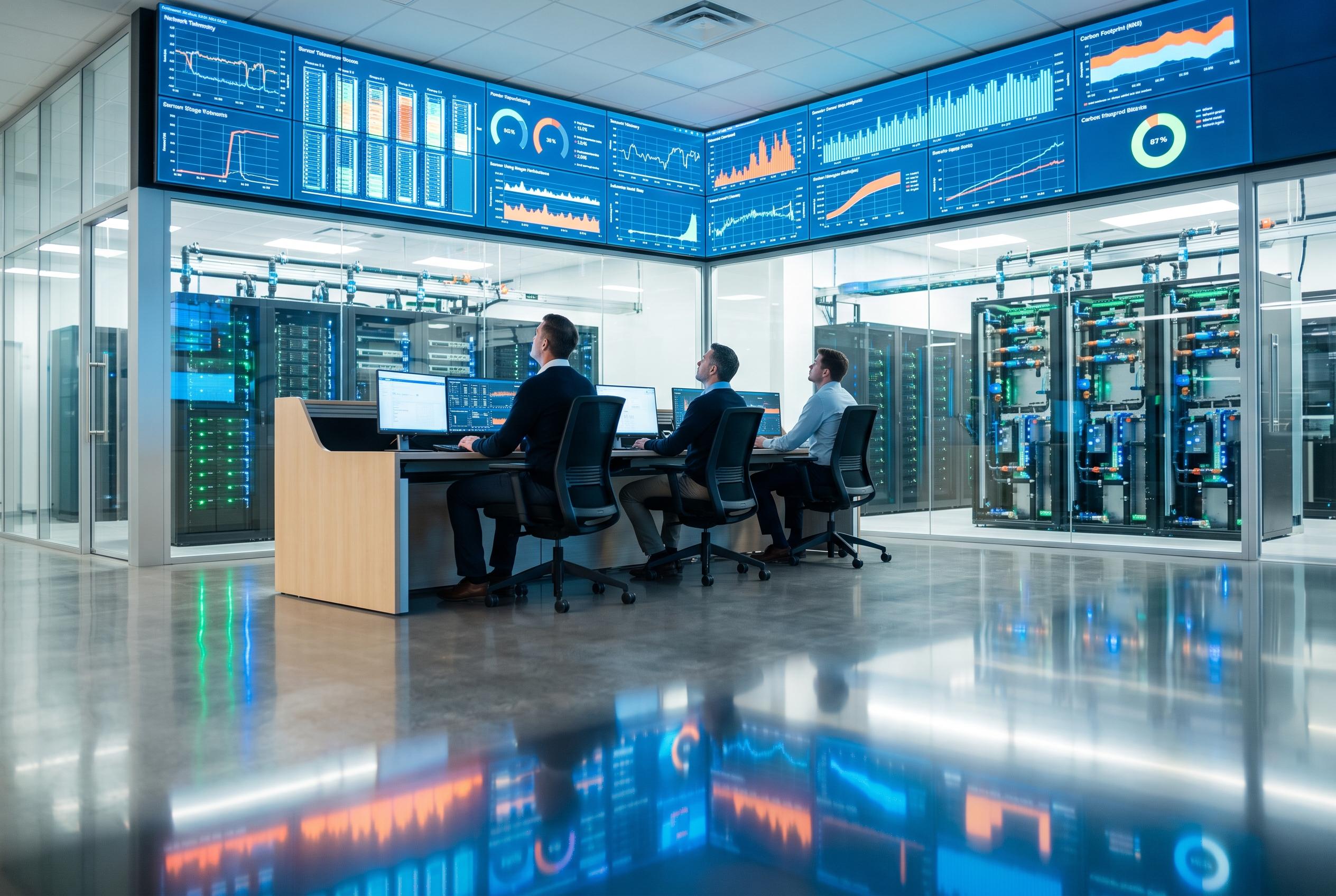
The exhibition will also turn to the infrastructure supporting the AI boom. Siemens plans to present its Data Centre 5.0+ architecture, which is designed to coordinate cooling, power distribution, simulation, carbon management, and operational monitoring across the facility lifecycle.
A particularly relevant feature is the use of real-time analysis to adjust cooling demand and the balance between air and liquid cooling. As computing workloads grow hotter and more power-hungry, that sort of responsive control could help operators protect uptime without simply throwing more energy at the problem. Siemens has made the same connection between AI expansion, industrial infrastructure, and energy efficiency in its wider event programme.
For electronics and semiconductor manufacturing, Siemens will demonstrate AI-assisted programming for optical-module assembly. The company says the approach can help standardise and digitise the process while cutting project delivery time by about 50 percent. That promise will naturally draw attention from manufacturers under pressure to launch products faster, though actual gains will depend on the line, workforce, and existing software setup.
The “Heart of Diamonds 3.0” Aims to Connect the Industrial Stack
Siemens will also unveil an upgraded version of its “Heart of Diamonds 3.0” showcase. The concept is built around the five layers of industrial architecture, from field devices and control systems to operations, management, and cloud services.
The goal is straightforward, even if the machinery underneath isn't: make information move more smoothly between shop-floor equipment and higher-level engineering or business systems. Siemens says the platform will combine automation with software such as Intelligence Center X and Teamcenter, giving manufacturers a more connected path from product design to production and ongoing operations.
That same end-to-end idea appears throughout Siemens' industrial portfolio. Designcenter AI, Simcenter AI, and Teamcenter AI will support virtual testing and simulation, while TIA provides a common engineering environment for automation projects. At the other end of the process, DRIVETRAIN Analyser and DCMA are intended to monitor equipment health, predict faults, and recommend maintenance before a breakdown brings production to a noisy, expensive halt.
What Visitors Should Watch for at CIIF 2026
The most useful demonstrations may be the ones that show several systems working together rather than one clever machine performing a polished trick. Siemens plans to show a flexible manufacturing setup using SIMATIC T-CPU technology and a coordinated magnetic-levitation system, allowing materials to move rapidly while robotic arms handle precise operations.
The company says this approach has already been applied to multi-product pharmaceutical filling. Because the carriers move without contact, the system can reduce particle contamination and equipment wear, which is a practical benefit in clean manufacturing environments. Its value is tactile and immediate: fewer collisions, cleaner handling, and less mechanical friction.
Siemens will exhibit with a group of technology partners working across precision manufacturing, automated machining, intelligent line control, robotics, and equipment integration. It will also host livestreamed sessions from October 12, giving viewers who can't make it to Shanghai a chance to follow discussions around AI-enabled automation.
For factory leaders, the sensible takeaway is to look past the robot itself. Ask how quickly it can be reprogrammed, what data it needs, how it handles exceptions, and whether existing machines can join the workflow. Those details, rather than the novelty factor, will decide whether industrial AI becomes a useful colleague or simply an impressive trade-show guest.
It's a small shift in focus, but it may be the one that makes physical AI genuinely useful.
Disclaimer: This article may have been created with AI assistance and reviewed by our editorial team. It is provided for general informational purposes only. Readers should verify information independently before relying on this content.
