
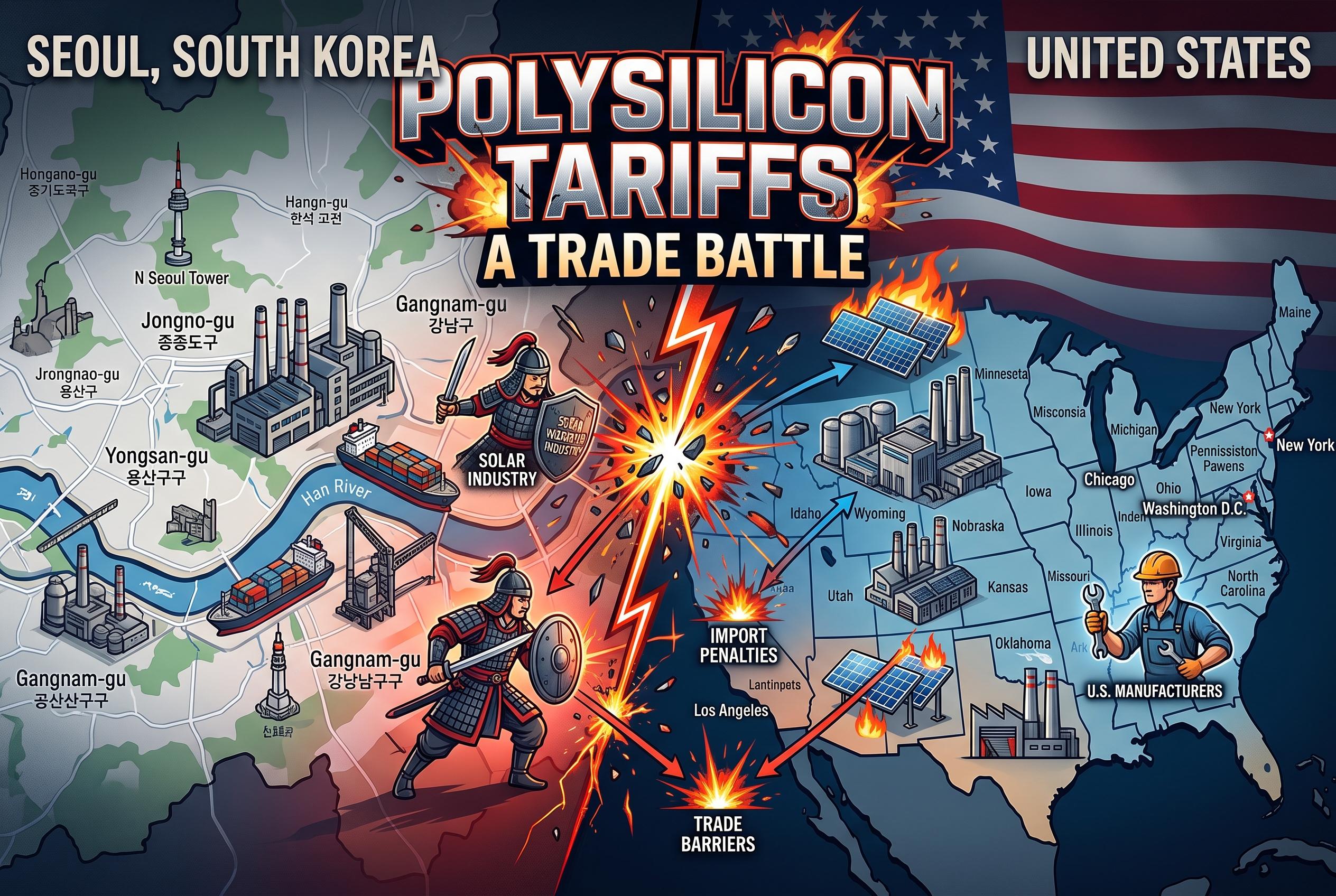
- Seoul assesses the potential fallout from U.S. Section 232 tariffs on polysilicon imports
- Major Korean companies like Samsung and Hanwha are closely monitoring supply chain disruptions
- Authorities plan proactive consultations with Washington to mitigate export damage
Please provide the article text to edit.
Seoul Scrambles to Assess U.S. Polysilicon Tariffs as Samsung, Hanwha, and Solar Supply Chains Come Under Pressure
South Korea is moving to assess the possible fallout from new U.S. tariff measures on imported polysilicon and related products, with officials set to work with industry and push consultations with Washington to limit export damage.
The Ministry of Trade, Industry and Energy said it held a public-private emergency meeting on August 11 in Seoul, chaired by Deputy Minister for Trade Park Jeong-seong, on the U.S. polysilicon Section 232 tariff measures.
The meeting was attended by relevant ministries including the Ministry of Climate, Energy and Environment, as well as key companies such as Samsung Electronics, Hanwha Qcells, OCI, SK Siltron, and HD Hyundai Energy Solutions, along with officials from the Korea Semiconductor Industry Association.
The meeting was arranged to closely examine the impact of the U.S. measures on Korean exports to the U.S. and on supply chains of Korean companies operating and investing in the United States, and to explore response measures to minimize the impact on Korean firms.
Earlier, the White House announced a proclamation on August 6, based on the results of a Section 232 investigation that had been underway since July last year, introducing tariffs and a minimum import price (MIP) system on polysilicon and derivative products. The measures are intended to strengthen supply-chain security for U.S. industries such as semiconductors and solar power by securing commercial viability for domestic production, and are set to take full effect on December 4 this year, U.S. Eastern Time.
Under the measures, minimum import prices will be introduced for each item, at $21 per kilogram for polysilicon, $100 per kilogram for ingots and wafers, $0.22 per watt for solar cells, and $0.38 per watt for modules. In addition, derivative products such as ingots and wafers will face an additional 15% tariff.
However, for countries with trade agreements, including South Korea, Japan, the European Union, Taiwan, and Switzerland, the total tariff rate, combining existing most-favored-nation (MFN) tariffs and Section 232 tariffs, will be 15%.
According to government estimates, South Korea’s polysilicon exports to the U.S. subject to the measure will total about $2.2 million in 2025, while polysilicon derivative exports to the U.S. will reach about $430 million.
At the meeting, participants discussed in depth the details of the U.S. Section 232 measures on polysilicon, along with the business impact on companies operating in the U.S. and their future response plans.
Based on the discussions, the government said it will maintain close communication with industry and activate comprehensive response measures, including consultations with the U.S., so that damage to Korean companies can be minimized.
Park said, “I will closely examine the short- and long-term impact on our industry from this polysilicon Section 232 measure,” adding, “Based on that, we will do our best so the government can provide the necessary support in a timely and targeted manner.”
