Download App
Better Online and Trade Show Sourcing Experiences.Scan the QR code to download.
Learn More
Hot Topics
Building up to be the next big thing.
For the most part, 3D printing remains a niche component of the construction industry. While the technology has been augmented extensively for the benefit of many industries including medicine, manufacturing, electronics and others, its use in construction is yet to be adopted widely because of a number of concerns, chief among which being budget and overall feasibility. In the industry, 3D printing is also referred to as Additive Manufacturing (AM).
Originally developed for product prototyping applications, development over the years has led 3D printing technology to offer many advantages in construction. Parts and components that would otherwise take a long, costly and complex manufacturing process to produce – such as those with geometrically complex shapes – take mere days using a 3D printer. Not only does the technology effectively reduce waste by only using as much raw materials as needed, it also cuts transportation costs as parts can just be printed on-site.
A construction 3D printer builds walls, for example, by depositing concrete through a nozzle layer by layer, eliminating the need for formwork and thus saving time and resources, cutting costs and requiring less manual labor. Projects undertaken by pioneers in modern 3D construction have shown that the technology can build structures from mere groundwork in a matter of days, with the automation of the process effective in reducing human errors that could cause delays.
Yingchuang Building Technique, more popularly known as Winsun, is a Chinese construction company that 3D prints small houses using a combination of concrete and recycled materials in as little as 24 hours. The company is confident that it will be possible to use the technique to build larger houses or even skyscrapers in the future.
Among the many advantages offered by 3D printing, perhaps the most significant is having exceptional freedom to design in free-form. Computer aided design (CAD) enables engineers and architects to have flexible designs actualized for use in projects. 3D concrete printing giant Saint-Gobain Weber Beamix's marketing manager says "3D concrete printing enables you to make any shape. You can bend it, you can make angles, you can make virtually any organic shape you want to, and it's a one-to-one copy to what you designed on paper."
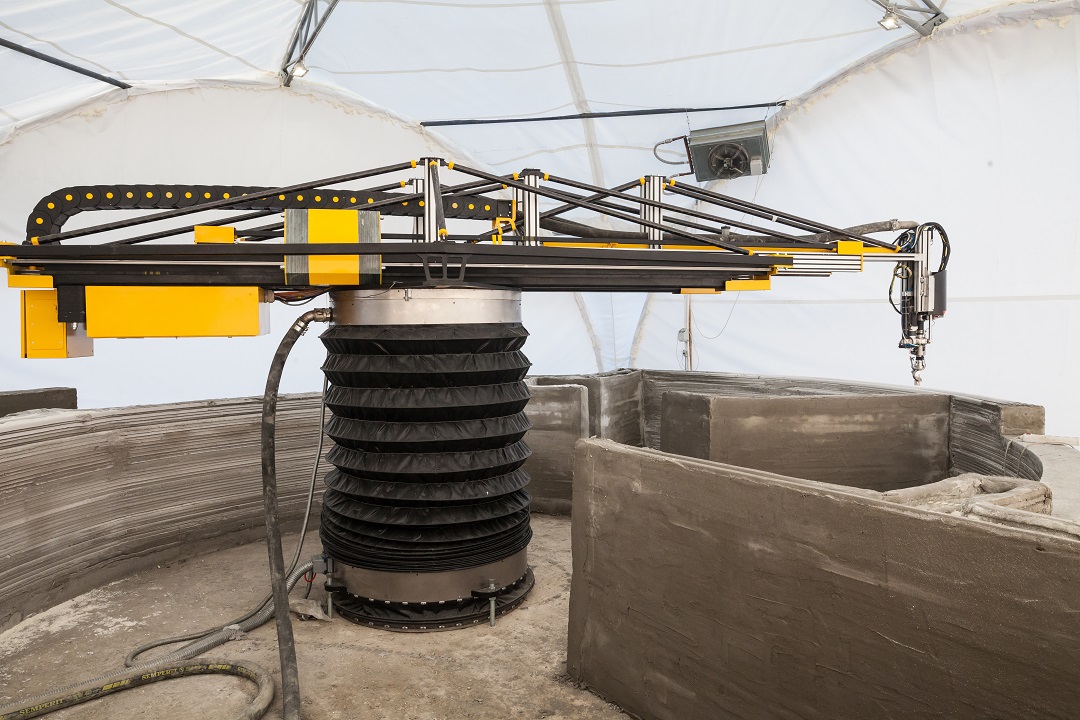
The difficulties
Given the potential it offers, 3D printing is looking to be one of the most promising technologies to drive innovation in the construction industry. Beyond all the surrounding buzz, however, there are a few considerations keeping the technology from being adopted in the mainstream.
Budget
According to research website Aniwaa, a construction 3D printer can cost from $180,000 to over $1 million, singling out robotic arm systems as the component that drives the price higher. Moreover, the cost of the equipment alone doesn't include maintenance and the cost induced by transporting and setting up the equipment to work on-site. The equipment, however, as mentioned earlier, cuts manual labor costs and saves on resources, resulting in affordable housing for consumers with less money to spend.
Shortage of knowledgeable workforce
There's already a shortage of qualified workers in the construction sector in general. This problem is amplified in projects that use 3D concrete printers because of the specific skillset needed to operate the machinery. Unfavorable weather conditions will have a bigger impact on 3D concrete printing than on conventional construction methods, meaning workers will have to monitor it more closely as well.
Quality control and regulations
Certain regulations have to be met by construction sites to ensure stability and safety of the structure being built. 3D construction printing may have a harder time meeting these regulations due to the fact that it uses printers to perform human tasks. Moreover, regulations for using 3D printers on a construction site aren't yet clearly defined, another aspect delaying wider adoption.

Market insights
Consulting firm MarketsandMarkets forecasts a 3D printing construction market growth from $3 million in 2019 to $1.57 billion worldwide by 2024, at a CAGR of 245.9 percent. Their report suggests the technology's speed and cost efficiency will drive robust market growth, as well as growing demand from the building and infrastructure sectors. Market research provider IndustryARC, using a more tightly defined scope of the subject, stated in a recent report that the market for 3D printing in construction is expected to reach $314 million by 2023.
Aside from the promising market growth, major companies investing in 3D printing in construction are also taking the technology to new heights of adoption. Tracxn, one of the world's largest platforms for tracking startups and private companies, compiled a list of companies with major investments in the technology. It includes ICON, Skanska, Apis Cor, Ai Build, Mighty Buildings, Ethereal Machines, and the aforementioned WinSun. With each company from different regions making different levels of investment and augmenting the technology to better fit today's standards, there is no doubt that 3D printing in construction will be adopted widely.
The takeaway
It cannot be denied that 3D printing in construction offers many advantages over conventional methods. The growing demand from the building and infrastructure sectors, the developments meant to address the problems with the tech, and the number of companies worldwide making significant investment in the technology are all factors pushing 3D printing in construction toward robust worldwide growth.
More Sourcing News
Read Also

关注 “环球资源外贸” 官方微信,获取实时外贸资讯
iOS & Android
iOS & Android(Mainland China)
Copyright © 2026 Publishers Representatives Limited. All rights reserved.




