Download App
Better Online and Trade Show Sourcing Experiences.Scan the QR code to download.
Learn More
Hot Topics
by Vianie Li & Cecile de Veyra
In an increasingly sensor-equipped world thanks to breakthrough technologies, the healthcare industry is a beneficiary. Even before COVID-19, R&D had yielded solutions such as miniaturization that led to the development of portable but advanced medical equipment. This boosted the mobility and accessibility trend in the industry and extended to personal wellness via consumer electronics, with sensors embedded in smartphones and wearable bands.
With the pandemic, which has made devices for noncontact temperature measurement ubiquitous, demand for temperature sensors has been on the upswing, especially for biological and medical applications. CAGR will be 5.18 percent from 2020 to 2025, according to Elecfans.
MarketsandMarkets offers a farther view, forecasting rise from $5.9 billion in 2021 to $8 billion by 2028 or at 4.5 percent CAGR for the category. Noncontact variants will achieve the highest growth in the coming years, “owing to their capacity of measuring the surface temperature of a body or object to be identified without any physical contact between the sensor and the measurement object.”
NTC thermistors, thermocouples and thermopile sensors are the key types, all with a common advantage of small size. The first has high sensitivity and a wide temperature range, typically from -150 to 300 C. Thermocouples have a simple structure but offer enhanced temperature sensing, transmit signal over a long distance and have multipoint sensing in the range of -270 to 1,800 C. The third, with a contactless mode, has high temperature sensing and can detect moving objects. Its temperature range is -270 to 2,000 C.
In addition to the medical industry, the temperature sensor segment benefits from wide use in household appliances, vehicles, home and building automation systems, and the chemical, oil and industrial fields. All contributed to the $6.3 billion total reached by this sensor category in 2020, according to QY Research.
To take advantage of this expanding market, manufacturers of temperature sensors in China are proceeding with R&D as medical electronics have a steeper requirement for accuracy than most applications. They look to boost the release of smaller but robust units with higher levels of sensitivity and reliability.
Thermistors currently form the bulk of shipments of Chinese suppliers for the medical market. These have a sensing range of 0 to 60 C and tolerance of ±0.1 or ±0.2 C.
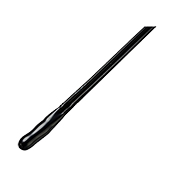
Hefei Jingpu has the JP402 series of temperature sensors, which have an epoxy resin probe 9.5 or 12mm in diameter and 500mm to 450cm cable length. These products are compatible with all medical equipment with YSI 400 sensors from GE, HP, Philips and Siemens.
Customization is generally welcome, orders based on which account for 20 to 40 percent of their deliveries. This extends to the source of materials and components used, which may be from domestic or foreign providers.
The cost of manufacturing inputs increased in 2021, prompting most suppliers to hike up their prices by 10 percent. Others raised it by as much as 15 percent. Quotes will stabilize in 2022 if outlay for materials and components does as well.
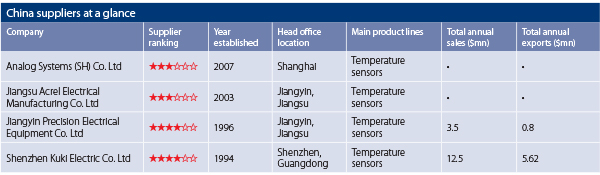
Anticipating rising demand in medical applications post-pandemic, Chinese manufacturers will continue to bolster their production. According to suppliers interviewed by Global Sources Electronic Components, the target increase will be about 10 percent in 2022 through 2023.
There are hundreds of temperature sensor manufacturers in China. Most offer products for the medical industry, shipments of which represent between 10 and 40 percent of the total.
About 20 to 50 percent of China-made temperature sensors are exported to Europe, the Americas, the Asia-Pacific region and the Middle East.
Major homegrown players in this category include HG Tech, Chongqing Chuanyi, Anhui Tiankang and Tianshui Huatian. HG Tech, also one of the largest suppliers in the world, has a production base in Wuhan with a daily production capacity of 1.8 million temperature sensors.
In addition to Wuhan, many manufacturers are based in Shenzhen, Dongguan, Ningbo, Nanjing, Changzhou and Chongqing.
More Sourcing News
Read Also

关注 “环球资源外贸” 官方微信,获取实时外贸资讯
iOS & Android
iOS & Android(Mainland China)
Copyright © 2026 Publishers Representatives Limited. All rights reserved.




