Download App
Better Online and Trade Show Sourcing Experiences.Scan the QR code to download.
Learn More
Hot Topics
Lenovo, Huawei, LG and others are challenging the market leaders.
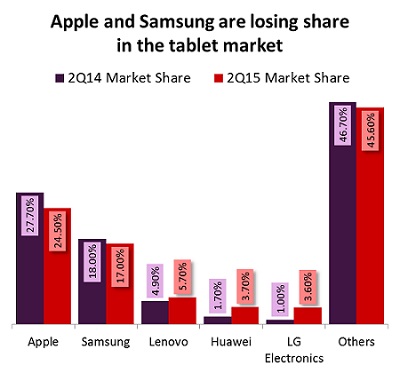
Apple and Samsung are losing share in the tablet market on back of longer replacement cycles and the rise of phablets (Source: IDC)
The once-hot tablet market has been beset by challenges over the past year as longer replacement cycles and the rise of phablets have lowered growth in the market. According to market research firm IDC, it is becoming hardest on the top names in the market: Apple and Samsung. Both companies saw declines in shipments and market share in 2Q 2015, with Apple now holding 24.5 percent of the market and Samsung holding 17 percent. Their combined market share in 2Q 2014 was 45.7 percent. The last quarter saw both companies' shares decline to 41.5 percent, with Apple falling more than 3 percent.
According to IDC, this is in large part due to increasing competition from a variety of other manufacturers. As IDC's research director for tablets Jean Philippe Bouchard said, “Each of the growing vendors managed to address available pockets of growth in the market; connected tablets for LG and Huawei, larger tablets and 2-in-1s in the right price bands for E FUN. This trend is also something we see on a wider scale with the top 5 vendors accounting for 54 percent of the market, down from 58 percent last quarter. It is worth mentioning that Huawei enters the top 5 ranking for the first time, while E FUN has re-entered the top 10 after more than a year, further indicating that the vendor landscape is indeed evolving."
It is also notable that share outside of the top 5 manufacturers continues to gain and fare better against the rest of the market. “Other” manufacturers now account for 46.7 percent of the market by shipments.
IDC does have some notes of hope for the future of tablets. The company said that the 2-in-1 form factor in particular is expected to grow significantly, and is one of the main reasons why Lenovo has grown in share over the past year, especially in the business-focused market.
More Sourcing News
Read Also

关注 “环球资源外贸” 官方微信,获取实时外贸资讯
iOS & Android
iOS & Android(Mainland China)
Copyright © 2026 Publishers Representatives Limited. All rights reserved.





