Download App
Better Online and Trade Show Sourcing Experiences.Scan the QR code to download.
Learn More
Hot Topics
Startup Light has raised $25 million to try to make it happen.
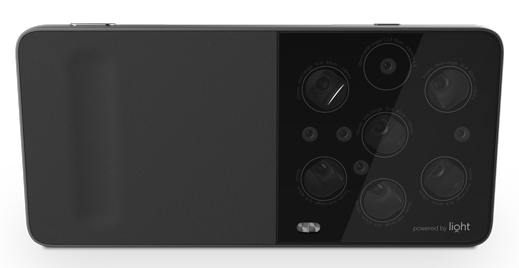
This concept image of a smartphone embedded with Light's camera array would be able to provide DSLR-quality images in a small package, especially in larger form factor phablets (Image source: Light)
The smartphone is really a misnamed device. It is a pocket computer that acts as a camera, video communications device, portable storage, text messenger and a phone. One of the most important aspects of a smartphone is of course the camera and imaging software, and that is one of the reasons why high-quality lenses and hardware have become so important to high-end phones. Still, no phone has yet been able to replicate the extraordinary fidelity and resolution of a high-end DSLR camera.
While some companies have built attachments to replicate the technology, the ideal solution would simply to have a high-quality camera lens in the phone itself. However, while the technology is there, the cost is not. A high-end camera module in a flagship phone can range between $20 and $25 while a DSLR-grade camera module is estimated to cost between $60 and $80. While some companies have launched into the space, none have seen notable takeup or success so far.
That said, a startup called Light recently announced that it had received $25 million in Series A funding, the latest in a number of successes from the company that could indicate that it is ready for the next step. The company has already developed its technology and signed a licensing agreement with Foxconn. All of this points to a technology that is likely to lower the cost and increase adoption of DSLR-grade camera modules in smartphones in the near future.
The tech itself works like this: instead of a single, high-powered lens, which typically don’t fit well in a smartphone, it uses a large number of sensors. Each image sensor captures images individually, which are then stitched together by the processing software. This creates better image quality than would otherwise be possible in a small package. It also makes it more likely that the technology will be able to come in at a competitive price.
The tech itself is of interest not only to smartphone makers but also for any applications that require a high-fidelity camera. The makers recently showed off a 16-module array that they said could be used in applications such as a self-driving/semi-autonomous car or a security camera.
More Sourcing News
Read Also

关注 “环球资源外贸” 官方微信,获取实时外贸资讯
iOS & Android
iOS & Android(Mainland China)
Copyright © 2026 Publishers Representatives Limited. All rights reserved.