Download App
Better Online and Trade Show Sourcing Experiences.Scan the QR code to download.
Learn More
Hot Topics
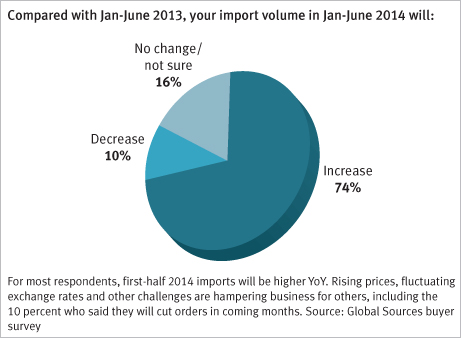
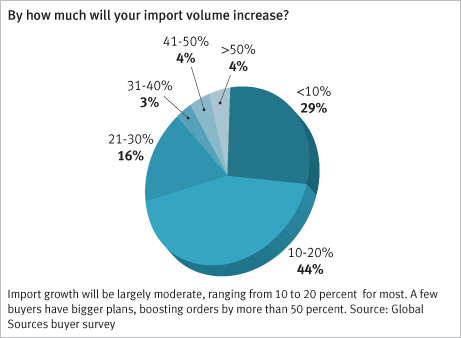
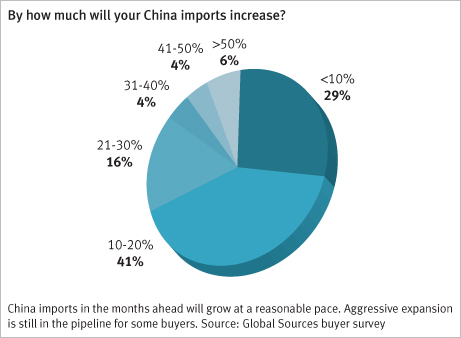
When asked about their first-half 2014 purchasing plans, most buyers surveyed recently by Global Sources said import volume will rise YoY.
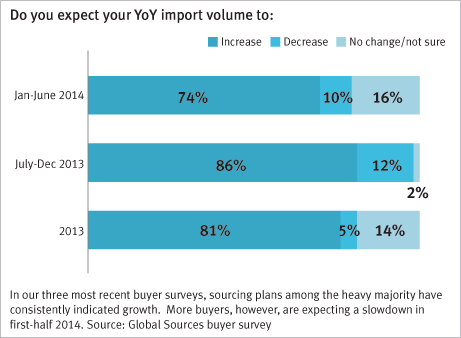
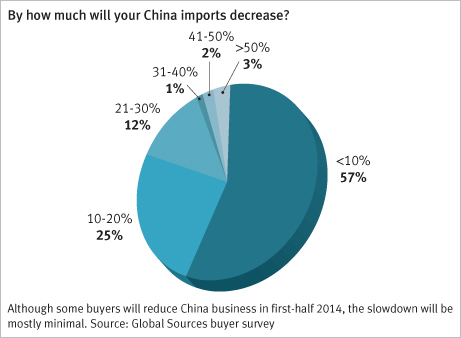
This is the third straight buyer survey that more than 70 percent, a heavy majority of participants, forecast growth in imports. The share of responses “Increase” gathered, however, is lower at 75 percent while that of “No change/not sure” climbed to 16 percent. In the preceding half-year cycle, 86 percent of buyers were confident of higher imports and just 2 percent were unsure.
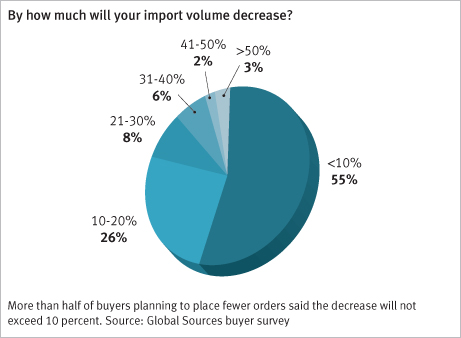
The "Decrease" response share in the first-half 2014 survey dropped 2 percentage points from second-half 2013.
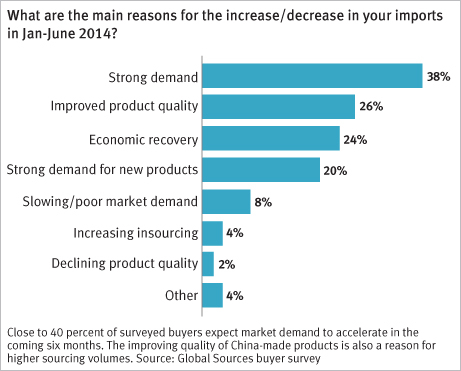
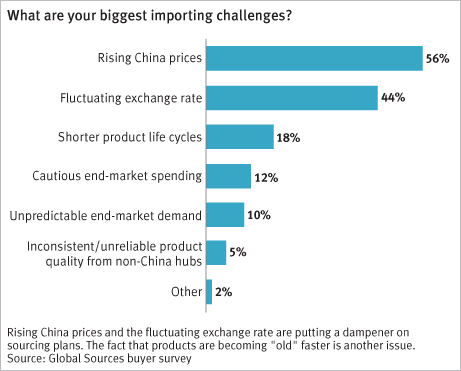
Rising prices remain the biggest challenge for importers. Quotes of China-made goods have been on an upward trend for the past several years as domestic production and labor become more expensive. Worker salaries there are forecast to increase again this year, reinforcing further the notion that upscale China is fast replacing "cheap" China. In an article on Bloomberg, Bank of America economist Lu Ting said China wages will go up 11 percent this year after rising about 10.7 percent in 2013.
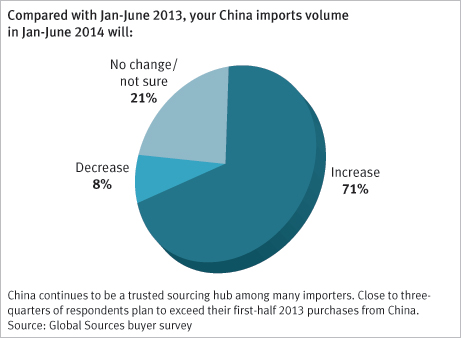
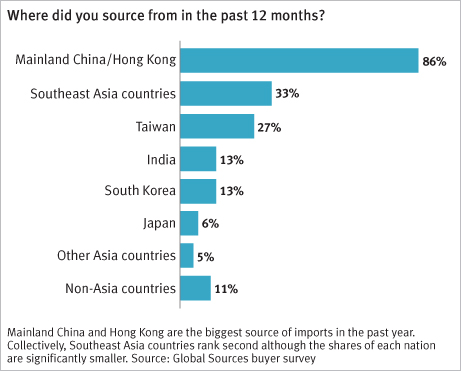
Nevertheless, importers will still source heavily from China this half-year. In our survey, more than 70 percent of respondents said the volume of products they will buy from China between January and June 2014 will exceed purchases they made during the same period last year.
There are many factors why buyers are sticking with their China partners and reliable product quality is one of them. Five percent of respondents said inconsistent or unreliable quality of goods from other manufacturing countries is a challenge.
This is not to say that China quality is not without issues. In his guide to carrying out quality procedures for China orders, David Chen said it is an accepted reality that a certain batch of products will have defects of a certain level. He therefore advised that buyers agree with their supplier on an Acceptable Quality Level that is the worst tolerable percentage of defects. Chen is co-founder and account manager for Sourcing Spectrum.
Clients should also weigh the pros and cons of shifting to lower-cost non-China production hubs. Kristina Koehler, China director of the Klako Group, told Global Sources that "The location with the lowest labor costs may not actually be the preferred one - or even the most cost-effective place to do business."
In addition, Koehler advised importers to consider a range of factors, including transportation and electricity costs, supply chain risks, workforce skills and tax incentives, when assessing potential manufacturing locations.
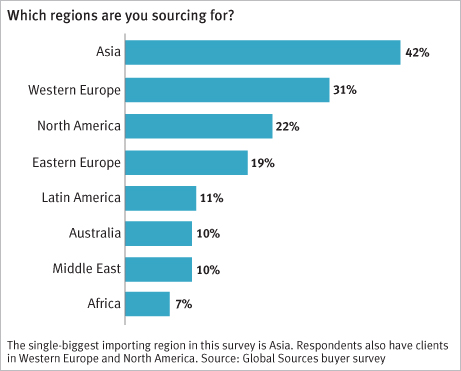
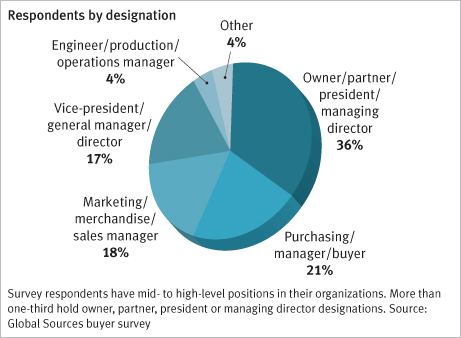
This survey was conducted among 1,719 international volume buyers, many of whom identified Asia as the region they are sourcing for. Others purchase for Western and Eastern Europe, and North America.
Respondents hold mid- to high-level positions in their organizations. Thirty-six percent listed owner, partner, president or managing director as designation while 21 percent classified themselves as purchasing manager or buyer.
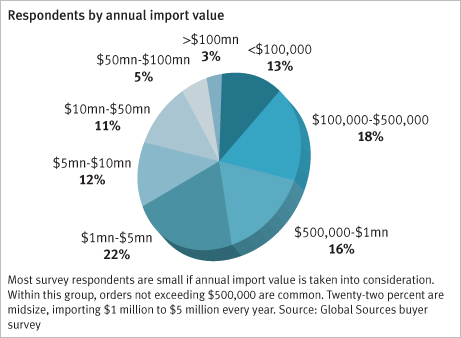
The participants were also categorized according to their annual import value. Those under the $1 million to $5 million range form the biggest group with 22 percent share. Businesses purchasing $100,000 to $500,000 and $500,000 to $1 million follow at 18 and 16 percent, respectively. A few said they buy $50 million to $100 million every year.
More Sourcing News
Read Also

关注 “环球资源外贸” 官方微信,获取实时外贸资讯
iOS & Android
iOS & Android(Mainland China)
Copyright © 2026 Publishers Representatives Limited. All rights reserved.




