Download App
Better Online and Trade Show Sourcing Experiences.Scan the QR code to download.
Learn More
Hot Topics
The Protruly Darling smartphone was made to record 360-degree videos.
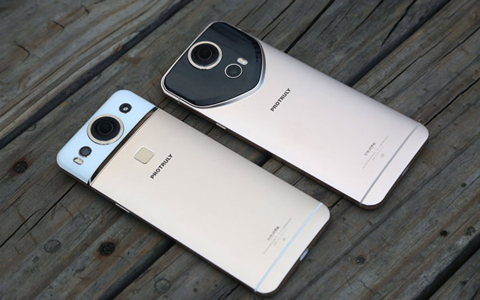
The Protruly Darling has versions that cost about $580 and $1,280, showing the company is dedicated to the premium market (Source: Protruly)
Shenzhen Protruly Electronics likes to beat competitors to market with new features. Arguably, these products hit the market before the market is ready for them. In the past, these devices have included a speed dome camera with a 27x optical zoom and a portable night vision camcorder. Now, Protruly is tackling smartphone innovation with its new Darling phone, which the company calls the world's first virtual reality-recording smartphone. The company is confident enough in the product to be doing an English media blitz through outlets like China Daily and China Radio International. The phone even has a version that will cost 8,800 yuan (nearly $1,280), although a more affordable 3,980 yuan (about $580) version will also be available.
The VR aspect of the Darling comes from the fact that the camera can record 360-degree videos. While many smartphone makers would love to be the first to push such a feature into the mainstream, Protruly might have jumped the gun. A research analyst with IDC told China Daily that augmented reality functions built into phones with dual-lens cameras were more likely to become common before VR-recording smartphones.
The price suggests, however, that Protruly is not skimping on specifications. The Darling uses the MediaTek Helio X20, a 2.5GHz decacore processor. It also adopts a 5.5in AMOLED display, which is becoming more common but many companies have avoided to keep costs down. LCDs are still much cheaper than AMOLED displays and China makers usually have to import the latter.
However, more emphasis is clearly being placed on smartphone cameras. It is one of the few areas that often fall short for many consumers. The iPhone 7, Google Pixel and Galaxy S7 have all received rave reviews for their camera quality, but few smartphone cameras outside of those companies get high marks. Dual-lens cameras look like the next big thing for now, but if VR becomes more mainstream, 360-degree cameras will need to become more common, too.
More Sourcing News
Read Also

关注 “环球资源外贸” 官方微信,获取实时外贸资讯
iOS & Android
iOS & Android(Mainland China)
Copyright © 2026 Publishers Representatives Limited. All rights reserved.




