Download App
Better Online and Trade Show Sourcing Experiences.Scan the QR code to download.
Learn More
Hot Topics
Apple's suppliers are reeling from less-than-expected demand, but they could find opportunities in other smartphone or electronics markets.
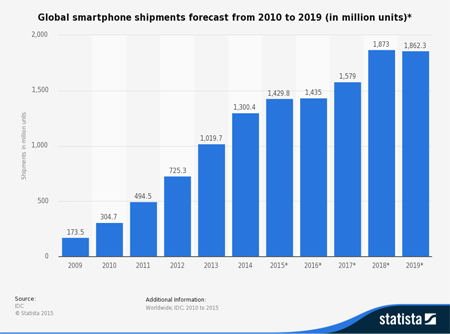
Apple has seemingly faced low demand, but the smartphone market as a whole is expected
to grow by nearly 600 million units in five years (Image from Statista)
China factories are facing idle capacity as Apple scales back orders for iPhones, according to the Wall Street Journal. While some might like to believe this is a temporary lull, it could be Apple facing a reality that many analysts have been predicting: Sales of the iPhone 6 and 6 Plus will be hard to beat. Additionally, Apple’s most important market is now China, where the smartphone space is already mature and saturated. The latest iPhone models, the 6s and 6s Plus, are not much different from the previous model, which might be contributing to the lower-than-expected sales. This resulted in idle capacity in the last two months of 2015, when factories would normally be ramping up production of Apple devices for the holiday season. This has largely affected the Taiwan manufacturing juggernaut Foxconn, but the biggest impact was at its Zhengzhou factory, where some workers were laid off.
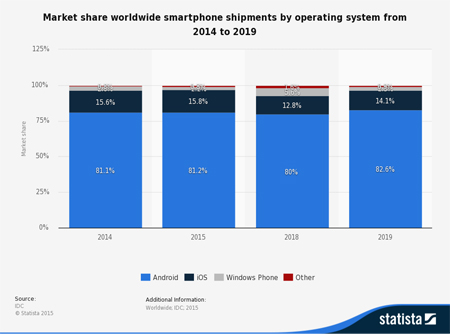
A decline in demand from Apple, though, does not necessarily mean a flood of new Android phones from China factories. Today’s idle capacity could be repurposed in other ways. Foxconn, for instance, is now working with Royal Group subsidiary Beijing Sun Shine on children’s education products in the form of wearables and virtual reality devices. A Deutsche Bank report on Jabil Electronics, another major Apple supplier with factories in China, shows concern over the fact that Apple is the company’s largest supplier as it faces slower growth, but it also notes that management is positive about electronic manufacturing opportunities. While the company could see better margins in electronic manufacturing, it also faces “weaker demand trends in mobility.” So while projections suggest opportunity is not dead in the mobile handset sector, Apple suppliers are also eyeing other electronics markets.
More Sourcing News
Read Also

关注 “环球资源外贸” 官方微信,获取实时外贸资讯
iOS & Android
iOS & Android(Mainland China)
Copyright © 2026 Publishers Representatives Limited. All rights reserved.




