Download App
Better Online and Trade Show Sourcing Experiences.Scan the QR code to download.
Learn More
Hot Topics
Huawei tries to crack the US market with a $200 handset and LeTV shows off the first phone powered by a Snapdragon 820 processor.
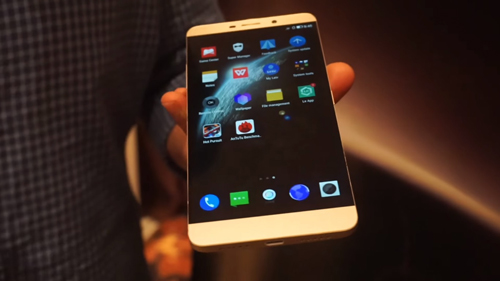
LeTV shows off its new Le Max Pro, the first phone running a Qualcomm Snapdragon 820 processor.
Image from Ubergizmo
Halfway through the 2016 Consumer Electronics Show, a trend is showing up in new smartphone announcements: China is dominating the competition. This isn’t to say China smartphones have suddenly become the most popular products in the world. Apple and Samsung are still king. However, China companies are showing product maturity that they lacked in past years. The first smartphone with a Qualcomm Snapdragon 820 processor is LeTV’s Le Max Pro, a brand that isn’t well-known outside China. Xiaomi used the deluge of technology news this week and LeTV’s announcement as an opportunity to reveal that its next flagship phone, the Mi 5, will also use the Snapdragon 820.
In China, LeTV is perhaps best known for its online streaming service, and its spokesman at CES said the company wanted to “focus on the visual [and] audio experience.” The phone has a custom digital-to-analog and hi-fi audio chip and a 6.33in display with a 1440×2560-pixel resolution. Other specifications include an improved fingerprint scanner, Quick Charge 2.0 compatibility and a 21-megapixel camera. All of these add up to a premium smartphone that should be able to hold its own against other flagships, but there’s no information yet on price or availability.
Huawei is also picking up a fair amount of smartphone press coverage at CES, but not for its most high-end products, which sold very well in China in 2015. Instead, news is focusing on its mid-tier Honor 5X, a $199 smartphone that's meant to be the company’s introduction to the US market. Huawei did make the Nexus 6P, which is available in the US, but Nexus phones are often synonymous with “Google phones” in the region, though Google does not manufacture its own phones. The Honor 5X has a 1080-pixel, 5.5in screen, Snapdragon 615 processor, 2GB of RAM, 13MP camera and a 3,000mAh battery. The specs are not significantly different from the $249 OnePlus X, which has tempered glass on the back instead of the metal exterior of the Honor 5X. The OnePlus X screen is also a little smaller at 5in. OnePlus put a lot more emphasis on design and a premium feel, which the company probably hopes justifies the extra $50. Huawei has deeper pockets to undercut its competition, though, and its phone still has a premium design, using metal instead of plastic, and includes a fingerprint scanner.
With LeTV and Xiaomi vying for attention over their chosen processor, and Huawei undercutting OnePlus, the conspicuous omission here is smartphone companies outside China. Manufacturers from the country are now concerned about one-upping each other, signaling the future of smartphones is China’s. Lenovo also announced a $199 smartphone, the Vibe S1, at CES this year, but it is using its Motorola Mobility acquisition for international expansion. To be sure, Samsung will get a lot of coverage of its Galaxy S7 when that is announced and Apple will continue to dominate the high end of the market with innovations to be adopted by others later. However, it’s no longer possible to talk about the state of the smartphone market without talking about China manufacturers.
More Sourcing News
Read Also

关注 “环球资源外贸” 官方微信,获取实时外贸资讯
iOS & Android
iOS & Android(Mainland China)
Copyright © 2026 Publishers Representatives Limited. All rights reserved.