




China’s localization and globalization efforts include the semicon industry Image source: Getty
Almost ten years ago, China embarked on a project to grow its semiconductor industry and reduce dependence on foreign technology. The objective, enshrined in the “Made in China 2025” (MIC2025) plan announced in 2015, was to achieve $305 billion output by 2030 and fill 80 percent of domestic demand, up from $65 billion and 33 percent in 2016, according to the South China Morning Post, reporting in 2018.
In preparation, the government created the China National Integrated Circuit Industry Investment Fund in 2014. Also called “Big Fund I” and “Big Fund II” after the phases of their scheduled releases, respectively 2014 to 2019 and 2019 to 2024, these capital infusions to chipmakers were planned to cover all relevant segments of the industrial chain – manufacturing, equipment and materials.
The plan also extended to boosting design work further and making China a key player in the semiconductor industry globally. Chinese companies at the time of its inception were chiefly involved in packaging and testing or outsourced semiconductor assembly and testing (OSAT), although design work began expanding annually at 30 percent between 2005 and 2016, according to SCMP.
In practice, gains have fallen short of MIC2025’s ambitious targets. Speaking at the 2023 IC NANSHA industry forum in in Guangzhou on June 17, Chinese financial paper National Business Daily reports, Wei Shaojun, a professor at Tsinghua University and deputy chairman of the China Semiconductor Industry Association, remarked that in terms of value, the proportion of domestic demand filled by homegrown chips had increased from 13 percent in 2013 to 41.4 percent in 2022. While affirming the progress this represents, Wei noted that it was still not a commanding majority of the total domestic demand and called for a “re-globalization” of the industry.
Efforts for design work do look to be bearing fruit. In a November 2022 report by the US’ Semiconductor Industry Association, the outlook for China’s design market is upbeat. From a global share of 9 percent in 2020, the country is expected to have 23 percent by 2030. “A substantial increase, but still far from world-beating,” according to The China Project, commenting on the report.
Microcontrollers
A microcontroller is an IC that integrates a processor, memory and programmable input-output peripherals. It is used in devices that are automatically controlled, including those found in consumer electronics, office machines, toys, power tools, vehicles, robots, vending machines, medical devices and home appliances.
Such ubiquity translates to a market valued at $18.6 billion in 2022 and projected to reach $55.4 billion by 2031, at a CAGR of 11.6 percent from 2023, according to Transparency Market Research. The report said that the key growth drivers are the automotive industry and the medical sector’s portable segment.
Chinese MCUs to catch up
China is the world’s manufacturing hub for electronics and the automotive industry but continues to depend on other countries for core technologies, including microcontrollers. The contribution of foreign-funded semiconductor manufacturing to the growth of China's semiconductor industry is twice that of domestically funded enterprises, according to Shaojun.
NXP, STMicroelectronics, Infineon, Microchip, Renesas and other foreign companies remain China’s key providers of these semicon devices, while domestic suppliers try to catch up to take advantage of this captive and huge market.
To compete with industry giants, Chinese MCU companies will continue to strengthen R&D and production capability in the next several years.
Leading Chinese manufacturers include GigaDevice, SinoWealth, Huada Semiconductor, BYD Micro and Nations Technologies, with the first two having respective market shares of 4.4 and 4.1 percent, according to AskCI.
China’s microcontroller market was $5.21 billion in 2021, rising 35.69 percent year on year, and grew 15.17 percent to $6 billion in 2022, according to AskCI. Zhiyan Consulting Network said that industrial control is China’s largest market with a 34 percent share of shipments, with the automotive and consumer electronics applications accounting for 27 and 25 percent. Image source: Getty
Jump-starters
Only around 5 percent of chips used in cars manufactured in China are locally made, according to Gizmochina based on a report posted on Chinese website MyDrivers. This might change amid the shortage of high-end MCUs for automotive applications.
Research and Markets’ “Automotive Microcontroller Unit (MCU) Industry Report, 2023” reports that Chinese MCUs are in tight supply thanks to great demand from the new energy vehicles industry. SAIC, the country’s largest carmaker, used a ChipON MCU, while Dongfeng Motor is working with the Commission on Information and Communications Technology (CICT) on a facility for chips. The latter finished the design of “the first MCU with world's leading functional performance indicators” with China’s top chip foundry, SMIC.
The report also cited Chinese manufacturers that have undertaken mass production of body control MCUs for OEMs, and AutoChips and Huada Semiconductor as matching foreign-made chips used in cockpit entertainment.
For AD/ADAS, it is still a long way to go for China, but Research and Markets said there are already three major suppliers with product plans.
Key Chinese MCU suppliers
Here are some of the leading Chinese manufacturers of microcontrollers.
GigaDevice Semiconductor Inc. was established in Beijing in 2005 and listed in 2016. It has a 1,500-strong workforce and has shipped up to 20 billion ICs since the start of operations.
At present, GigaDevice offers 41 series and more than 500 MCU models widely used in automotive, consumer electronics and industrial applications. Flash memory, 32-bit general-purpose MCUs, smart human-machine interaction sensors, and analog products and solutions make up its main selection.
The company has announced to release its first Arm Cortex-M7 core microcontroller family, the GD32H737/757/759 ultrahigh performance MCU series, based on Armv7E-M architecture with up to 600MHz clock frequency in five package types, including BGA176, LQFP176, LQFP144, BGA100 and LQFP100. These new MCUs will be put into mass production in the last quarter of 2023.
GigaDevice has the following rankings in its bio: China’s top fabless flash memory and Arm general-purpose MCU supplier, and globally, third in fabless flash memory and fingerprints ICs and fourth in touch control ICs.
Established in 1994, SinoWealth Electronic Ltd is a Shanghai-based supplier specializing in MCU and battery management chip design and fabrication. It is a keystone semiconductor enterprise, a designation given by the Ministry of Industry and Information Technology. The company offers 8 to 32-bit MCUs for home appliances, computers and peripherals, industrial control and digital signal devices.
In recent years, SinoWealth has focused on high-end MCUs for smart household appliances with the release of a 55nm Arm cortex-M3 MCU. It is said to lead in this category worldwide, accounting for over two-thirds of MCU shipments for microwave ovens. Recently, the company has also started exploring the automotive market, having developed its first 32-bit MCU. This latest product is undergoing AEC Q100 certification and will be available in small batches within 2023.
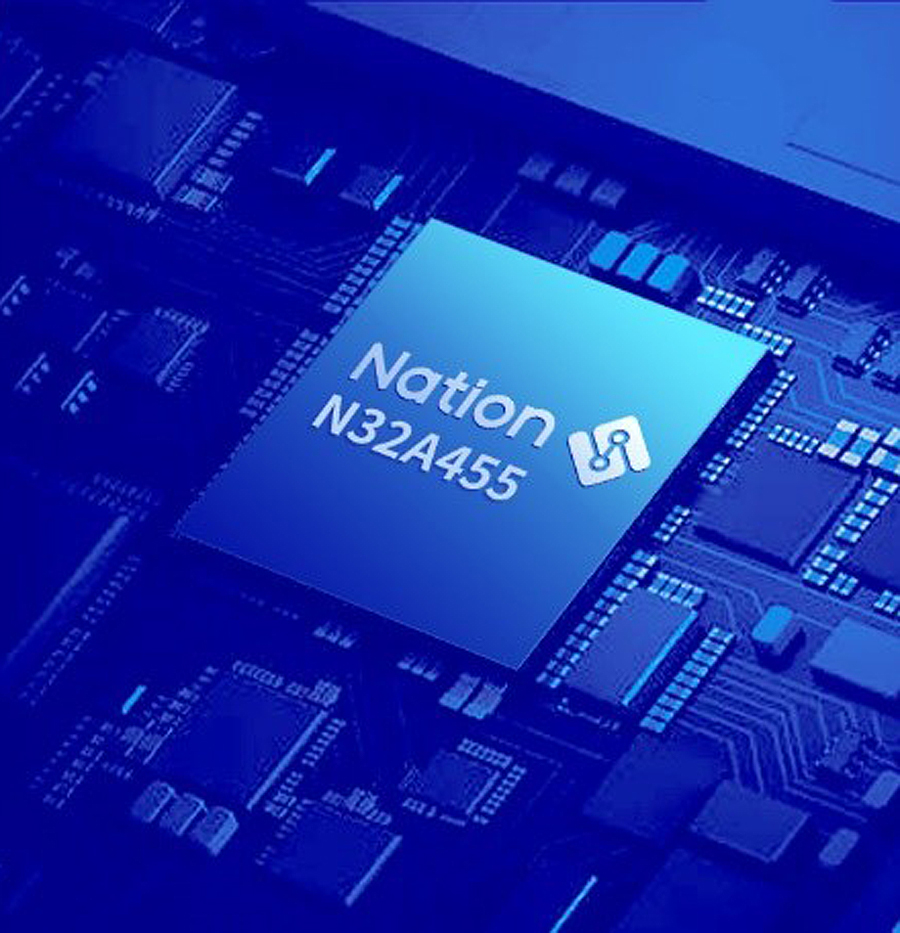
Nations Technologies Inc. is among the leaders in China’s general-purpose MCUs and security ICs, with a 1.8 percent market share in the domestic MCU category, according to AskCI. It was established in 2000 in Shenzhen and listed on the GEM board in 2010.
Nations manufactures general-purpose MCUs, and security, trusted computing and Bluetooth ICs, smart cards and other products widely used in cybersecurity authentication, e-banking, e-licenses, mobile payments, IoT, industrial control, vehicles, home appliances and smart home devices. Emphasizing technology innovation, it has acquired more than 1,500 international and domestic patents and nine China Patent Excellence Awards.
In early 2023, the company announced its plan to mass produce the N32A455 series of automotive-grade 40nm MCUs embedded with Arm Cortex-M4 core+FPU for use in lighting, motor and body control, and virtual meters. These MCUs, having already passed AEC Q100 qualification, will be available in LQFP48, LQFP64 and LQFP100 packages.
Affiliated with the China Electronics Corp. (CEC), Huada Semiconductor Co. Ltd has a total asset of more than $5.71 billion and nine subsidiaries with over 6,000 employees. It produces MCUs mainly for the consumer electronics, automotive, industrial and security IoT fields. The company is the country’s top supplier of water meter MCUs, with a market share exceeding 20 percent.
In the past two years, Huada ventured into automotive and industrial control MCU R&D. Early in 2023, such initiative resulted in the launch of its HC32F448 series, consisting of industrial control MCUs with an Arm Cortex-M4 core and available in QFN32, QFN48, LQFP48, LQFP64 and LQFP80 packages.

