Download App
Better Online and Trade Show Sourcing Experiences.Scan the QR code to download.
Learn More
Hot Topics
The makers behind Eero do not want to call the device a "router" because it works as a system of nodes placed around the house.
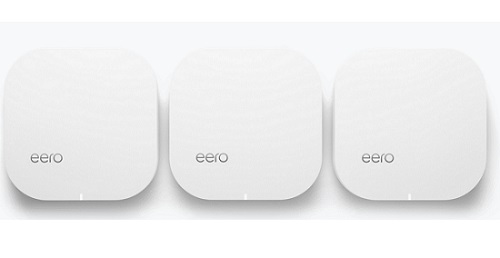
Eero recommends users buy a three-pack of its devices to place around the home, but it comes at a hefty $499 (Image: Eero)
The latest trend in wireless routers is selling nodes that users can place around a house or an apartment to avoid dead zone or slow connection. This is the premise behind the Eero, one of the more expensive options for node-based home Wi-Fi. However, the company does not use the term "node." In fact, it does not even want to call its product a router. The promotional video says explicitly "this is not a router." The idea is to keep things as simple and seamless for users as possible. The initial setup takes place in a smartphone app, and the company recommends users buy at least three of the devices. One plugs directly into the modem, and the other two can be placed wherever the user needs to boost the Wi-Fi signal.
The Eero devices are the combination of three devices into one: a router, range extender and a repeater. Co-founder Nick Weaver told Engadget that traditional repeaters can cut bandwidth by half and are sometimes difficult to set up. Eero is a product that aims to solve these pain points. Early reviews suggest the company has done just that. Eero keeps up with streaming and downloading on several different devices at once. The only issue appears to be its price. One Eero device costs $199, while the recommended pack of three is $499. Many will not find this to be a bargain with top-notch yet simple routers from the likes of Apple and Google costing only $199. Walt Mossberg wrote in Verge that his solution before Eero has been to link three Apple Airport Extreme routers together. This would cost $100 more than three Eero devices, though. Apple's AirPort Express only costs $99 each, but it does not offer 802.11ac, just the older and slower 802.11n standard.
Good and simple connectivity does not come cheap. That much is clear. Still, the Eero works so well that Geoffrey Fowler at the Wall Street Journal said this kind of “distributed design…may just be the future of how we set up Wi-Fi at home.” He also noted that big companies such as Linksys and D-Link are already working on similar products. China suppliers are, too. Zhejian Zailing Technology created a similar product called INFi that supports up to seven extension nodes with speeds up to 200Mbps. The Eero system is four times faster on average according to Mossberg, but it is a premium product. China makers can help consumers dip their toes into the world of these new node-based routers.
More Sourcing News
Read Also

关注 “环球资源外贸” 官方微信,获取实时外贸资讯
iOS & Android
iOS & Android(Mainland China)
Copyright © 2026 Publishers Representatives Limited. All rights reserved.