Download App
Better Online and Trade Show Sourcing Experiences.Scan the QR code to download.
Learn More
Hot Topics
by Cecile de Veyra (Managing Editor)
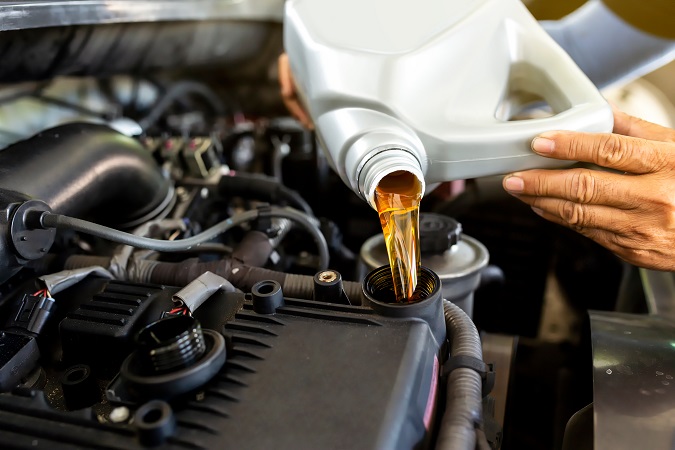 Image source: Shutterstock
Engine oil helps maintain motor health and keep it running in optimum condition. It provides lubrication to moving parts, preventing friction that can hasten wear and tear, cools by drawing heat from them, and removes contaminants such as metal particles, dirt, soot, acids and other deposits that can corrode and oxidize components. Sludge that builds up over time can cause a host of costly problems, including power loss, high fuel consumption and overheating. It’s not considered the engine killer for nothing.
There are various grades of engine oil based on viscosity and reaction to temperature as specified by the Society of Automotive Engineers (SAE). This is because oil is formulated to become thicker in cold temperatures and thinner when it heats up. The SAE alphanumeric code in current use includes a number referring to how the oil will flow in cold conditions, the letter W for winter or how the oil will behave during a cold start, and another number for how finely the oil will flow at normal operating temperature, as explained by Vishal Khanna on gomechanic.in.
“What it all comes down to is that the lower the first number is, the less resistance to flow the oil has when you cold start your engine. And the lower the second number is, the less resistance to flow the oil has at normal operating temperature,” according to California-based auto repair service company Repair Smith.
Based on composition, there are three types of engine oil. One is mineral oil made from crude petroleum, another is synthetic or chemically engineered and the third is semisynthetic or a blend of both.
For enhanced performance, additives are added to mineral and synthetic oils. Oxidation inhibitor, detergent, dispersant, anti-foam, anti-wear, corrosion inhibitor and anti-freeze substances are some of them, in addition to viscosity index modifiers.
Mineral or conventional oil is the lowest-priced but requires more frequent replacement due to performance issues under temperature stresses. Significantly more expensive is synthetic oil, which is the most highly refined. Its efficiency in any temperature, including at extreme levels, is well-established, making it the best engine oil.
In the 2-cycle engine oil category, the same choices are available. Compared to four-stroke engines, most applications of this type of lubricant are gasoline-powered, with oil mixed in. As such, the synthetic variant “is better for the environment, producing lower deposits and emissions due to lower ash content,” according to US-based automotive media platform The Drive.
To get the most of this “magic fluid,” mechanics and carmakers recommend regularly scheduled engine oil changes. This can be done in auto repair shops, car care centers or oil-lube establishments, with DIY another option that can be done with the help of a few tools and a bevy of tutorials on the internet.
Because of its vital role not only in vehicle maintenance but also in other applications such as industrial and heavy-duty equipment, engine oil continues to have a sizeable market. In 2021, it reached 21 billion liters and is forecast to increase at more than 2 percent CAGR from 2022 to 2027, according to Mordor Intelligence.
More Sourcing News
Read Also

关注 “环球资源外贸” 官方微信,获取实时外贸资讯
iOS & Android
iOS & Android(Mainland China)
Copyright © 2026 Publishers Representatives Limited. All rights reserved.




