Industrial automation works effectively and seamlessly when complemented with power and power-failure management solutions, such as uninterruptible power supplies (UPS). A UPS provides a backup and enables a soft shutdown, letting robotic systems finish a cycle and save data. It also ensures safety, preventing sudden stops that can result in collisions and spills in conveyance and other control systems.
Current UPS for industrial robotics use a lead-acid or a LiFePO4 battery to store power. Lead-acid batteries are the usual choice for their proven reliability and cost-effectiveness, especially in applications where weight is not an issue. LFP types, on the other hand, have the advantages of safe and nontoxic chemistry, high energy density, long life span requiring no maintenance, wide operating temperature range and low cost in the long term.
Chinese manufacturers of UPS for industrial robotics interviewed by Global Sources said that LFP batteries will replace lead-acid units in the near future. This is based on the projected trend favoring small size, long operating life, and high efficiency, reliability and stability in UPS for this application. As such, battery suppliers are introducing more LFP units for industrial robots to cash in on China’s huge market as a large number of factories there use robotics for manufacturing processes.
China’s industrial robotics
China, in fact, has been leading in terms of the number of robot installations every year, according to the International Federation of Robotics, a professional nonprofit organization based in Germany. “There are 392 robots per 10,000 employees in manufacturing, with robots already being used across 65 industries and 206 sub-industries,” as reported by Digital Watch, an initiative of the Geneva Internet Platform, when it covered the 2023 World Robot Conference in Beijing.
In 2022, the country’s industrial robotics sector reached $8.7 billion in 2022, according to the Shangpu Consulting Group. This could potentially triple in 2023, driven by high demand in the new energy vehicle, electronics, semiconductor, solar power systems, space and aviation industries.
Globally, the robotics market was on the scale of $51.3 billion in 2022, with industrial robotics accounting for $19.5 billion, according to the same report. By the end of 2023, the value will increase further to $65 billion and that of industrial robotics will reach $26 billion, outperforming service and special robotics.
Growth prospects for industrial robotics power supplies
China’s manufacturing sector for power supplies for industrial robotics is poised for growth through 2024, with export shipments expected to rise by 10 percent complementing the increase domestically.
Many companies have been boosting their production because of this demand trend. Shenzhen KStar, a top supplier of UPS in the country, invested $329 million in projects in 2022, in addition to the $19.44 million allocation for a new factory in Vietnam as part of its global expansion.
There more than a thousand manufacturers of power supplies in China and over half can offer products for industrial robotics, a number that will likely grow as automation makes more headway. The majority are small and midsize domestically owned enterprises, and the rest are from the US, Europe and the Taiwan region.
Most factories are in southern China, specifically in Shenzhen, Dongguan, Zhongshan, Suzhou, Changzhou and Ningbo, but there are also others up north in Shandong and northwest in Shaanxi.
UPS for industrial robots
The mainstream power supplies offered by Chinese manufacturers for industrial robotics applications are three-phase UPS with an input voltage of 220, 380 or 400V, operating frequency of 50/60Hz, efficiency rating of over 90 percent, power factor of up to 0.9, and operating temperature of 0 to 40 C. They comply with IEC standards and are CE-approved and UL-listed.
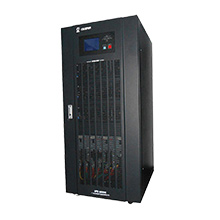
There are products that can be sourced that use a DSP control system, and advanced IGBT inverter and pure-online double conversion technologies. The third feature ensures low power dissipation, high efficiency, long operating life and robust overload capability. An example that has all these features is Guangdong Prostar New Energy Technology Co. Ltd’s GT80K online UPS, which also has intelligent software thrown in to show and monitor UPS parameters via computers.
As in all industries in China, customization is widely welcomed by UPS suppliers, with orders based on buyer’s specifications representing between 30 and 60 percent of their shipments. This business practice extends to the sources of materials and components, such as batteries, inverters, transfer switches and cases, to be used.
So far, the cost of manufacturing inputs, whether obtained from foreign or domestic providers, has been stable in the past 12 months and will likely remain so for the rest of 2023 and through 2024.
Power supply, 380VAC nominal voltage
Company: Foshan Xinchen Electronic Co. Ltd
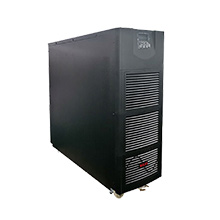
This CE-marked power supply from Foshan Xinchen, the 10KVA(L), has 380VAC nominal voltage, 190 to 520VAC voltage range at 50 percent load and 276 to 520VAC at 100 percent load and 46 to 54Hz frequency. This three-phase unit’s output voltage is 208, 220, 230 or 240VAC and its AC voltage regulation ±1 percent.
MOQ: 10 units
Lead time: 10 days
Inquire now
Power supply, 380, 400, 415VAC±25% input voltage
Company: Guangdong Prostar New Energy Technology Co. Ltd
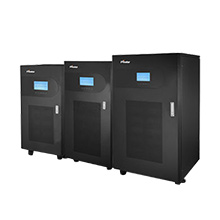
A three-phase four-wire system with grounding, the GT80K power supply from Guangdong Prostar has 380 and 400 or 415VAC±25 percent input voltage, 380, 400 or 415VAC±1 percent output voltage and 384V battery voltage. It has 90kVA or 64kW capacity and meets CE requirements.
MOQ: Negotiable
Lead time: 7 days
Inquire now
Power supply, 380VAC rated voltage
Company: Guangdong Zhicheng Champion Group Co. Ltd
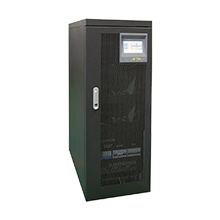
Guangdong Zhicheng markets the CPTM2100T three-phase power supply with 380VAC rated voltage, 176 to 264VAC voltage range, 45 to 55Hz frequency range, ≥0.99 input power factor, and -25 to 55 C operating and -20 to 40 C battery temperatures. It has 80kVA rating.
MOQ: 5 units
Lead time: 20 days
Inquire now
Power supply, 380VAC input voltage
Company: Shenzhen Jeidar Electronics Co. Ltd
Shenzhen Jeidar’s DT150L33 three-phase power supply has 380VAC+N+W input and 285 to 475VAC input voltage range, 50Hz±5 input percent frequency, 30A input current, and 380, 400 or 415VAC 1±1 percent line output voltage or 220, 230 or 240VAC 1±1 percent phase voltage. Its capacity is 15kVA or 13.5kW.
MOQ: Negotiable
Lead time: 7 days
Inquire now