Download App
Better Online and Trade Show Sourcing Experiences.Scan the QR code to download.
Learn More
Hot Topics
The material could create batteries that can be recharged more than 200,000 times without any loss of capacity.
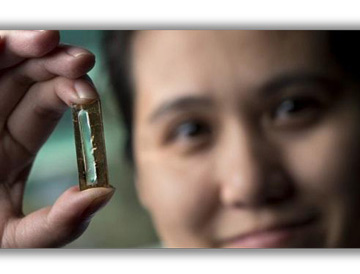
UC-Irvine doctoral candidate Mya Le Thai holds up a nanowire-based technology that allows Li-ion batteries to be recharged hundreds of thousands of times. Source: Steve Zylius/UC Irvine via EE Times
A team at the University of California, Irvine reports almost inadvertently inventing a nanowire-based battery material that can be recharged hundreds of thousands of times, moving us closer to a battery that would never require replacement.
The basic structures being investigated are charge-storage mechanisms based around nanowires. The "wires" in question are deposited structures (wires only in the sense that they are long, thin conductors). In the work reported, these are gold and coated or sheathed in manganese dioxide (MnO2). The device is essentially a capacitor, with the charge-storing capacitance being formed between interleaved arrays of the wires, all suspended in an electrolyte medium.
The use of nanowires is known to offer higher charge storage than films of identical materials. Thousands of times thinner than human hair, the gold wires are highly conductive and feature a large surface area for the storage and transfer of electrons. Laid down on glass, these are 240nm across and 35nm thick. Various shell thicknesses between 143 and 300nm were evaluated. Prior work has found that these filaments are extremely fragile and do not hold up well to repeated discharging and recharging, or cycling. In a typical Li-ion battery, they expand and grow brittle, which leads to cracking.
UCI researchers have solved this problem by coating a gold nanowire in a manganese dioxide shell and encasing the assembly in an electrolyte made of a Plexiglas-like gel: a gel of poly-methyl-methacrylate and LiClO4 (lithium perchlorate, source of the lithium ions to form a lithium ion battery). The combination is reliable and resistant to failure.
More Sourcing News
Read Also

关注 “环球资源外贸” 官方微信,获取实时外贸资讯
iOS & Android
iOS & Android(Mainland China)
Copyright © 2026 Publishers Representatives Limited. All rights reserved.





